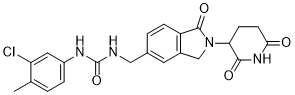
CC-885 (CC885) is a novel and potent cereblon (CRBN) modulator with potent antitumour activity, it acts by the degradation of GSPT1 and was demonstrated to mediate antitumor effects through the recruitment and degradation of G1 to S phase transition 1 protein (GSPT1). GSPT1 (also named eRF3a) is a translation termination factor that binds eukaryotic translation termination factor 1 (eFR1) to mediate stop codon recognition and nascent protein release from the ribosome.
Physicochemical Properties
| Molecular Formula | C22H21CLN4O4 |
| Molecular Weight | 440.879544019699 |
| Exact Mass | 440.13 |
| Elemental Analysis | C, 59.93; H, 4.80; Cl, 8.04; N, 12.71; O, 14.52 |
| CAS # | 1010100-07-8 |
| PubChem CID | 24788636 |
| Appearance | Off white to light purple solid powder |
| LogP | 1.7 |
| Hydrogen Bond Donor Count | 3 |
| Hydrogen Bond Acceptor Count | 4 |
| Rotatable Bond Count | 4 |
| Heavy Atom Count | 31 |
| Complexity | 747 |
| Defined Atom Stereocenter Count | 0 |
| InChi Key | DOEVCIHTTTYVCC-UHFFFAOYSA-N |
| InChi Code | InChI=1S/C22H21ClN4O4/c1-12-2-4-15(9-17(12)23)25-22(31)24-10-13-3-5-16-14(8-13)11-27(21(16)30)18-6-7-19(28)26-20(18)29/h2-5,8-9,18H,6-7,10-11H2,1H3,(H2,24,25,31)(H,26,28,29) |
| Chemical Name | N-(3-chloro-4-methylphenyl)-N'-[[2-(2,6-dioxo-3-piperidinyl)-2,3-dihydro-1-oxo-1H-isoindol-5-yl]methyl]-urea |
| Synonyms | CC-885; CC 885; CC885. |
| HS Tariff Code | 2934.99.9001 |
| Storage |
Powder-20°C 3 years 4°C 2 years In solvent -80°C 6 months -20°C 1 month |
| Shipping Condition | Room temperature (This product is stable at ambient temperature for a few days during ordinary shipping and time spent in Customs) |
Biological Activity
| Targets |
CRBN CC-885 acts as a cereblon modulator that recruits the translation termination factor GSPT1 (eRF3a) to the CRL4CRBN E3 ubiquitin ligase, leading to its ubiquitination and degradation. It also promotes cereblon-dependent degradation of Ikaros (IKZF1). [1] |
| ln Vitro |
CC-885 is applied at different concentrations to human peripheral blood mononuclear cells (PBMC), human liver epithelial cell line (THLE-2) and acute myeloblatlic leukemia (AML) cell lines, with IC50s of 10×-6-1 μM. With IC50s>10 μM, CC-885 has a greater effect on cell proliferation in AML cell lines, THLE-2, and human PBMC than Lenalidomide and Pomalidomide.In order to determine whether the cytotoxic effects of CC-885 are caused by the cereblon-dependent degradation of GSPT1, a GSPT1 mutant that maintains its normal function but does not exhibit CC-885-dependent cereblon binding is employed to differentiate GSPT1's function from that of other substrates. In 293T HEK cells that consistently express CC-885-sensitive or -resistant GSPT1 variants, CC-885 is tested. While overexpressing a CC-885-sensitive variant, GSPT1Δ(1-138), only partially protects against the CC-885-induced anti-proliferation, overexpressing a resistant variant, GSPT1Δ(1–138)/(G575N), completely abrogates the effect. AML cell lines yield comparable outcomes[1]. CC-885 exhibits broad-spectrum anti-proliferative activity against 132 human cancer cell lines, with sub-nanomolar potency against 4 out of 5 patient-derived acute myeloid leukemia (AML) samples.[1] CC-885 induces cereblon-dependent ubiquitination and degradation of GSPT1, as shown by immunoblot and ubiquitination assays in 293FT HEK and AML cell lines.[1] CC-885 does not decrease GSPT1 mRNA levels, indicating a post-transcriptional mechanism.[1] CC-885 also promotes degradation of Ikaros in NB-4 leukemia cells.[1] |
| ln Vivo | The study assessed the therapeutic efficacy of this combination in vivo by using nude mice bearing tumors. While volasertib and CC-885 alone inhibited tumor growth, the combination of both small molecular drugs markedly inhibited tumor growth and reduced tumor weights (Figures 1I and IJ). Taken together, these data clearly show that CC-885 synergizes with volasertib against NSCLC cells both in vitro and in vivo. |
| Enzyme Assay |
Surface plasmon resonance (SPR) was used to measure binding between cereblon-DDB1 and GSPT1 in the presence of CC-885, showing a dissociation constant (K_D) of approximately 350 nM.[1] In vitro ubiquitination assays were performed using recombinant CUL4A-RBX1-DDB1-cereblon complex, Ube1 E1, UbcH5a E2, ubiquitin, GSPT1, and CC-885. Reactions were carried out at 30°C for 2 hours in ubiquitination assay buffer with or without ATP and CC-885, followed by immunoblot analysis.[1] |
| Cell Assay |
The growth medium-cultured human cancer cell lines are seeded into black 384-well plates with DMSO or test compounds like CC-885 (10×-6-1 μM). Every cell line's seeding density is carefully calibrated to facilitate cell growth within the linear range over the course of a three-day culture period. Black 96-well plates containing DMSO or test compounds like CC-885 are seeded with 5,000–10,000 cells per well in 200 μl complete culture media to test the compound effect on cell proliferation in acute myeloid leukemia (AML) cell lines. Cell proliferation is measured using the CellTiter-Glo (CTG) Luminescent Cell Viability Assay after 48 or 72 hours[1]. Cell proliferation was assessed using CellTiter-Glo assay after treating cells with CC-885 for 3 days.[1] Immunoprecipitation of Flag-HA-cereblon from 293T HEK cells was performed in the presence of CC-885 to identify GSPT1 binding via mass spectrometry and immunoblot.[1] Co-immunoprecipitation of HA-tagged GSPT1 with cereblon was conducted in the presence of CC-885 to confirm enhanced binding.[1] Protein half-life analysis was performed by treating 293FT HEK cells with cycloheximide and CC-885, followed by immunoblotting at various time points.[1] Lentiviral shRNA was used to silence GSPT1 expression in 293T HEK, OCI-AML2, and MOLM-13 cells to assess the effect on cell proliferation.[1] |
| References |
[1]. A novel cereblon modulator recruits GSPT1 to the CRL4CRBN ubiquitin ligase. Nature. 2016 Jul 14;535(7611):252-7. |
| Additional Infomation |
CC-885 contains a glutarimide ring that binds cereblon, similar to other immunomodulatory drugs, but features extended chemical groups that enable unique interactions with GSPT1.[1] Crystal structure of the cereblon-DDB1-CC-885-GSPT1 complex reveals that GSPT1 binds via a surface turn with a glycine residue at a key position, forming hydrogen bonds with cereblon residues N351, H357, and W400.[1] CC-885 shows reduced activity against normal lymphoid cells compared to AML tumor cells.[1] The E377V polymorphism in rodent cereblon confers resistance to CC-885.[1] |
Solubility Data
| Solubility (In Vitro) | DMSO : 40~67.5 mg/mL ( 90.72~153.10 mM ) |
| Solubility (In Vivo) |
Solubility in Formulation 1: 2.25 mg/mL (5.10 mM) in 10% DMSO + 40% PEG300 + 5% Tween80 + 45% Saline (add these co-solvents sequentially from left to right, and one by one), suspension solution; with sonication. For example, if 1 mL of working solution is to be prepared, you can add 100 μL of 22.5 mg/mL clear DMSO stock solution to 400 μL PEG300 and mix evenly; then add 50 μL Tween-80 to the above solution and mix evenly; then add 450 μL normal saline to adjust the volume to 1 mL. Preparation of saline: Dissolve 0.9 g of sodium chloride in 100 mL ddH₂ O to obtain a clear solution. Solubility in Formulation 2: ≥ 2.25 mg/mL (5.10 mM) (saturation unknown) in 10% DMSO + 90% Corn Oil (add these co-solvents sequentially from left to right, and one by one), clear solution. For example, if 1 mL of working solution is to be prepared, you can add 100 μL of 22.5 mg/mL clear DMSO stock solution to 900 μL of corn oil and mix evenly. (Please use freshly prepared in vivo formulations for optimal results.) |
| Preparing Stock Solutions | 1 mg | 5 mg | 10 mg | |
| 1 mM | 2.2682 mL | 11.3410 mL | 22.6819 mL | |
| 5 mM | 0.4536 mL | 2.2682 mL | 4.5364 mL | |
| 10 mM | 0.2268 mL | 1.1341 mL | 2.2682 mL |