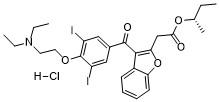
Physicochemical Properties
| Exact Mass | 703.03 |
| Elemental Analysis | C, 43.83; H, 4.36; Cl, 4.79; I, 34.31; N, 1.89; O, 10.81 |
| CAS # | 478941-80-9 |
| Related CAS # | 478941-80-9 (HCl);478941-93-4 (tartrate);335148-45-3;478941-90-1; 478941-86-5 (fumarate); 478941-98-9 (citrate); |
| Appearance | Solid powder |
| InChi Key | WDMVNERQUKWYOA-LMOVPXPDSA-N |
| InChi Code | InChI=1S/C27H31I2NO5.ClH/c1-5-17(4)34-24(31)16-23-25(19-10-8-9-11-22(19)35-23)26(32)18-14-20(28)27(21(29)15-18)33-13-12-30(6-2)7-3;/h8-11,14-15,17H,5-7,12-13,16H2,1-4H3;1H/t17-;/m0./s1 |
| Chemical Name | (S)-sec-butyl 2-(3-(4-(2-(diethylamino)ethoxy)-3,5-diiodobenzoyl)benzofuran-2-yl)acetate hydrochloride |
| Synonyms | Budiodarone HCl; Budiodarone hydrochloride; (S)-ATI 2042; ATI-2042; ATI2042; ATI 2042; Budiodarone; |
| HS Tariff Code | 2934.99.9001 |
| Storage |
Powder-20°C 3 years 4°C 2 years In solvent -80°C 6 months -20°C 1 month |
| Shipping Condition | Room temperature (This product is stable at ambient temperature for a few days during ordinary shipping and time spent in Customs) |
Biological Activity
| References | 1: Bunch TJ, Anderson JL. Adjuvant antiarrhythmic therapy in patients with implantable cardioverter defibrillators. Am J Cardiovasc Drugs. 2014 Apr;14(2):89-100. doi: 10.1007/s40256-013-0056-x. PMID: 24288157. 2: Whitehead DM, Hartmann S, Ilyas T, Taylor KR, Kohler AD, Ellames GJ. A convenient method to produce [(14) C]carbon monoxide and its application to the radiosynthesis of [carboxyl-(14) C]celivarone, [carboxyl-(14) C]SSR149744. J Labelled Comp Radiopharm. 2013 Feb;56(2):36-41. doi: 10.1002/jlcr.3009. Epub 2013 Jan 22. PMID: 24285280. 3: Khitri AR, Aliot EM, Capucci A, Connolly SJ, Crijns H, Hohnloser SH, Kulakowski P, Roy D, Radzik D, Kowey PR. Celivarone for maintenance of sinus rhythm and conversion of atrial fibrillation/flutter. J Cardiovasc Electrophysiol. 2012 May;23(5):462-72. doi: 10.1111/j.1540-8167.2011.02234.x. Epub 2011 Dec 15. PMID: 22171925. 4: Kowey PR, Crijns HJ, Aliot EM, Capucci A, Kulakowski P, Radzik D, Roy D, Connolly SJ, Hohnloser SH; ALPHEE Study Investigators. Efficacy and safety of celivarone, with amiodarone as calibrator, in patients with an implantable cardioverter-defibrillator for prevention of implantable cardioverter- defibrillator interventions or death: the ALPHEE study. Circulation. 2011 Dec 13;124(24):2649-60. doi: 10.1161/CIRCULATIONAHA.111.072561. Epub 2011 Nov 14. PMID: 22082672. 5: Gojkovic O, Aliot EM, Capucci A, Connolly SJ, Crijns H, Hohnloser SH, Kulakowski P, Roy D, Radzik D, Singh BN, Kowey PR. Celivarone in patients with an implantable cardioverter-defibrillator: adjunctive therapy for the reduction of ventricular arrhythmia-triggered implantable cardioverter-defibrillator interventions. Heart Rhythm. 2012 Feb;9(2):217-224.e2. doi: 10.1016/j.hrthm.2011.09.073. Epub 2011 Oct 4. PMID: 21978965. 6: Gramley F, Himmrich E, Mollnau H, Theis C, Hammwohner M, Goette A. Recent advances in the pharmacological treatment of cardiac arrythmias. Drugs Today (Barc). 2009 Nov;45(11):807-24. doi: 10.13581/dot.2009.45.11.1412574. Erratum in: Drugs Today (Barc). 2010 Jan;46(1):69. PMID: 20126673. 7: Mason PK, DiMarco JP. New pharmacological agents for arrhythmias. Circ Arrhythm Electrophysiol. 2009 Oct;2(5):588-97. doi: 10.1161/CIRCEP.109.884429. PMID: 19843928. 8: Verma A. Alternatives to amiodarone: search for the Holy Grail. Europace. 2009 Apr;11(4):402-4. doi: 10.1093/europace/eup042. Epub 2009 Feb 17. PMID: 19223364. 9: Arya A, Silberbauer J, Teichman SL, Milner P, Sulke N, Camm AJ. A preliminary assessment of the effects of ATI-2042 in subjects with paroxysmal atrial fibrillation using implanted pacemaker methodology. Europace. 2009 Apr;11(4):458-64. doi: 10.1093/europace/eun384. Epub 2009 Jan 26. PMID: 19174378; PMCID: PMC2659603. 10: Tomillero A, Moral MA. Gateways to clinical trials. Methods Find Exp Clin Pharmacol. 2008 May;30(4):313-31. PMID: 18773127. 11: Han TS, Williams GR, Vanderpump MP. Benzofuran derivatives and the thyroid. Clin Endocrinol (Oxf). 2009 Jan;70(1):2-13. doi: 10.1111/j.1365-2265.2008.03350.x. Epub 2008 Aug 22. PMID: 18727707. 12: Naccarelli GV, Wolbrette DL, Samii S, Banchs JE, Penny-Peterson E, Gonzalez MD. New antiarrhythmic treatment of atrial fibrillation. Expert Rev Cardiovasc Ther. 2007 Jul;5(4):707-14. doi: 10.1586/14779072.5.4.707. PMID: 17605649. 13: Gautier P, Serre M, Cosnier-Pucheu S, Djandjighian L, Roccon A, Herbert JM, Nisato D. In vivo and in vitro antiarrhythmic effects of SSR149744C in animal models of atrial fibrillation and ventricular arrhythmias. J Cardiovasc Pharmacol. 2005 Feb;45(2):125-35. doi: 10.1097/01.fjc.0000151899.03379.76. PMID: 15654261. 14: Gautier P, Guillemare E, Djandjighian L, Marion A, Planchenault J, Bernhart C, Herbert JM, Nisato D. In vivo and in vitro characterization of the novel antiarrhythmic agent SSR149744C: electrophysiological, anti-adrenergic, and anti-angiotensin II effects. J Cardiovasc Pharmacol. 2004 Aug;44(2):244-57. doi: 10.1097/00005344-200408000-00015. PMID: 15243307. 15: Morey TE, Seubert CN, Raatikainen MJ, Martynyuk AE, Druzgala P, Milner P, Gonzalez MD, Dennis DM. Structure-activity relationships and electrophysiological effects of short-acting amiodarone homologs in guinea pig isolated heart. J Pharmacol Exp Ther. 2001 Apr;297(1):260-6. PMID: 11259553. |
Solubility Data
| Solubility (In Vitro) | May dissolve in DMSO (in most cases), if not, try other solvents such as H2O, Ethanol, or DMF with a minute amount of products to avoid loss of samples |
| Solubility (In Vivo) |
Note: Listed below are some common formulations that may be used to formulate products with low water solubility (e.g. < 1 mg/mL), you may test these formulations using a minute amount of products to avoid loss of samples. Injection Formulations (e.g. IP/IV/IM/SC) Injection Formulation 1: DMSO : Tween 80: Saline = 10 : 5 : 85 (i.e. 100 μL DMSO stock solution → 50 μL Tween 80 → 850 μL Saline) *Preparation of saline: Dissolve 0.9 g of sodium chloride in 100 mL ddH ₂ O to obtain a clear solution. Injection Formulation 2: DMSO : PEG300 :Tween 80 : Saline = 10 : 40 : 5 : 45 (i.e. 100 μL DMSO → 400 μLPEG300 → 50 μL Tween 80 → 450 μL Saline) Injection Formulation 3: DMSO : Corn oil = 10 : 90 (i.e. 100 μL DMSO → 900 μL Corn oil) Example: Take the Injection Formulation 3 (DMSO : Corn oil = 10 : 90) as an example, if 1 mL of 2.5 mg/mL working solution is to be prepared, you can take 100 μL 25 mg/mL DMSO stock solution and add to 900 μL corn oil, mix well to obtain a clear or suspension solution (2.5 mg/mL, ready for use in animals). Injection Formulation 4: DMSO : 20% SBE-β-CD in saline = 10 : 90 [i.e. 100 μL DMSO → 900 μL (20% SBE-β-CD in saline)] *Preparation of 20% SBE-β-CD in Saline (4°C,1 week): Dissolve 2 g SBE-β-CD in 10 mL saline to obtain a clear solution. Injection Formulation 5: 2-Hydroxypropyl-β-cyclodextrin : Saline = 50 : 50 (i.e. 500 μL 2-Hydroxypropyl-β-cyclodextrin → 500 μL Saline) Injection Formulation 6: DMSO : PEG300 : castor oil : Saline = 5 : 10 : 20 : 65 (i.e. 50 μL DMSO → 100 μLPEG300 → 200 μL castor oil → 650 μL Saline) Injection Formulation 7: Ethanol : Cremophor : Saline = 10: 10 : 80 (i.e. 100 μL Ethanol → 100 μL Cremophor → 800 μL Saline) Injection Formulation 8: Dissolve in Cremophor/Ethanol (50 : 50), then diluted by Saline Injection Formulation 9: EtOH : Corn oil = 10 : 90 (i.e. 100 μL EtOH → 900 μL Corn oil) Injection Formulation 10: EtOH : PEG300:Tween 80 : Saline = 10 : 40 : 5 : 45 (i.e. 100 μL EtOH → 400 μLPEG300 → 50 μL Tween 80 → 450 μL Saline) Oral Formulations Oral Formulation 1: Suspend in 0.5% CMC Na (carboxymethylcellulose sodium) Oral Formulation 2: Suspend in 0.5% Carboxymethyl cellulose Example: Take the Oral Formulation 1 (Suspend in 0.5% CMC Na) as an example, if 100 mL of 2.5 mg/mL working solution is to be prepared, you can first prepare 0.5% CMC Na solution by measuring 0.5 g CMC Na and dissolve it in 100 mL ddH2O to obtain a clear solution; then add 250 mg of the product to 100 mL 0.5% CMC Na solution, to make the suspension solution (2.5 mg/mL, ready for use in animals). Oral Formulation 3: Dissolved in PEG400 Oral Formulation 4: Suspend in 0.2% Carboxymethyl cellulose Oral Formulation 5: Dissolve in 0.25% Tween 80 and 0.5% Carboxymethyl cellulose Oral Formulation 6: Mixing with food powders Note: Please be aware that the above formulations are for reference only. InvivoChem strongly recommends customers to read literature methods/protocols carefully before determining which formulation you should use for in vivo studies, as different compounds have different solubility properties and have to be formulated differently. (Please use freshly prepared in vivo formulations for optimal results.) |