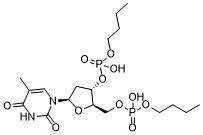
Physicochemical Properties
| Molecular Formula | C18H32N2O11P2 |
| Molecular Weight | 514.40 |
| Exact Mass | 514.15 |
| Elemental Analysis | C, 42.03; H, 6.27; N, 5.45; O, 34.21; P, 12.04 |
| CAS # | 403717-06-6 |
| PubChem CID | 10279357 |
| Appearance | Solid powder |
| LogP | 0.1 |
| Hydrogen Bond Donor Count | 3 |
| Hydrogen Bond Acceptor Count | 11 |
| Rotatable Bond Count | 14 |
| Heavy Atom Count | 33 |
| Complexity | 821 |
| Defined Atom Stereocenter Count | 3 |
| SMILES | CCCCOP(=O)(O)OC[C@@H]1[C@H](C[C@@H](O1)N2C=C(C(=O)NC2=O)C)OP(=O)(O)OCCCC |
| InChi Key | ZXQBUNYVGNOEBQ-ARFHVFGLSA-N |
| InChi Code | InChI=1S/C18H32N2O11P2/c1-4-6-8-27-32(23,24)29-12-15-14(31-33(25,26)28-9-7-5-2)10-16(30-15)20-11-13(3)17(21)19-18(20)22/h11,14-16H,4-10,12H2,1-3H3,(H,23,24)(H,25,26)(H,19,21,22)/t14-,15+,16+/m0/s1 |
| Chemical Name | ((2R,3S,5R)-3-((butoxy(hydroxy)phosphoryl)oxy)-5-(5-methyl-2,4-dioxo-3,4-dihydropyrimidin-1(2H)-yl)tetrahydrofuran-2-yl)methyl butyl hydrogen phosphate |
| Synonyms | Bisphosphocin NU-3; NU-3; NU 3; NU3; |
| HS Tariff Code | 2934.99.9001 |
| Storage |
Powder-20°C 3 years 4°C 2 years In solvent -80°C 6 months -20°C 1 month |
| Shipping Condition | Room temperature (This product is stable at ambient temperature for a few days during ordinary shipping and time spent in Customs) |
Biological Activity
| References | 1: Babot-Marquillas C, Sánchez-Martín MJ, Amigo JM, Yousef I, H Valido I, Boada R, Valiente M. Tooth whitening effects on dental enamel, oxidation or reduction? Comparison of physicochemical alterations in bovine enamel using Synchrotron- based Micro-FTIR. Dent Mater. 2022 Apr;38(4):670-679. doi: 10.1016/j.dental.2022.02.006. Epub 2022 Mar 5. PMID: 35256209. 2: Sa Y, Jiang T, Li BY, Wang ZJ, Wang ZH, Wang YN. [Effects of three at-home bleaching agents on enamel structure and structure-related mechanical properties]. Zhonghua Kou Qiang Yi Xue Za Zhi. 2012 May;47(5):281-6. Chinese. doi: 10.3760/cma.j.issn.1002-0098.2012.05.007. PMID: 22883823. 3: Zhao W. Measurement of Raman χ(3) and theoretical estimation of DOVE four wave mixing of hydrogen peroxide. J Phys Chem A. 2011 Jun 23;115(24):6525-30. doi: 10.1021/jp202977v. Epub 2011 May 18. PMID: 21591714. 4: Cao S, Sun LQ, Wang M. Antimicrobial activity and mechanism of action of Nu-3, a protonated modified nucleotide. Ann Clin Microbiol Antimicrob. 2011 Jan 14;10:1. doi: 10.1186/1476-0711-10-1. PMID: 21232163; PMCID: PMC3031213. 5: Sun J, Hu Y, Cao S, Zhang G, Sun LQ, Wang M. Acute, multiple-dose dermal and genetic toxicity of Nu-3: a novel antimicrobial agent. J Biomed Biotechnol. 2010;2010:362524. doi: 10.1155/2010/362524. Epub 2010 Jul 20. PMID: 20706607; PMCID: PMC2914288. 6: Xue W, He H, Zhu J, Yuan P. FTIR investigation of CTAB-Al-montmorillonite complexes. Spectrochim Acta A Mol Biomol Spectrosc. 2007 Jul;67(3-4):1030-6. doi: 10.1016/j.saa.2006.09.024. Epub 2006 Sep 27. PMID: 17289428. 7: Feng M, Tachikawa H, Wang X, Pfister TD, Gengenbach AJ, Lu Y. Resonance Raman spectroscopy of cytochrome c peroxidase variants that mimic manganese peroxidase. J Biol Inorg Chem. 2003 Sep;8(7):699-706. doi: 10.1007/s00775-003-0460-9. Epub 2003 Jul 9. PMID: 14505074. 8: Pleshko NL, Boskey AL, Mendelsohn R. An FT-IR microscopic investigation of the effects of tissue preservation on bone. Calcif Tissue Int. 1992 Jul;51(1):72-7. doi: 10.1007/BF00296221. PMID: 1393781. 9: Oosterhof GO, Smits GA, de Ruyter AE, Schalken JA, Debruyne FM. Effects of high-energy shock waves combined with biological response modifiers in different human kidney cancer xenografts. Ultrasound Med Biol. 1991;17(4):391-9. doi: 10.1016/0301-5629(91)90139-n. PMID: 1949350. 10: Combes M, Moroz VI, Crovisier J, Encrenaz T, Bibring JP, Grigoriev AV, Sanko NF, Coron N, Crifo JF, Gispert R, Bockelée-Morvan D, Nikolsky YuV, Krasnopolsky VA, Owen T, Emerich C, Lamarre JM, Rocard F. The 2.5-12 micrometers spectrum of comet Halley from the IKS-VEGA experiment. Icarus. 1988;76:404-36. doi: 10.1016/0019-1035(88)90013-9. PMID: 11538667. |
| Additional Infomation | Bisphosphocin Nu-3 is under investigation in clinical trial NCT02737722 (Topically Applied Bisphosphocin Nu-3 on Infected Diabetic Ulcers of Subjects With Type I or II Diabetes Mellitus). |
Solubility Data
| Solubility (In Vitro) | May dissolve in DMSO (in most cases), if not, try other solvents such as H2O, Ethanol, or DMF with a minute amount of products to avoid loss of samples |
| Solubility (In Vivo) |
Note: Listed below are some common formulations that may be used to formulate products with low water solubility (e.g. < 1 mg/mL), you may test these formulations using a minute amount of products to avoid loss of samples. Injection Formulations (e.g. IP/IV/IM/SC) Injection Formulation 1: DMSO : Tween 80: Saline = 10 : 5 : 85 (i.e. 100 μL DMSO stock solution → 50 μL Tween 80 → 850 μL Saline) *Preparation of saline: Dissolve 0.9 g of sodium chloride in 100 mL ddH ₂ O to obtain a clear solution. Injection Formulation 2: DMSO : PEG300 :Tween 80 : Saline = 10 : 40 : 5 : 45 (i.e. 100 μL DMSO → 400 μLPEG300 → 50 μL Tween 80 → 450 μL Saline) Injection Formulation 3: DMSO : Corn oil = 10 : 90 (i.e. 100 μL DMSO → 900 μL Corn oil) Example: Take the Injection Formulation 3 (DMSO : Corn oil = 10 : 90) as an example, if 1 mL of 2.5 mg/mL working solution is to be prepared, you can take 100 μL 25 mg/mL DMSO stock solution and add to 900 μL corn oil, mix well to obtain a clear or suspension solution (2.5 mg/mL, ready for use in animals). Injection Formulation 4: DMSO : 20% SBE-β-CD in saline = 10 : 90 [i.e. 100 μL DMSO → 900 μL (20% SBE-β-CD in saline)] *Preparation of 20% SBE-β-CD in Saline (4°C,1 week): Dissolve 2 g SBE-β-CD in 10 mL saline to obtain a clear solution. Injection Formulation 5: 2-Hydroxypropyl-β-cyclodextrin : Saline = 50 : 50 (i.e. 500 μL 2-Hydroxypropyl-β-cyclodextrin → 500 μL Saline) Injection Formulation 6: DMSO : PEG300 : castor oil : Saline = 5 : 10 : 20 : 65 (i.e. 50 μL DMSO → 100 μLPEG300 → 200 μL castor oil → 650 μL Saline) Injection Formulation 7: Ethanol : Cremophor : Saline = 10: 10 : 80 (i.e. 100 μL Ethanol → 100 μL Cremophor → 800 μL Saline) Injection Formulation 8: Dissolve in Cremophor/Ethanol (50 : 50), then diluted by Saline Injection Formulation 9: EtOH : Corn oil = 10 : 90 (i.e. 100 μL EtOH → 900 μL Corn oil) Injection Formulation 10: EtOH : PEG300:Tween 80 : Saline = 10 : 40 : 5 : 45 (i.e. 100 μL EtOH → 400 μLPEG300 → 50 μL Tween 80 → 450 μL Saline) Oral Formulations Oral Formulation 1: Suspend in 0.5% CMC Na (carboxymethylcellulose sodium) Oral Formulation 2: Suspend in 0.5% Carboxymethyl cellulose Example: Take the Oral Formulation 1 (Suspend in 0.5% CMC Na) as an example, if 100 mL of 2.5 mg/mL working solution is to be prepared, you can first prepare 0.5% CMC Na solution by measuring 0.5 g CMC Na and dissolve it in 100 mL ddH2O to obtain a clear solution; then add 250 mg of the product to 100 mL 0.5% CMC Na solution, to make the suspension solution (2.5 mg/mL, ready for use in animals). Oral Formulation 3: Dissolved in PEG400 Oral Formulation 4: Suspend in 0.2% Carboxymethyl cellulose Oral Formulation 5: Dissolve in 0.25% Tween 80 and 0.5% Carboxymethyl cellulose Oral Formulation 6: Mixing with food powders Note: Please be aware that the above formulations are for reference only. InvivoChem strongly recommends customers to read literature methods/protocols carefully before determining which formulation you should use for in vivo studies, as different compounds have different solubility properties and have to be formulated differently. (Please use freshly prepared in vivo formulations for optimal results.) |
| Preparing Stock Solutions | 1 mg | 5 mg | 10 mg | |
| 1 mM | 1.9440 mL | 9.7201 mL | 19.4401 mL | |
| 5 mM | 0.3888 mL | 1.9440 mL | 3.8880 mL | |
| 10 mM | 0.1944 mL | 0.9720 mL | 1.9440 mL |