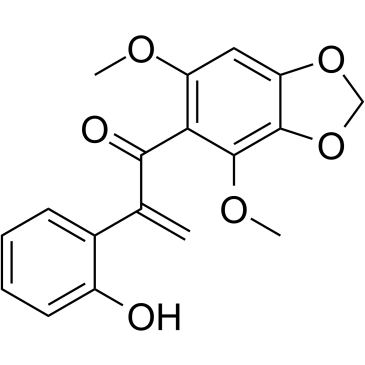
Physicochemical Properties
| Molecular Formula | C18H16O6 |
| Molecular Weight | 328.316045761108 |
| Exact Mass | 328.094 |
| CAS # | 1801433-90-8 |
| PubChem CID | 124079379 |
| Appearance | White to yellow viscous liquid |
| LogP | 3.2 |
| Hydrogen Bond Donor Count | 1 |
| Hydrogen Bond Acceptor Count | 6 |
| Rotatable Bond Count | 5 |
| Heavy Atom Count | 24 |
| Complexity | 478 |
| Defined Atom Stereocenter Count | 0 |
| InChi Key | SIKIIXNKUAAGAM-UHFFFAOYSA-N |
| InChi Code | InChI=1S/C18H16O6/c1-10(11-6-4-5-7-12(11)19)16(20)15-13(21-2)8-14-17(18(15)22-3)24-9-23-14/h4-8,19H,1,9H2,2-3H3 |
| Chemical Name | 1-(4,6-dimethoxy-1,3-benzodioxol-5-yl)-2-(2-hydroxyphenyl)prop-2-en-1-one |
| HS Tariff Code | 2934.99.9001 |
| Storage |
Powder-20°C 3 years 4°C 2 years In solvent -80°C 6 months -20°C 1 month |
| Shipping Condition | Room temperature (This product is stable at ambient temperature for a few days during ordinary shipping and time spent in Customs) |
Biological Activity
| ln Vitro | Primary cilia can be reduced by bilitresone, and microtubule stability can be observed in a number-dependent manner, suggesting that bilitresone can decrease the microtubule stability of primary newborn extrahepatic bile ducts [1]. In mice, biliatresone (2 μg/mL) causes anomalies in the cholangiocytes and ruptures the spheroid lumen [1]. |
| ln Vivo | In zebrafish experiments, the lethal dose of Biliatresone was found to be 1 μg/mL. Biliatresone is toxic at levels between 0.065 and 1.0 μg/mL and is dramatically reduced at higher concentrations [1]. The larvae treated with modest dosages at 5 dpf [0.0625 μg/mL (0.2 μM) and 0.125 μg/mL (0.4 μM)] only displayed severe gallbladder problems, while the larvae treated with the prior group clearly displayed morphological defects related to the gallbladder and extrahepatic ducts [1]. |
| References |
[1]. Biliatresone, a Reactive Natural Toxin From Dysphania Glomulifera and D. Littoralis: Discovery of the Toxic Moiety 1,2-Diaryl-2-Propenone. Chem Res Toxicol. 2015 Aug 17;28(8):1519-21. [2]. Identification of a Plant Isoflavonoid That Causes Biliary Atresia. Sci Transl Med. 2015 May 6;7(286):286ra67. |
| Additional Infomation | Biliatresone is a member of the class of benzodioxoles that is 1,3-benzodioxole which is substituted at positions 5 by a 2-(2-hydroxyphenyl)-3-oxoprop-1-en-3-yl group and at positions 4 and 6 by methoxy groups. A very rare type of isoflavonoid-related 1,2-diaryl-2-propenone found in Dysphania glomulifera (red crumbweed) and D. littoralis, the enone moiety is particularly reactive, undergoing ready Michael addition of water and methanol. Biliatresone has been found to cause extrahepatic biliary atresia (obliteration or discontinuity of the extrahepatic biliary system, resulting in obstruction to bile flow) in a zebrafish model. It has a role as a toxin and a plant metabolite. It is a member of benzodioxoles, an enone, an aromatic ketone, an aromatic ether and a member of phenols. |
Solubility Data
| Solubility (In Vitro) | DMSO : ~50 mg/mL (~152.29 mM) |
| Solubility (In Vivo) |
Solubility in Formulation 1: 2 mg/mL (6.09 mM) in 10% DMSO + 40% PEG300 + 5% Tween80 + 45% Saline (add these co-solvents sequentially from left to right, and one by one), suspension solution; with sonication. For example, if 1 mL of working solution is to be prepared, you can add 100 μL of 20.0 mg/mL clear DMSO stock solution to 400 μL PEG300 and mix evenly; then add 50 μL Tween-80 to the above solution and mix evenly; then add 450 μL normal saline to adjust the volume to 1 mL. Preparation of saline: Dissolve 0.9 g of sodium chloride in 100 mL ddH₂ O to obtain a clear solution. Solubility in Formulation 2: ≥ 2 mg/mL (6.09 mM) (saturation unknown) in 10% DMSO + 90% (20% SBE-β-CD in Saline) (add these co-solvents sequentially from left to right, and one by one), clear solution. For example, if 1 mL of working solution is to be prepared, you can add 100 μL of 20.0 mg/mL clear DMSO stock solution to 900 μL of 20% SBE-β-CD physiological saline solution and mix evenly. Preparation of 20% SBE-β-CD in Saline (4°C,1 week): Dissolve 2 g SBE-β-CD in 10 mL saline to obtain a clear solution. Solubility in Formulation 3: ≥ 2 mg/mL (6.09 mM) (saturation unknown) in 10% DMSO + 90% Corn Oil (add these co-solvents sequentially from left to right, and one by one), clear solution. For example, if 1 mL of working solution is to be prepared, you can add 100 μL of 20.0 mg/mL clear DMSO stock solution to 900 μL of corn oil and mix evenly. (Please use freshly prepared in vivo formulations for optimal results.) |
| Preparing Stock Solutions | 1 mg | 5 mg | 10 mg | |
| 1 mM | 3.0458 mL | 15.2290 mL | 30.4581 mL | |
| 5 mM | 0.6092 mL | 3.0458 mL | 6.0916 mL | |
| 10 mM | 0.3046 mL | 1.5229 mL | 3.0458 mL |