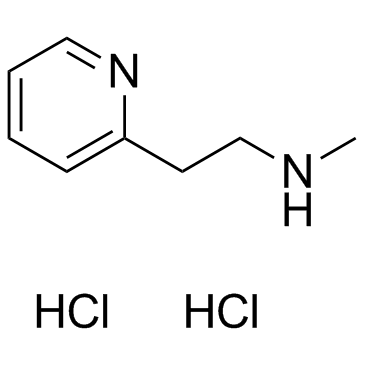
Betahistine dihydrochloride (formerly PT 9; PT9; trade names Veserc, Serc, Hiserk, Betaserc, Vergo), the dihydrochloride salt of Betahistine which was pproved in EU in 1970s for treating Ménière's disease, is a potent antagonist of histamine H3 receptor used as an anti-vertigo drug. It inhibits the histamine H3 receptor with an IC50 of 1.9 μM. Betahistine has been prescribed frequently to treat balance issues or to lessen the symptoms of vertigo linked to Ménière's disease.
Physicochemical Properties
| Molecular Formula | C8H12N2.2HCL |
| Molecular Weight | 209.12 |
| Exact Mass | 208.053 |
| Elemental Analysis | C, 45.95; H, 6.75; Cl, 33.90; N, 13.40 |
| CAS # | 5579-84-0 |
| Related CAS # | Betahistine; 5638-76-6; Betahistine-d3 dihydrochloride; 244094-72-2; Betahistine mesylate; 54856-23-4; Betahistine-13C,d3 dihydrochloride; 5638-76-6; 5579-84-0 (HCl); 54856-23-4 (mesylate) |
| PubChem CID | 68643 |
| Appearance | White to off-white solid powder |
| Density | 0.967 g/cm3 |
| Boiling Point | 210.9ºC at 760 mmHg |
| Melting Point | 150-154 °C |
| Flash Point | 96.7ºC |
| LogP | 2.838 |
| Hydrogen Bond Donor Count | 3 |
| Hydrogen Bond Acceptor Count | 2 |
| Rotatable Bond Count | 3 |
| Heavy Atom Count | 12 |
| Complexity | 83.3 |
| Defined Atom Stereocenter Count | 0 |
| SMILES | Cl[H].Cl[H].N([H])(C([H])([H])[H])C([H])([H])C([H])([H])C1=C([H])C([H])=C([H])C([H])=N1 |
| InChi Key | XVDFMHARQUBJRE-UHFFFAOYSA-N |
| InChi Code | InChI=1S/C8H12N2.2ClH/c1-9-7-5-8-4-2-3-6-10-8;;/h2-4,6,9H,5,7H2,1H3;2*1H |
| Chemical Name | N-methyl-2-pyridin-2-ylethanamine;dihydrochloride |
| Synonyms | PT-9; Betahistine dihydrochloride; Betahistine dihydrochloride; 5579-84-0; Betahistine hydrochloride; Betahistine HCl; Betahistine 2HCl; 2-Pyridineethanamine, N-methyl-, dihydrochloride; Betaserc; Microser; Betahistine HCl; PT 9; PT9; trade names Veserc, Serc; Hiserk; Betaserc; Vergo |
| HS Tariff Code | 2934.99.9001 |
| Storage |
Powder-20°C 3 years 4°C 2 years In solvent -80°C 6 months -20°C 1 month Note: (1). This product requires protection from light (avoid light exposure) during transportation and storage.(2). Please store this product in a sealed and protected environment (e.g. under nitrogen), avoid exposure to moisture. |
| Shipping Condition | Room temperature (This product is stable at ambient temperature for a few days during ordinary shipping and time spent in Customs) |
Biological Activity
| Targets | Histamine H3 receptor ( IC50 = 1.9 μM ) | |
| ln Vitro |
|
|
| ln Vivo |
|
|
| Enzyme Assay | Researchers previously suggested that therapeutic effects of betahistine in vestibular disorders result from its antagonist properties at histamine H(3) receptors (H(3)Rs). However, H(3)Rs exhibit constitutive activity, and most H(3)R antagonists act as inverse agonists. Here, Researchers have investigated the effects of betahistine at recombinant H(3)R isoforms. On inhibition of cAMP formation and [(3)H]arachidonic acid release, betahistine behaved as a nanomolar inverse agonist and a micromolar agonist. Both effects were suppressed by pertussis toxin, were found at all isoforms tested, and were not detected in mock cells, confirming interactions at H(3)Rs [2]. | |
| Cell Assay | In vitro, betahistine suppressed CD4(+) T cell differentiation into Th17 cells. These results indicate that betahistine is effective in suppressing both inflammatory and Th17 responses in mouse CIA and that it may have therapeutic value as an adjunct treatment for rheumatoid arthritis [3]. | |
| Animal Protocol |
Collagen-induced arthritis (CIA) DBA/1 male mouse model 1 mg/kg; 5mg/kg Oral adminstration; day 21 to day 42 after a 21-day CIA induction Histamine antagonism has been implicated in antipsychotic drug-induced weight gain. Betahistine, a histamine enhancer with H1 agonistic/H3 antagonistic properties (48 mg t.i.d.), was coadministered with olanzapine (10 mg/day) in three first-episode schizophrenia patients for 6 weeks. Body weight was measured at baseline and weekly thereafter. Clinical rating scales were completed at baseline and at week 6. All participants gained weight (mean weight gain 3.1+/-0.9 kg) and a similar pattern of weight gain was observed: an increase during the first 2 weeks and no additional weight gain (two patients) or minor weight loss (one patient) from weeks 3 to 6. None gained 7% of baseline weight, which is the cut-off for clinically significant weight gain. Betahistine was safe and well tolerated and did not interfere with the antipsychotic effect of olanzapine. Our findings justify a placebo-controlled evaluation of the putative weight-attenuating effect of betahistine in olanzapine-induced weight gain.[1] The inverse agonist potency of betahistine and its affinity on [(125)I]iodoproxyfan binding were similar in rat and human. We then investigated the effects of betahistine on histamine neuron activity by measuring tele-methylhistamine (t-MeHA) levels in the brains of mice. Its acute intraperitoneal administration increased t-MeHA levels with an ED(50) of 0.4 mg/kg, indicating inverse agonism. At higher doses, t-MeHA levels gradually returned to basal levels, a profile probably resulting from agonism. After acute oral administration, betahistine increased t-MeHA levels with an ED(50) of 2 mg/kg, a rightward shift probably caused by almost complete first-pass metabolism. In each case, the maximal effect of betahistine was lower than that of ciproxifan, indicating partial inverse agonism. After an oral 8-day treatment, the only effective dose of betahistine was 30 mg/kg, indicating that a tolerance had developed. These data strongly suggest that therapeutic effects of betahistine result from an enhancement of histamine neuron activity induced by inverse agonism at H(3) autoreceptors.[2] The objective of this study was to evaluate the potential therapeutic effects of betahistine dihydrochloride (betahistine) in a collagen-induced arthritis (CIA) mouse model. CIA was induced in DBA/1 male mice by primary immunization with 100μl of emulsion containing 2mg/ml chicken type II collagen (CII) mixed with complete Freund's adjuvant (CFA) in an 1:1 ratio, and booster immunization with 100μl of emulsion containing 2mg/ml CII mixed with incomplete Freund's adjuvant (IFA) in an 1:1 ratio. Immunization was performed subcutaneously at the base of the tail. After being boosted on day 21, betahistine (1 and 5mg/kg) was orally administered daily for 2weeks. The severity of CIA was determined by arthritic scores and assessment of histopathological joint destruction. Expression of cytokines in the paw and anti-CII antibodies in the serum was evaluated by ELISA. The proliferative response against CII in the lymph node cells was measured by (3)H-thymidine incorporation assay. The frequencies of different CII specific CD4(+) T cell subsets in the lymph node were determined by flow-cytometric analysis. Betahistine treatment attenuated the severity of arthritis and reduced the levels of pro-inflammatory cytokines, including TNF-α, IL-6, IL-23 and IL-17A, in the paw tissues of CIA mice. Lymph node cells from betahistine-treated mice showed a decrease in proliferation, as well as a lower frequency of Th17 cells. [3] |
|
| ADME/Pharmacokinetics |
Absorption, Distribution and Excretion When given orally, betahistine is rapidly and almost completely absorbed from the gastrointestinal tract. In the fasted state, Cmax is achieved within 1 hour of administration; in the fed state, Cmax is delayed, but the total drug absorption is similar. Food, therefore, has little effect on the absorption of betahistine.[A220563,16388] Betahistine is mainly excreted in the urine; with approximately 85-91% being detected in urine samples within 24 hours of administration. In a pharmacokinetic study of rats, betahistine was found to be distributed throughout the body. Human data for betahistine's volume of distribution is not readily available. Metabolism / Metabolites Betahistine is metabolized primarily into the inactive metabolite 2-pyridylacetic acid. There is both clinical and in vitro evidence that monoamine oxidase enzymes are responsible for the metabolism of betahistine. Biological Half-Life The half-life of betahistine is 3-4 hours. |
|
| Toxicity/Toxicokinetics |
Protein Binding The plasma protein binding of betahistine is reported to be less than 5%. rat LD50 oral 6110 mg/kg Problemi na Farmatsiyata. Problems in Pharmacy., 13(63), 1985 rat LD50 intraperitoneal 980 mg/kg Problemi na Farmatsiyata. Problems in Pharmacy., 13(63), 1985 mouse LD50 oral 2920 mg/kg Problemi na Farmatsiyata. Problems in Pharmacy., 13(63), 1985 mouse LD50 intraperitoneal 320 mg/kg Problemi na Farmatsiyata. Problems in Pharmacy., 13(63), 1985 |
|
| References |
[1]. The effect of betahistine, a histamine H1 receptor agonist/H3 antagonist, on olanzapine-induced weight gain in first-episode schizophrenia patients. Int Clin Psychopharmacol. 2005 Mar;20(2):101-3. [2]. Effects of betahistine at histamine H3 receptors: mixed inverse agonism/agonism in vitro and partial inverse agonism in vivo.J Pharmacol Exp Ther. 2010 Sep 1;334(3):945-54. [3]. Betahistine attenuates murine collagen-induced arthritis by suppressing both inflammatory and Th17 cell responses.Int Immunopharmacol. 2016 Oct;39:236-245. |
|
| Additional Infomation |
Betahistine Hydrochloride is the hydrochloride salt form of betahistine, a histamine analog with weak histamine H1 agonistic and more potent histamine H3 antagonistic properties. Upon intranasal administration, betahistine binds to histamine H1 and H3 receptors and exerts its agonistic and antagonistic actions locally and centrally. This promotes cochlear, vestibular and cerebral blood flow, decreases neuronal firing in the vestibular nuclei and increases histamine synthesis and release in the brain which facilitates vestibular compensation. Increased blood flow around the inner ear reduces the amount of fluid in the inner ear and may alleviate vertigo, tinnitus, and hearing loss. A histamine analog and H1 receptor agonist that serves as a vasodilator. It is used in MENIERE DISEASE and in vascular headaches but may exacerbate bronchial asthma and peptic ulcers. |
Solubility Data
| Solubility (In Vitro) |
|
|||
| Solubility (In Vivo) |
Solubility in Formulation 1: 150 mg/mL (717.29 mM) in PBS (add these co-solvents sequentially from left to right, and one by one), clear solution; with sonication. (Please use freshly prepared in vivo formulations for optimal results.) |
| Preparing Stock Solutions | 1 mg | 5 mg | 10 mg | |
| 1 mM | 4.7819 mL | 23.9097 mL | 47.8194 mL | |
| 5 mM | 0.9564 mL | 4.7819 mL | 9.5639 mL | |
| 10 mM | 0.4782 mL | 2.3910 mL | 4.7819 mL |