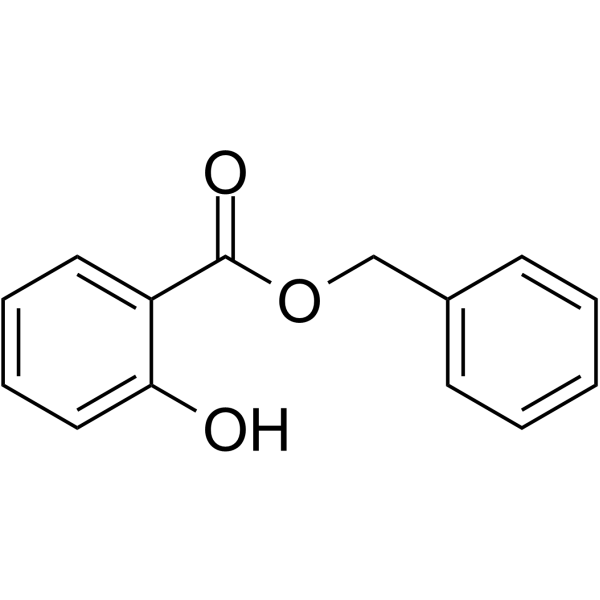
Physicochemical Properties
| Molecular Formula | C14H12O3 |
| Molecular Weight | 228.2433 |
| Exact Mass | 228.078 |
| CAS # | 118-58-1 |
| Related CAS # | Benzyl salicylate-d4;1219802-40-0 |
| PubChem CID | 8363 |
| Appearance | Colorless to light yellow liquid |
| Density | 1.2±0.1 g/cm3 |
| Boiling Point | 320.0±0.0 °C at 760 mmHg |
| Melting Point |
75 °F (NTP, 1992) 24 °C 23.4 °C |
| Flash Point | 146.4±13.7 °C |
| Vapour Pressure | 0.0±0.7 mmHg at 25°C |
| Index of Refraction | 1.607 |
| LogP | 3.2 |
| Hydrogen Bond Donor Count | 1 |
| Hydrogen Bond Acceptor Count | 3 |
| Rotatable Bond Count | 4 |
| Heavy Atom Count | 17 |
| Complexity | 246 |
| Defined Atom Stereocenter Count | 0 |
| InChi Key | ZCTQGTTXIYCGGC-UHFFFAOYSA-N |
| InChi Code | InChI=1S/C14H12O3/c15-13-9-5-4-8-12(13)14(16)17-10-11-6-2-1-3-7-11/h1-9,15H,10H2 |
| Chemical Name | benzyl 2-hydroxybenzoate |
| HS Tariff Code | 2934.99.9001 |
| Storage |
Powder-20°C 3 years 4°C 2 years In solvent -80°C 6 months -20°C 1 month |
| Shipping Condition | Room temperature (This product is stable at ambient temperature for a few days during ordinary shipping and time spent in Customs) |
Biological Activity
| ADME/Pharmacokinetics |
Metabolism / Metabolites Salicylates are used as fragrance and flavor ingredients for foods, as UV absorbers and as medicines. Here, we examined the hydrolytic metabolism of phenyl and benzyl salicylates by various tissue microsomes and plasma of rats, and by human liver and small-intestinal microsomes. Both salicylates were readily hydrolyzed by tissue microsomes, predominantly in small intestine, followed by liver, although phenyl salicylate was much more rapidly hydrolyzed than benzyl salicylate. The liver and small-intestinal microsomal hydrolase activities were completely inhibited by bis(4-nitrophenyl)phosphate, and could be extracted with Triton X-100. Phenyl salicylate-hydrolyzing activity was co-eluted with carboxylesterase activity by anion exchange column chromatography of the Triton X-100 extracts of liver and small-intestinal microsomes. Expression of rat liver and small-intestinal isoforms of carboxylesterase, Ces1e and Ces2c (AB010632), in COS cells resulted in significant phenyl salicylate-hydrolyzing activities with the same specific activities as those of liver and small-intestinal microsomes, respectively. Human small-intestinal microsomes also exhibited higher hydrolyzing activity than liver microsomes towards these salicylates. Human CES1 and CES2 isozymes expressed in COS cells both readily hydrolyzed phenyl salicylate, but the activity of CES2 was higher than that of CES1. These results indicate that significant amounts of salicylic acid might be formed by microsomal hydrolysis of phenyl and benzyl salicylates in vivo. The possible pharmacological and toxicological effects of salicylic acid released from salicylates present in commercial products should be considered. |
| Toxicity/Toxicokinetics |
Toxicity Summary IDENTIFICATION AND USE: Benzyl salicylate is a thick colorless liquid. Benzyl salicylate is widely used in soap and cosmetic industry as fragrance; also effective in absorbing UV light, and can be used in protective sunscreen lotions. Benzyl salicylate is also used in deodorant sprays. HUMAN STUDIES: Benzyl salicylate has a very low potential to induce hypersensitivity or to elicit reactions presumably attributable to pre-existing sensitization. Estrogenic potential of benzyl salicylate was tested using an in vitro human estrogen receptor alpha(hERalpha)-coactivator recruiting assay. Benzyl salicylate showed obvious in vitro hERalpha agonistic activities and exhibited a higher estrogenic activity compared to bisphenol A. Estrogenic activity was also demonstrated in assays using the estrogen-responsive MCF7 human breast cancer cell line. ANIMAL STUDIES: Benzyl salicylate was not irritating in the isolated bovine cornea test. Erythema was observed in the rabbit skin test. Estrogenic potential of benzyl salicylate was tested using an in vivo immature rodent uterotrophic bioassay. The uterine weights were significantly increased in mice treated with 11.1, 33.3, 100 and 300 mg/kg/day benzyl salicylate and rats treated with 3.7, 11.1, 33.3 and 100 mg/kg/day for 3 days. Benzyl salicylate was not mutagenic in Salmonella typhimurium strains TA98, TA100, TA1535, and TA1537 with or without metabolic activation. ECOTOXICITY STUDIES: Zebra fish (Danio rerio) were exposed to benzyl salicylate at 0, 0.7, 1.0, 1.4, 2.0 or 2.8 mg/L under static-renewal conditions for 96 hours. Mortalities were noted at 2.0 and 2.8 mg/L. Fish at these concentrations exhibited normal swimming behavior. No effects were seen at concentrations Interactions Disinfection of swimming pool water is essential to inactivate pathogenic microorganisms. However chlorine based disinfectants, the most commonly used, are known to lead to the formation of disinfection by-products (DBPs), some of which have been associated with adverse health effects. Precursors of DBPs include the organic matter present in the water used to fill the swimming pool, human body fluids and personal care products (PCPs) used by swimmers and bathers. The increased use, in the last years, of PCPs lead to an increased concern about the fate of PCPs in swimming pool waters and potential health risks of formed DBPs. In this study, the chemical transformations of two salicylates, benzyl salicylate (BzS) and phenyl salicylate (PS), incorporated in several PCPs, in chlorinated water were investigated. High-performance liquid chromatography (HPLC) with UV-diode-array detection (HPLC-UV-DAD) was used to follow the reaction kinetics and HPLC with mass spectrometry (HPLC-MS) was used to tentatively identify the major transformation by-products. Under the experimental conditions used in this work both salicylates reacted with chlorine following pseudo-first order kinetics: rate constant k = (0.0038 +/- 0.0002) min(-1) and half-life t1/2 = (182 +/- 10) min for BzS and rate constant k = (0.0088 +/- 0.0005) min(-1) and half-life t1/2 = (79 +/- 4) min for PS (mean =/- standard deviation). The reactions of the two salicylates in chlorinated water led to the formation of DBPs that were tentatively identified as mono- and dichloro- substituted compounds. Most probably they result from an electrophilic substitution of one or two hydrogen atoms in the phenolic ring of both salicylates by one or two chlorine atoms. Non-Human Toxicity Values LD50 Rat oral 2227 mg/kg |
| References |
[1]. Sensitization to benzyl salicylate and other allergens in patients with frontal fibrosing alopecia. Contact Dermatitis. 2021 Jun;84(6):423-430. |
| Additional Infomation |
Benzyl salicylate is a colorless liquid. Melting point near room temperature (18-20 °C). (NTP, 1992) Benzyl salicylate is a benzoate ester and a member of phenols. It is functionally related to a salicylic acid. Benzyl salicylate has been reported in Desmos chinensis, Plumeria rubra, and other organisms with data available. |
Solubility Data
| Solubility (In Vitro) | DMSO : ~100 mg/mL (~438.14 mM) |
| Solubility (In Vivo) |
Solubility in Formulation 1: ≥ 2.5 mg/mL (10.95 mM) (saturation unknown) in 10% DMSO + 40% PEG300 + 5% Tween80 + 45% Saline (add these co-solvents sequentially from left to right, and one by one), clear solution. For example, if 1 mL of working solution is to be prepared, you can add 100 μL of 25.0 mg/mL clear DMSO stock solution to 400 μL PEG300 and mix evenly; then add 50 μL Tween-80 to the above solution and mix evenly; then add 450 μL normal saline to adjust the volume to 1 mL. Preparation of saline: Dissolve 0.9 g of sodium chloride in 100 mL ddH₂ O to obtain a clear solution. Solubility in Formulation 2: ≥ 2.5 mg/mL (10.95 mM) (saturation unknown) in 10% DMSO + 90% (20% SBE-β-CD in Saline) (add these co-solvents sequentially from left to right, and one by one), clear solution. For example, if 1 mL of working solution is to be prepared, you can add 100 μL of 25.0 mg/mL clear DMSO stock solution to 900 μL of 20% SBE-β-CD physiological saline solution and mix evenly. Preparation of 20% SBE-β-CD in Saline (4°C,1 week): Dissolve 2 g SBE-β-CD in 10 mL saline to obtain a clear solution. Solubility in Formulation 3: ≥ 2.5 mg/mL (10.95 mM) (saturation unknown) in 10% DMSO + 90% Corn Oil (add these co-solvents sequentially from left to right, and one by one), clear solution. For example, if 1 mL of working solution is to be prepared, you can add 100 μL of 25.0 mg/mL clear DMSO stock solution to 900 μL of corn oil and mix evenly. (Please use freshly prepared in vivo formulations for optimal results.) |
| Preparing Stock Solutions | 1 mg | 5 mg | 10 mg | |
| 1 mM | 4.3814 mL | 21.9068 mL | 43.8135 mL | |
| 5 mM | 0.8763 mL | 4.3814 mL | 8.7627 mL | |
| 10 mM | 0.4381 mL | 2.1907 mL | 4.3814 mL |