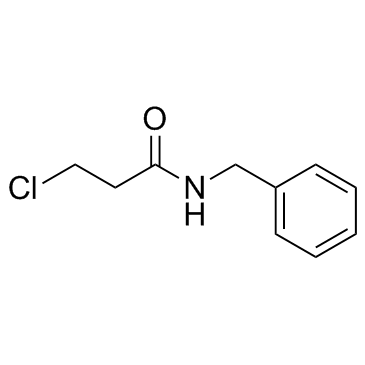
Physicochemical Properties
| Molecular Formula | C10H12NOCL |
| Molecular Weight | 197.66138 |
| Exact Mass | 197.061 |
| CAS # | 501-68-8 |
| PubChem CID | 10391 |
| Appearance | White to off-white solid powder |
| Density | 1.145g/cm3 |
| Boiling Point | 386.9ºC at 760mmHg |
| Flash Point | 187.8ºC |
| Index of Refraction | 1.532 |
| LogP | 2.322 |
| Hydrogen Bond Donor Count | 1 |
| Hydrogen Bond Acceptor Count | 1 |
| Rotatable Bond Count | 4 |
| Heavy Atom Count | 13 |
| Complexity | 155 |
| Defined Atom Stereocenter Count | 0 |
| SMILES | O=C(NCC1=CC=CC=C1)CCCl |
| InChi Key | JPYQFYIEOUVJDU-UHFFFAOYSA-N |
| InChi Code | InChI=1S/C10H12ClNO/c11-7-6-10(13)12-8-9-4-2-1-3-5-9/h1-5H,6-8H2,(H,12,13) |
| Chemical Name | N-benzyl-3-chloropropanamide |
| HS Tariff Code | 2934.99.9001 |
| Storage |
Powder-20°C 3 years 4°C 2 years In solvent -80°C 6 months -20°C 1 month |
| Shipping Condition | Room temperature (This product is stable at ambient temperature for a few days during ordinary shipping and time spent in Customs) |
Biological Activity
| ADME/Pharmacokinetics |
Absorption, Distribution and Excretion Metabolites appear in urine only. 4- hydroxybeclamide is present in the urine to a greater extent than 3 hydroxybeclamide. Approximately 20% of the radiolabel was excreted in urine. Metabolism / Metabolites Rapidly metabolized. Major pathway of metabolism is oxidation of the benzene ring to yield 3-hydroxyphenyl and 4-hydroxyphenyl metabolites, and oxidation of the benyl methylene to yield benzoic acid. 3 and 4 hydroxyphenyl metabolites are excreted extensively as gluconuride and sulphate conjugates, and benzoic acid is excreted as a glycine conjugate (hippuric acid). |
| Additional Infomation |
Beclamide is a member of benzenes. Beclamide (N-benzyl-B-chloropropionamide) is a no longer used drug that possesses anticonvulsant and sedative activity. It was studied in the 1950s for generalised tonic-clonic seizures but was not effective for absence seizures. Drug Indication Has been used in the management of epilepsy and epilepsy related behavioural disorders. It was used for generalised tonic-clonic seizures, and was not effective for absence seizures. More recently focus has shifted to the use of beclamide in behavioural disorders. In mentally handicapped epileptic patients it has been found to decrease anxiety, antisocial and demanding behaviours, and impulsivity. Mood stabilizing effects were also noted. [2] Additionally, due to its effects on monoamines, beclamide may have a potential place in treating conditions such as tardive dyskinesia and hyperkinetic syndromes. [2] Mechanism of Action Beclamide has been used for over three decades with little knowledge of how it acts in the CNS. In one study using rats, beclamide was seen to reduce striatal dopamine and serotonin levels and increase the levels of dopamine's major metabolites (and thus dopamine turnover), while reducing the levels of serotonin's major metabolite below detectable levels. A similar effect on neurotransmitter levels was seen in the rat frontal cortices. It is theorized that animal aggression is linked to levels of biogenic monoamines such as dopamine and serotonin, however the exact role is unclear. |
Solubility Data
| Solubility (In Vitro) |
DMSO : ≥ 100 mg/mL (~505.92 mM) H2O : ~0.67 mg/mL (~3.39 mM) |
| Solubility (In Vivo) |
Solubility in Formulation 1: ≥ 2.5 mg/mL (12.65 mM) (saturation unknown) in 10% DMSO + 40% PEG300 + 5% Tween80 + 45% Saline (add these co-solvents sequentially from left to right, and one by one), clear solution. For example, if 1 mL of working solution is to be prepared, you can add 100 μL of 25.0 mg/mL clear DMSO stock solution to 400 μL PEG300 and mix evenly; then add 50 μL Tween-80 to the above solution and mix evenly; then add 450 μL normal saline to adjust the volume to 1 mL. Preparation of saline: Dissolve 0.9 g of sodium chloride in 100 mL ddH₂ O to obtain a clear solution. Solubility in Formulation 2: ≥ 2.5 mg/mL (12.65 mM) (saturation unknown) in 10% DMSO + 90% (20% SBE-β-CD in Saline) (add these co-solvents sequentially from left to right, and one by one), clear solution. For example, if 1 mL of working solution is to be prepared, you can add 100 μL of 25.0 mg/mL clear DMSO stock solution to 900 μL of 20% SBE-β-CD physiological saline solution and mix evenly. Preparation of 20% SBE-β-CD in Saline (4°C,1 week): Dissolve 2 g SBE-β-CD in 10 mL saline to obtain a clear solution. Solubility in Formulation 3: ≥ 2.5 mg/mL (12.65 mM) (saturation unknown) in 10% DMSO + 90% Corn Oil (add these co-solvents sequentially from left to right, and one by one), clear solution. For example, if 1 mL of working solution is to be prepared, you can add 100 μL of 25.0 mg/mL clear DMSO stock solution to 900 μL of corn oil and mix evenly. (Please use freshly prepared in vivo formulations for optimal results.) |
| Preparing Stock Solutions | 1 mg | 5 mg | 10 mg | |
| 1 mM | 5.0592 mL | 25.2960 mL | 50.5919 mL | |
| 5 mM | 1.0118 mL | 5.0592 mL | 10.1184 mL | |
| 10 mM | 0.5059 mL | 2.5296 mL | 5.0592 mL |