|
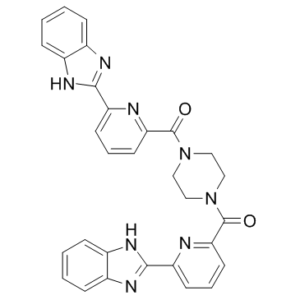
This product is discontinued due to commercial reason. BT-11 is a first-in-class, potent, orally available and selective modulator of LANCL2 (Lanthionine synthetase C-like 2) which is a novel therapeutic target for inflammatory and autoimmune diseases and diabetes, exerts anti-inflammatory and insulin-sensitizing effects. BT-11 at high doses has an excellent safety profile up to 1000 mg/kg/day. It has demonstrated therapeutic efficacy in 3 validated mouse models of colitis at doses as low as 8 mg/kg/d; It protects from IBD by targeting LANCL2. BT-11 has potential to be a safe and effective orally active therapeutic for IBD. The oral treatment with BT-11 (8 mg/kg/d) in a mouse model of IBD resulted in lowering the disease activity index, decreasing colonic inflammatory lesions by 4-fold, and suppressing inflammatory markers (e.g., TNF-α, and interferon-γ) in the gut. Furthermore, studies in LANCL2-/- mice demonstrated that loss of LANCL2 abrogated beneficial actions of BT-11, suggesting high selectivity for the target. In conclusion, BT-11 merits continued development as a LANCL2-based, first-in-class orally active therapeutic for IBD.
|
Physicochemical Properties
| Molecular Formula |
C30H24N8O2
|
| Molecular Weight |
528.5640
|
| Exact Mass |
528.202
|
| CAS # |
1912399-75-7
|
| Related CAS # |
1912399-91-7 (HCl);1912399-75-7;
|
| PubChem CID |
121299620
|
| Appearance |
Typically exists as solid at room temperature
|
| LogP |
3.4
|
| Hydrogen Bond Donor Count |
2
|
| Hydrogen Bond Acceptor Count |
6
|
| Rotatable Bond Count |
4
|
| Heavy Atom Count |
40
|
| Complexity |
840
|
| Defined Atom Stereocenter Count |
0
|
| InChi Key |
MVHWZNBAQIGPOQ-UHFFFAOYSA-N
|
| InChi Code |
InChI=1S/C30H24N8O2/c39-29(25-13-5-11-23(31-25)27-33-19-7-1-2-8-20(19)34-27)37-15-17-38(18-16-37)30(40)26-14-6-12-24(32-26)28-35-21-9-3-4-10-22(21)36-28/h1-14H,15-18H2,(H,33,34)(H,35,36)
|
| Chemical Name |
[4-[6-(1H-benzimidazol-2-yl)pyridine-2-carbonyl]piperazin-1-yl]-[6-(1H-benzimidazol-2-yl)pyridin-2-yl]methanone
|
| Synonyms |
|
| HS Tariff Code |
2934.99.9001
|
| Storage |
Powder-20°C 3 years
4°C 2 years
In solvent -80°C 6 months
-20°C 1 month
|
| Shipping Condition |
Room temperature (This product is stable at ambient temperature for a few days during ordinary shipping and time spent in Customs)
|
|
Biological Activity
| ln Vitro |
In vitro activity: BT-11 is a first-in-class, potent, orally available and selective modulator of LANCL2 (Lanthionine synthetase C-like 2) which is a novel therapeutic target for inflammatory and autoimmune diseases and diabetes, exerts anti-inflammatory and insulin-sensitizing effects. BT-11 at high doses has an excellent safety profile up to 1000 mg/kg/day. It has demonstrated therapeutic efficacy in 3 validated mouse models of colitis at doses as low as 8 mg/kg/d; It protects from IBD by targeting LANCL2. BT-11 has potential to be a safe and effective orally active therapeutic for IBD. The oral treatment with BT-11 (8 mg/kg/d) in a mouse model of IBD resulted in lowering the disease activity index, decreasing colonic inflammatory lesions by 4-fold, and suppressing inflammatory markers (e.g., TNF-α, and interferon-γ) in the gut. Furthermore, studies in LANCL2-/- mice demonstrated that loss of LANCL2 abrogated beneficial actions of BT-11, suggesting high selectivity for the target. In conclusion, BT-11 merits continued development as a LANCL2-based, first-in-class orally active therapeutic for IBD.
Kinase Assay: LANCL2 engagement produces an increase of PKA, followed by an accumulation of cAMP in the cytoplasm. BT-11 treatment splenocytes shows a dose−response increase of cAMP production. BT-11 stimulates cAMP production by activating the LANCL2 pathway. |
|
| ln Vivo |
| Oral treatment with BT-11 at 8 mg/kg/d in a mouse model of inflammatory bowel disease results in lowering the disease activity index, decreasing colonic inflammatory lesions by 4-fold, and suppressing inflammatory markers (e.g., TNF-α, and interferon-γ) in the gut. Furthermore, studies in LANCL2−/− mice demonstrates that loss of LANCL2 abrogates beneficial actions of BT-11, suggesting high selectivity for the target. Oral treatment with BT-11 (8 mg/kg/day) ameliorates colitis in mice. Initial safety assessment in rats indicates that oral treatment with BT-11 at high doses has an excellent safety profile up to 1000 mg/kg/day[1]. BT-11 is well tolerated in rats, and may hold promise as an orally active therapeutic for Crohn’s disease. One hour after oral administration of a single dose of 80 mg/kg, BT-11 has a maximal concentration of 21 ng/mL; the half-life is 3 hours |
|
| Animal Protocol |
| 8 mg/kg/d for mouse model; 500 mg/kg and 80 mg/kg/d for rats; oral | | Male Harlan Sprague Dawley rats and Wild type and LANCL2 / male mice with IBD models | |
|
| References |
J Med Chem.2016 Nov 23;59(22):10113-10126;Int J Toxicol.2016 Sep;35(5):521-9.
|
|
Solubility Data
| Solubility (In Vitro) |
| DMSO:≥ 30 mg/mL | | Water:<1 mg/mL | | Ethanol:<1 mg/mL |
|
| Solubility (In Vivo) |
| O=C(N1CCN(C(C2=NC(C3=NC4=CC=CC=C4N3)=CC=C2)=O)CC1)C5=NC(C6=NC7=CC=CC=C7N6)=CC=C5 |
(Please use freshly prepared in vivo formulations for optimal results.)
|
| Preparing Stock Solutions |
|
1 mg |
5 mg |
10 mg |
| 1 mM |
1.8919 mL |
9.4597 mL |
18.9193 mL |
| 5 mM |
0.3784 mL |
1.8919 mL |
3.7839 mL |
| 10 mM |
0.1892 mL |
0.9460 mL |
1.8919 mL |
*Note: Please select an appropriate solvent for the preparation of stock solution based on your experiment needs. For most products, DMSO can be used for preparing stock solutions (e.g. 5 mM, 10 mM, or 20 mM concentration); some products with high aqueous solubility may be dissolved in water directly. Solubility information is available at the above Solubility Data section. Once the stock solution is prepared, aliquot it to routine usage volumes and store at -20°C or -80°C. Avoid repeated freeze and thaw cycles. |