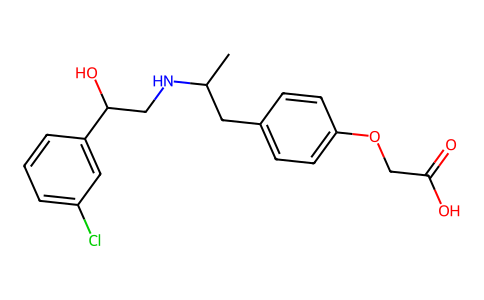
Physicochemical Properties
| Molecular Formula | C19H22CLNO4 |
| Molecular Weight | 363.838 |
| Exact Mass | 363.124 |
| Elemental Analysis | C, 62.72; H, 6.10; Cl, 9.74; N, 3.85; O, 17.59 |
| CAS # | 114333-71-0 |
| Related CAS # | 90730-96-4 (free acid); 114333-71-0; 127299-93-8 (sodium) |
| PubChem CID | 2437 |
| Appearance | Typically exists as solid at room temperature |
| Density | 1.267g/cm3 |
| Boiling Point | 569.7ºC at 760 mmHg |
| Flash Point | 298.4ºC |
| Vapour Pressure | 8.09E-14mmHg at 25°C |
| Index of Refraction | 1.591 |
| LogP | 3.448 |
| Hydrogen Bond Donor Count | 3 |
| Hydrogen Bond Acceptor Count | 5 |
| Rotatable Bond Count | 9 |
| Heavy Atom Count | 25 |
| Complexity | 401 |
| Defined Atom Stereocenter Count | 0 |
| SMILES | ClC1=CC=CC(C(O)CNC(C)CC2C=CC(OCC(O)=O)=CC=2)=C1 |
| InChi Key | ZGGNJJJYUVRADP-UHFFFAOYSA-N |
| InChi Code | InChI=1S/C19H22ClNO4/c1-13(21-11-18(22)15-3-2-4-16(20)10-15)9-14-5-7-17(8-6-14)25-12-19(23)24/h2-8,10,13,18,21-22H,9,11-12H2,1H3,(H,23,24) |
| Chemical Name | 2-[4-[2-[[2-(3-chlorophenyl)-2-hydroxyethyl]amino]propyl]phenoxy]acetic acid |
| Synonyms | BRL-37344; BRL37344; 114333-71-0; Brl-37344; (4-(2-((2-(3-Chlorophenyl)-2-hydroxyethyl)amino)propyl)phenoxy)acetic acid; 2-[4-[2-[[2-(3-chlorophenyl)-2-hydroxyethyl]amino]propyl]phenoxy]acetic acid; 90730-96-4; DTXSID20921329; Lopac0_000197; CHEMBL13990; BRL 37344 |
| HS Tariff Code | 2934.99.9001 |
| Storage |
Powder-20°C 3 years 4°C 2 years In solvent -80°C 6 months -20°C 1 month |
| Shipping Condition | Room temperature (This product is stable at ambient temperature for a few days during ordinary shipping and time spent in Customs) |
Biological Activity
| Targets | β3-adrenergic receptor |
| ln Vitro | BRL37344, a β3-AR agonist, significantly decreased the amplitude, muscle force, and duration of the DSM contractions induced by 20 Hz EFS, in a concentration-dependent manner. This BRL37344-mediated inhibition of the amplitude and muscle force of the nerve-evoked DSM contraction was significantly reduced by iberiotoxin, a highly selective inhibitor of the BK channel, revealing a role for BK channels in the β3-AR-induced inhibition of human DSM nerve-evoked contractions. We further used atropine, α,β-methylene-ATP, and suramin to separate the cholinergic and purinergic components of human DSM nerve-evoked contractions. We found that the β3-AR agonist, BRL37344, inhibited both components of the EFS-induced (0.5–50 Hz) DSM contractions. [2] |
| ln Vivo | In obese mice, administration with BRL37344 sodium (BRL 37344A) dramatically lowers body weight [1]. Compared with the controls, the obese mice and DM mice showed successively lower 18F-FDG uptake in the interscapular BAT (P = 0.036 and < 0.001, respectively). After two-week BRL37344 treatment, the BAT uptake was significantly elevated in both obese mice (P = 0.010) and DM mice (P = 0.004), accompanied with significantly decreased blood glucose levels (P = 0.023 and 0.036, respectively). The BAT uptake was negatively correlated with the blood glucose levels in both obese mice (r = -0.71, P = 0.003) and DM mice (r = -0.74, P = 0.010). BRL37344 treatment also caused significant weight loss in the obese mice (P = 0.001). Levothyroxine treatment increased the BAT uptake in the control mice (P = 0.025) and obese mice (P = 0.013), but not in the DM mice (P = 0.45). Conclusion: The inhibited BAT function in obese and DM mice can be re-activated by β3-adrenergic receptor agonist or thyroid hormone, and effective BAT activation may lead to weight loss and blood glucose lowering. Activating BAT can provide a new treatment strategy for obesity and DM. [1] |
| Cell Assay |
Isometric DSM tension recordings [2] Isometric DSM tension recordings were conducted as previously described. Briefly, mucosa-free DSM tissues from humans were dissected into strips 5–7 mm long and 2–3 mm wide. DSM strips were clipped between a stationary mount and a force-displacement transducer then placed in tissue baths filled with Ca2+-containing physiological saline solution (PSS) (§Solutions and Drugs) thermostatically controlled at 37°C and aerated with 95% O2 and 5% CO2. Tissue baths were equipped with platinum electrodes for EFS. EFS pulses had 20 V amplitude, 0.75 ms width, 3 s stimulus duration, and polarity was reversed for alternating pulses. Then, DSM strips were stretched to 10 mN of initial tension and the bath solution was changed with fresh PSS every 15 min during an equilibration period of 45 to 60 min. Following the equilibration period, two different EFS protocols were generated using PHM-152I stimulator and the DSM response to EFS was recorded using MyoMed software. Compounds were applied only to DSM strips with stable pre-compound controls following the equilibration period. In the first EFS protocol, a 20 Hz EFS frequency was applied continuously every minute to generate DSM nerve-evoked contractions. In the second EFS protocol, nerve-evoked DSM contractions were generated by applying increasing EFS frequencies (0.5, 2, 3.5, 5, 7.5, 10, 12.5, 15, 20, 30, 40, 50 Hz) every 3 min. Researchers evaluated the BRL 37344 inhibitory effects on DSM contractions induced by EFS in the absence or presence of iberiotoxin, a selective BK channel blocker; atropine, a cholinergic blocker; suramin, a purinergic receptor blocker; and α,β-methylene-ATP, a purinergic receptor agonist. |
| Animal Protocol |
Animal/Disease Models: Fiveweeks old male imprinted control region (ICR) mice [1] Doses: 2.5 mg/kg Route of Administration: intraperitoneal (ip) injection; three times a week for two weeks Experimental Results: diminished the body weight of obese mice. Obese mice were established by a high-fat diet for eight weeks, and diabetes mellitus(DM) models were induced with Streptozocin in obese mice. 18F-FDG microPET was used to monitor BAT function during obese and DM modeling, and also after BRL37344 (a β3-adrenergic receptor agonist) or levothyroxine treatment. The BAT function was correlated with the body weight and blood glucose levels. [1] |
| References |
[1]. Activating brown adipose tissue for weight loss and lowering of blood glucose levels: a microPET study using obese and diabetic model mice. PLoS One. 2014 Dec 2;9(12):e113742. |
| Additional Infomation |
Adrenergic beta-Agonists:
Drugs that selectively bind to and activate beta-adrenergic receptors. The present study reveals that the β3-AR agonist, BRL37344, is very effective in reducing human DSM nerve-evoked contractions. We reveal for the first time that the β3-AR-agonist-mediated relaxation of human DSM nerve-evoked contractions is BK channel-dependent, emphasizing the critical role of BK channels in human DSM physiology. Future studies using DSM tissue from patients with OAB and detrusor overactivity are anticipated to demonstrate a similar functional relationship between β3-ARs and the BK channel, which would provide further impetus for studying potential pharmacologic targets in this area for the treatment of OAB.[2] |
Solubility Data
| Solubility (In Vitro) | May dissolve in DMSO (in most cases), if not, try other solvents such as H2O, Ethanol, or DMF with a minute amount of products to avoid loss of samples |
| Solubility (In Vivo) |
Note: Listed below are some common formulations that may be used to formulate products with low water solubility (e.g. < 1 mg/mL), you may test these formulations using a minute amount of products to avoid loss of samples. Injection Formulations (e.g. IP/IV/IM/SC) Injection Formulation 1: DMSO : Tween 80: Saline = 10 : 5 : 85 (i.e. 100 μL DMSO stock solution → 50 μL Tween 80 → 850 μL Saline) *Preparation of saline: Dissolve 0.9 g of sodium chloride in 100 mL ddH ₂ O to obtain a clear solution. Injection Formulation 2: DMSO : PEG300 :Tween 80 : Saline = 10 : 40 : 5 : 45 (i.e. 100 μL DMSO → 400 μLPEG300 → 50 μL Tween 80 → 450 μL Saline) Injection Formulation 3: DMSO : Corn oil = 10 : 90 (i.e. 100 μL DMSO → 900 μL Corn oil) Example: Take the Injection Formulation 3 (DMSO : Corn oil = 10 : 90) as an example, if 1 mL of 2.5 mg/mL working solution is to be prepared, you can take 100 μL 25 mg/mL DMSO stock solution and add to 900 μL corn oil, mix well to obtain a clear or suspension solution (2.5 mg/mL, ready for use in animals). Injection Formulation 4: DMSO : 20% SBE-β-CD in saline = 10 : 90 [i.e. 100 μL DMSO → 900 μL (20% SBE-β-CD in saline)] *Preparation of 20% SBE-β-CD in Saline (4°C,1 week): Dissolve 2 g SBE-β-CD in 10 mL saline to obtain a clear solution. Injection Formulation 5: 2-Hydroxypropyl-β-cyclodextrin : Saline = 50 : 50 (i.e. 500 μL 2-Hydroxypropyl-β-cyclodextrin → 500 μL Saline) Injection Formulation 6: DMSO : PEG300 : castor oil : Saline = 5 : 10 : 20 : 65 (i.e. 50 μL DMSO → 100 μLPEG300 → 200 μL castor oil → 650 μL Saline) Injection Formulation 7: Ethanol : Cremophor : Saline = 10: 10 : 80 (i.e. 100 μL Ethanol → 100 μL Cremophor → 800 μL Saline) Injection Formulation 8: Dissolve in Cremophor/Ethanol (50 : 50), then diluted by Saline Injection Formulation 9: EtOH : Corn oil = 10 : 90 (i.e. 100 μL EtOH → 900 μL Corn oil) Injection Formulation 10: EtOH : PEG300:Tween 80 : Saline = 10 : 40 : 5 : 45 (i.e. 100 μL EtOH → 400 μLPEG300 → 50 μL Tween 80 → 450 μL Saline) Oral Formulations Oral Formulation 1: Suspend in 0.5% CMC Na (carboxymethylcellulose sodium) Oral Formulation 2: Suspend in 0.5% Carboxymethyl cellulose Example: Take the Oral Formulation 1 (Suspend in 0.5% CMC Na) as an example, if 100 mL of 2.5 mg/mL working solution is to be prepared, you can first prepare 0.5% CMC Na solution by measuring 0.5 g CMC Na and dissolve it in 100 mL ddH2O to obtain a clear solution; then add 250 mg of the product to 100 mL 0.5% CMC Na solution, to make the suspension solution (2.5 mg/mL, ready for use in animals). Oral Formulation 3: Dissolved in PEG400 Oral Formulation 4: Suspend in 0.2% Carboxymethyl cellulose Oral Formulation 5: Dissolve in 0.25% Tween 80 and 0.5% Carboxymethyl cellulose Oral Formulation 6: Mixing with food powders Note: Please be aware that the above formulations are for reference only. InvivoChem strongly recommends customers to read literature methods/protocols carefully before determining which formulation you should use for in vivo studies, as different compounds have different solubility properties and have to be formulated differently. (Please use freshly prepared in vivo formulations for optimal results.) |
| Preparing Stock Solutions | 1 mg | 5 mg | 10 mg | |
| 1 mM | 2.7485 mL | 13.7423 mL | 27.4846 mL | |
| 5 mM | 0.5497 mL | 2.7485 mL | 5.4969 mL | |
| 10 mM | 0.2748 mL | 1.3742 mL | 2.7485 mL |