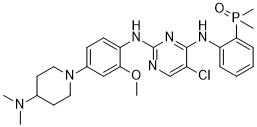
Brigatinib analog is derived from Brigatinib (AP-26113; Alunbrig), an oral bioavailable ALK (anaplastic lymphoma kinase) inhibitor that the FDA approved in 2017 for the treatment of non-small cell lung cancer (NSCLC) that has met ALK-positive metastatic criteria.
Physicochemical Properties
| Molecular Formula | C26H34CLN6O2P |
| Molecular Weight | 529.01 |
| Exact Mass | 528.216 |
| Elemental Analysis | C, 59.03; H, 6.48; Cl, 6.70; N, 15.89; O, 6.05; P, 5.85 |
| CAS # | 1197958-12-5 |
| Related CAS # | 1197958-12-5 (analog);1197953-54-0; |
| PubChem CID | 57390074 |
| Appearance | white solid powder |
| Density | 1.3±0.1 g/cm3 |
| Boiling Point | 737.6±70.0 °C at 760 mmHg |
| Flash Point | 399.9±35.7 °C |
| Vapour Pressure | 0.0±2.4 mmHg at 25°C |
| Index of Refraction | 1.626 |
| LogP | 1.1 |
| Hydrogen Bond Donor Count | 2 |
| Hydrogen Bond Acceptor Count | 8 |
| Rotatable Bond Count | 8 |
| Heavy Atom Count | 36 |
| Complexity | 733 |
| Defined Atom Stereocenter Count | 0 |
| SMILES | ClC1=C([H])N=C(N=C1N([H])C1=C([H])C([H])=C([H])C([H])=C1P(C([H])([H])[H])(C([H])([H])[H])=O)N([H])C1C([H])=C([H])C(=C([H])C=1OC([H])([H])[H])N1C([H])([H])C([H])([H])C([H])(C([H])([H])C1([H])[H])N(C([H])([H])[H])C([H])([H])[H] |
| InChi Key | OVDSPTSBIQCAIN-UHFFFAOYSA-N |
| InChi Code | InChI=1S/C26H34ClN6O2P/c1-32(2)18-12-14-33(15-13-18)19-10-11-21(23(16-19)35-3)30-26-28-17-20(27)25(31-26)29-22-8-6-7-9-24(22)36(4,5)34/h6-11,16-18H,12-15H2,1-5H3,(H2,28,29,30,31) |
| Chemical Name | 5-chloro-2-N-[4-[4-(dimethylamino)piperidin-1-yl]-2-methoxyphenyl]-4-N-(2-dimethylphosphorylphenyl)pyrimidine-2,4-diamine |
| Synonyms | AP-26113; Brigatinib-analog; AP26113; AP 26113; AP 26113-analog; AP26113-analog; AP-26113-analog |
| HS Tariff Code | 2934.99.9001 |
| Storage |
Powder-20°C 3 years 4°C 2 years In solvent -80°C 6 months -20°C 1 month |
| Shipping Condition | Room temperature (This product is stable at ambient temperature for a few days during ordinary shipping and time spent in Customs) |
Biological Activity
| Targets | ALK (IC50 = 0.07 nM); EGFR (IC50 = 28.4 nM); IGF1R (IC50 = 32 nM); EGFR (IC50 = 36.8 nM); EGFR (IC50 = 36.8 nM) | ||
| ln Vitro | AP26113-analog and brgatinib, both of which have IC50 values of less than 100 nM, are potent against triple-mutant EGFR. When EGFR mutations of any kind are expressed in cells, AP26113-analog inhibits the phosphorylation of EGFR and its downstream signal path[2]. | ||
| ln Vivo | AP26113 (< 50 mg/kg) inhibits p-ALK in the tumor of Karpas-299 xenograft mice model in a dose-dependent manner. AP26113 (< 50 mg/kg) inhibits tumor growth in the Karpas-299 and H3122 xenograft mouse models in a dose-dependent manner. Positive characteristics of AP26113 include a low level of inhibition of the main CYP isoforms and a moderate in vitro plasma protein binding (47%, 70%, and 76% in human, rat, and mouse). Rats show good tolerance to AP26113 (10 mg/kg), with a Cmax of 2587 ng/mL and an AUC of 41120 hr.ng/mL. In the model of HCC827(EGFR-DEL) or HCC827(EGFR-DEL/T790M) xenograft mice, AP26113 (25 mg/kg) causes tumor regression. | ||
| Enzyme Assay | A HotSpotSM kinase profile of 289 kinases is carried out in vitro. The experiment is carried out with brigatinib concentrations ranging from 0.05 nM to 1 μM in the presence of 10 μM [33P]-ATP. | ||
| Cell Assay | For three-day cell viability assays, black transparent-bottom 96-well plates are plated with 2,000, 1,500, or 2,000 cells per well of Ba/F3, PC9, or MGH121, respectively. Each TKI is applied to the cells in a 10-dose range of 0.3 nM to 10 μM on the same day for Ba/F3 cells and the following day for PC9 and MGH121 cells. The CellTiter-Glo assay is used to measure cell viability 72 hours after the start of drug treatment. | ||
| Animal Protocol |
|
||
| References |
[1]. AP26113, a potent ALK inhibitor, overcomes mutations in EML4-ALK that confer resistance to PF-02341066 (PF1066). Cancer Research: April 15, 2010; Volume 70, Issue 8, Supplement 1. [2]. AP26113 is a dual ALK/EGFR inhibitor: Characterization against EGFR T790M in cell and mouse models of NSCLC. Cancer Research: April 15, 2012; Volume 72, Issue 8, Supplement 1. |
||
| Additional Infomation | See also: Brigatinib (annotation moved to). |
Solubility Data
| Solubility (In Vitro) |
|
|||
| Solubility (In Vivo) |
Solubility in Formulation 1: ≥ 2.5 mg/mL (4.73 mM) (saturation unknown) in 10% DMSO + 40% PEG300 + 5% Tween80 + 45% Saline (add these co-solvents sequentially from left to right, and one by one), clear solution. For example, if 1 mL of working solution is to be prepared, you can add 100 μL of 25.0 mg/mL clear DMSO stock solution to 400 μL PEG300 and mix evenly; then add 50 μL Tween-80 to the above solution and mix evenly; then add 450 μL normal saline to adjust the volume to 1 mL. Preparation of saline: Dissolve 0.9 g of sodium chloride in 100 mL ddH₂ O to obtain a clear solution. Solubility in Formulation 2: ≥ 2.5 mg/mL (4.73 mM) (saturation unknown) in 10% DMSO + 90% (20% SBE-β-CD in Saline) (add these co-solvents sequentially from left to right, and one by one), clear solution. For example, if 1 mL of working solution is to be prepared, you can add 100 μL of 25.0 mg/mL clear DMSO stock solution to 900 μL of 20% SBE-β-CD physiological saline solution and mix evenly. Preparation of 20% SBE-β-CD in Saline (4°C,1 week): Dissolve 2 g SBE-β-CD in 10 mL saline to obtain a clear solution. Solubility in Formulation 3: ≥ 2.5 mg/mL (4.73 mM) (saturation unknown) in 10% DMSO + 90% Corn Oil (add these co-solvents sequentially from left to right, and one by one), clear solution. For example, if 1 mL of working solution is to be prepared, you can add 100 μL of 25.0 mg/mL clear DMSO stock solution to 900 μL of corn oil and mix evenly. Solubility in Formulation 4: NMP+polyethylene glycol 300 (10+90, v+v): 1 mg/mL (Please use freshly prepared in vivo formulations for optimal results.) |
| Preparing Stock Solutions | 1 mg | 5 mg | 10 mg | |
| 1 mM | 1.8903 mL | 9.4516 mL | 18.9032 mL | |
| 5 mM | 0.3781 mL | 1.8903 mL | 3.7806 mL | |
| 10 mM | 0.1890 mL | 0.9452 mL | 1.8903 mL |