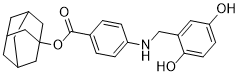
Adaphostin (NSC-680410) is the adamantyl ester of AG957, acting as a novel and potent activator of Fas-mediated death pathway in Bcr/Abl-positive leukaemia. It also causes apoptosis in T-lymphoblastic human leukemia cell lines (IC50 ranging from 17 to 216 nM) as a p210bcr/abl inhibitor (IC50=14 μM).
Physicochemical Properties
| Molecular Formula | C24H27NO4 |
| Molecular Weight | 393.47500 |
| Exact Mass | 393.194 |
| Elemental Analysis | C, 73.26; H, 6.92; N, 3.56; O, 16.26 |
| CAS # | 241127-58-2 |
| Related CAS # | 241127-58-2 |
| PubChem CID | 387042 |
| Appearance | Off-white to light brown solid powder |
| Density | 1.33g/cm3 |
| Boiling Point | 606.2ºC at 760mmHg |
| Flash Point | 320.4ºC |
| Vapour Pressure | 2.73E-15mmHg at 25°C |
| Index of Refraction | 1.661 |
| LogP | 4.991 |
| Hydrogen Bond Donor Count | 3 |
| Hydrogen Bond Acceptor Count | 5 |
| Rotatable Bond Count | 6 |
| Heavy Atom Count | 29 |
| Complexity | 558 |
| Defined Atom Stereocenter Count | 0 |
| SMILES | OC1=CC=C(O)C(CNC2=CC=C(C(OC34CC5CC(C3)CC(C5)C4)=O)C=C2)=C1 |
| InChi Key | YJZSUCFGHXQWDM-UHFFFAOYSA-N |
| InChi Code | InChI=1S/C24H27NO4/c26-21-5-6-22(27)19(10-21)14-25-20-3-1-18(2-4-20)23(28)29-24-11-15-7-16(12-24)9-17(8-15)13-24/h1-6,10,15-17,25-27H,7-9,11-14H2 |
| Chemical Name | 1-adamantyl 4-[(2,5-dihydroxyphenyl)methylamino]benzoate |
| Synonyms | Adaphostin |
| HS Tariff Code | 2934.99.9001 |
| Storage |
Powder-20°C 3 years 4°C 2 years In solvent -80°C 6 months -20°C 1 month |
| Shipping Condition | Room temperature (This product is stable at ambient temperature for a few days during ordinary shipping and time spent in Customs) |
Biological Activity
| ln Vitro |
Adaphostin inhibits granulocyte colony formation in specimens of chronic myelogenous leukemia (CML) at lower concentrations without increasing toxicity in normal progenitors and down-regulates p210bcr/abl in K562 cells[1]. N-acetylcysteine (NAC) inhibits adipostin-induced p53 up-regulation, DNA strand breaks, and ROS production in ML-1 cells[4]. |
| References |
[1]. Effects of the bcr/abl kinase inhibitors AG957 and NSC 680410 on chronic myelogenous leukemia cells in vitro. Clin Cancer Res. 2000;6(1):237-249. [2]. In vitro and in vivo evaluations of the tyrosine kinase inhibitor NSC 680410 against human leukemia and glioblastoma cell lines. Cancer Chemother Pharmacol. 2002;50(6):479-489. [3]. Adaphostin has significant and selective activity against chronic and acute myeloid leukemia cells. Cancer Sci. 2006;97(9):952-960. [4]. Involvement of reactive oxygen species in adaphostin-induced cytotoxicity in human leukemia cells. Blood. 2003;102(13):4512-4519. |
Solubility Data
| Solubility (In Vitro) | DMSO: ~50 mg/mL (~127.1 mM) |
| Solubility (In Vivo) |
Solubility in Formulation 1: ≥ 2.5 mg/mL (6.35 mM) (saturation unknown) in 10% DMSO + 40% PEG300 + 5% Tween80 + 45% Saline (add these co-solvents sequentially from left to right, and one by one), clear solution. For example, if 1 mL of working solution is to be prepared, you can add 100 μL of 25.0 mg/mL clear DMSO stock solution to 400 μL PEG300 and mix evenly; then add 50 μL Tween-80 to the above solution and mix evenly; then add 450 μL normal saline to adjust the volume to 1 mL. Preparation of saline: Dissolve 0.9 g of sodium chloride in 100 mL ddH₂ O to obtain a clear solution. Solubility in Formulation 2: ≥ 2.5 mg/mL (6.35 mM) (saturation unknown) in 10% DMSO + 90% (20% SBE-β-CD in Saline) (add these co-solvents sequentially from left to right, and one by one), clear solution. For example, if 1 mL of working solution is to be prepared, you can add 100 μL of 25.0 mg/mL clear DMSO stock solution to 900 μL of 20% SBE-β-CD physiological saline solution and mix evenly. Preparation of 20% SBE-β-CD in Saline (4°C,1 week): Dissolve 2 g SBE-β-CD in 10 mL saline to obtain a clear solution. (Please use freshly prepared in vivo formulations for optimal results.) |
| Preparing Stock Solutions | 1 mg | 5 mg | 10 mg | |
| 1 mM | 2.5414 mL | 12.7071 mL | 25.4143 mL | |
| 5 mM | 0.5083 mL | 2.5414 mL | 5.0829 mL | |
| 10 mM | 0.2541 mL | 1.2707 mL | 2.5414 mL |