Physicochemical Properties
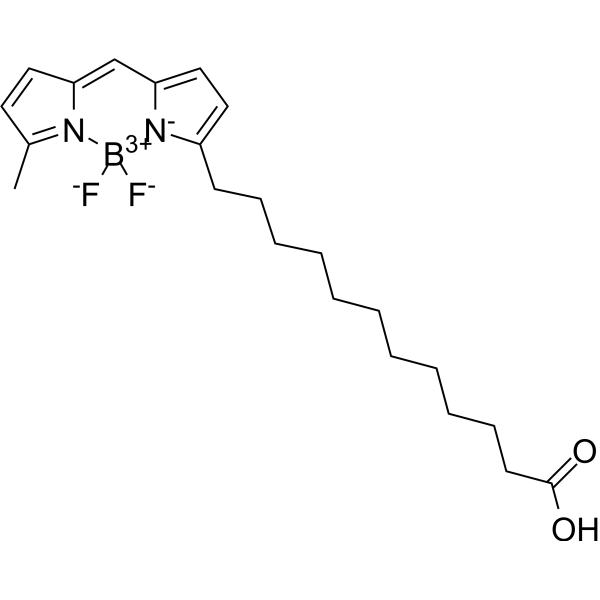
| Molecular Formula | C22H30BF2N2O2.H |
| Molecular Weight | 404.3015 |
| CAS # | 144672-74-2 |
| Appearance | Orange to red solid powder |
| SMILES | O=C([O-])CCCCCCCCCCCC1[N-]2[B+3]([F-])([F-])N3C(C=CC=3C)=CC2=CC=1 |
| HS Tariff Code | 2934.99.9001 |
| Storage |
Powder-20°C 3 years 4°C 2 years In solvent -80°C 6 months -20°C 1 month Note: This product requires protection from light (avoid light exposure) during transportation and storage. |
| Shipping Condition | Room temperature (This product is stable at ambient temperature for a few days during ordinary shipping and time spent in Customs) |
Biological Activity
| ln Vitro | Guidelines for usage 1. Composition of the working solution for BODIPY 500/510 C1, C12 1.1 Hydrogenate 1 milligram of BODIPY 500/510 C1, C12 with 247 μL of anhydrous DMSO to prepare the stock solution. Employ a stock solution of 10 mM. Note: After aliquots, BODIPY 500/510 C1 and C12 storage solutions should be kept at -20°C or -80°C in the dark. 1.2 To prepare BODIPY 500 with 1-10 μM, the working solution holder is filled with pre-prepared serum-free cell culture medium or PBS. Please note that the concentration of BODIPY 500/510 C1, C12 working solution should be adjusted based on the specific circumstances. and prepared for action. 2. Suspended cell staining: 2.1 Centrifuge the cells, add PBS, and wash twice. The density of cells is 1×10⁶/mL. 2.2 Add 1 mL BODIPY 500/510 C1, C12 working solution, and divide the group into work groups for a duration of 5 to 30 minutes. 2.3 Centrifuge for 3–4 minutes at 400 g, then remove the supernatant. 2.4 Wash the cells twice with PBS, giving them five minutes each time. 2.5 Re-suspend the cells in 1 milliliter of PBS or serum-free water, and use a flow cytometer or fluorescence microscope to observe. 3. Adherent cells that need to be stained: 3.1 Take off the coverslip; 3.2 Take the adherent cells out of the culture medium and aspirate any extra solution. 3.3 Pour 100 μL of the dye working solution into the cells and shake to fully coat them. Hold off for five to thirty minutes. 3.4 Take out the dye working solution, give the cells two to three aspiration washes for five minutes each, and use a flow cytometer or fluorescence microscope to monitor. Conditions for storage: Keep for a year at -20°C and out of direct sunlight. Observations 1. Please modify the BODIPY 500/510 C1, C12 working fluid concentration and working time to reflect the current circumstances. 2. For dramatic control, it is advised to use experimental cells, and to conduct further studies after the cosmetics have been mixed with 30 μM oleic acid soap for eight hours. 3. This product may not be used for clinical diagnosis or treatment, nor may it be included into food or medication. It is intended solely for professional use in scientific study. 4. Please wear a lab coat and a disposable snapper during the procedure for your own health and safety. |
| References |
[1]. PPARγ maintains the metabolic heterogeneity and homeostasis of renal tubules. EBioMedicine. 2018 Dec;38:178-190. [2]. BODIPY dyes in photodynamic therapy. Chem Soc Rev. 2013 Jan 7;42(1):77-88. [3]. BODIPY 493/503 Staining of Neutral Lipid Droplets for Microscopy and Quantification by Flow Cytometry. Bio Protoc. 2016 Sep 5;6(17):e1912. |
Solubility Data
| Solubility (In Vitro) | DMSO : ~100 mg/mL (~247.34 mM) |
| Solubility (In Vivo) |
Note: Listed below are some common formulations that may be used to formulate products with low water solubility (e.g. < 1 mg/mL), you may test these formulations using a minute amount of products to avoid loss of samples. Injection Formulations (e.g. IP/IV/IM/SC) Injection Formulation 1: DMSO : Tween 80: Saline = 10 : 5 : 85 (i.e. 100 μL DMSO stock solution → 50 μL Tween 80 → 850 μL Saline) *Preparation of saline: Dissolve 0.9 g of sodium chloride in 100 mL ddH ₂ O to obtain a clear solution. Injection Formulation 2: DMSO : PEG300 :Tween 80 : Saline = 10 : 40 : 5 : 45 (i.e. 100 μL DMSO → 400 μLPEG300 → 50 μL Tween 80 → 450 μL Saline) Injection Formulation 3: DMSO : Corn oil = 10 : 90 (i.e. 100 μL DMSO → 900 μL Corn oil) Example: Take the Injection Formulation 3 (DMSO : Corn oil = 10 : 90) as an example, if 1 mL of 2.5 mg/mL working solution is to be prepared, you can take 100 μL 25 mg/mL DMSO stock solution and add to 900 μL corn oil, mix well to obtain a clear or suspension solution (2.5 mg/mL, ready for use in animals). Injection Formulation 4: DMSO : 20% SBE-β-CD in saline = 10 : 90 [i.e. 100 μL DMSO → 900 μL (20% SBE-β-CD in saline)] *Preparation of 20% SBE-β-CD in Saline (4°C,1 week): Dissolve 2 g SBE-β-CD in 10 mL saline to obtain a clear solution. Injection Formulation 5: 2-Hydroxypropyl-β-cyclodextrin : Saline = 50 : 50 (i.e. 500 μL 2-Hydroxypropyl-β-cyclodextrin → 500 μL Saline) Injection Formulation 6: DMSO : PEG300 : castor oil : Saline = 5 : 10 : 20 : 65 (i.e. 50 μL DMSO → 100 μLPEG300 → 200 μL castor oil → 650 μL Saline) Injection Formulation 7: Ethanol : Cremophor : Saline = 10: 10 : 80 (i.e. 100 μL Ethanol → 100 μL Cremophor → 800 μL Saline) Injection Formulation 8: Dissolve in Cremophor/Ethanol (50 : 50), then diluted by Saline Injection Formulation 9: EtOH : Corn oil = 10 : 90 (i.e. 100 μL EtOH → 900 μL Corn oil) Injection Formulation 10: EtOH : PEG300:Tween 80 : Saline = 10 : 40 : 5 : 45 (i.e. 100 μL EtOH → 400 μLPEG300 → 50 μL Tween 80 → 450 μL Saline) Oral Formulations Oral Formulation 1: Suspend in 0.5% CMC Na (carboxymethylcellulose sodium) Oral Formulation 2: Suspend in 0.5% Carboxymethyl cellulose Example: Take the Oral Formulation 1 (Suspend in 0.5% CMC Na) as an example, if 100 mL of 2.5 mg/mL working solution is to be prepared, you can first prepare 0.5% CMC Na solution by measuring 0.5 g CMC Na and dissolve it in 100 mL ddH2O to obtain a clear solution; then add 250 mg of the product to 100 mL 0.5% CMC Na solution, to make the suspension solution (2.5 mg/mL, ready for use in animals). Oral Formulation 3: Dissolved in PEG400 Oral Formulation 4: Suspend in 0.2% Carboxymethyl cellulose Oral Formulation 5: Dissolve in 0.25% Tween 80 and 0.5% Carboxymethyl cellulose Oral Formulation 6: Mixing with food powders Note: Please be aware that the above formulations are for reference only. InvivoChem strongly recommends customers to read literature methods/protocols carefully before determining which formulation you should use for in vivo studies, as different compounds have different solubility properties and have to be formulated differently. (Please use freshly prepared in vivo formulations for optimal results.) |
| Preparing Stock Solutions | 1 mg | 5 mg | 10 mg | |
| 1 mM | 2.4734 mL | 12.3671 mL | 24.7341 mL | |
| 5 mM | 0.4947 mL | 2.4734 mL | 4.9468 mL | |
| 10 mM | 0.2473 mL | 1.2367 mL | 2.4734 mL |