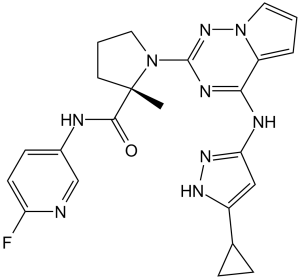
BMS-754807 (BMS754807) is an orally bioavailable small molecule inhibitor of IGF-1R/InsR (growth factor 1 receptor/insulin receptor family kinases) with potential antineoplastic activity. In cell-free assays, it inhibits IGF-1R/InsR with IC50s of 1.8 nM/1.7 nM. However, its potency against other kinases, including Met, PKA, Aurora A/B, Flt3, Lck, MK2, TrkA/B, Ron, and PKC, is lower. Excellent in vivo antitumor efficaciousness is demonstrated in nude mice with tumors of IGF-1R-Sal, GEO, Colo205, JJN3, RD1, or Rh41.
Physicochemical Properties
| Molecular Formula | C23H24FN9O | |
| Molecular Weight | 461.49 | |
| Exact Mass | 461.208 | |
| Elemental Analysis | C, 59.86; H, 5.24; F, 4.12; N, 27.32; O, 3.47 | |
| CAS # | 1001350-96-4 | |
| Related CAS # |
|
|
| PubChem CID | 24785538 | |
| Appearance | White to off-white solid powder | |
| Density | 1.6±0.1 g/cm3 | |
| Index of Refraction | 1.795 | |
| LogP | 1.76 | |
| Hydrogen Bond Donor Count | 3 | |
| Hydrogen Bond Acceptor Count | 8 | |
| Rotatable Bond Count | 6 | |
| Heavy Atom Count | 34 | |
| Complexity | 756 | |
| Defined Atom Stereocenter Count | 1 | |
| SMILES | FC1C([H])=C([H])C(=C([H])N=1)N([H])C([C@]1(C([H])([H])[H])C([H])([H])C([H])([H])C([H])([H])N1C1=NN2C([H])=C([H])C([H])=C2C(N([H])C2C([H])=C(C3([H])C([H])([H])C3([H])[H])N([H])N=2)=N1)=O |
|
| InChi Key | LQVXSNNAFNGRAH-QHCPKHFHSA-N | |
| InChi Code | InChI=1S/C23H24FN9O/c1-23(21(34)26-15-7-8-18(24)25-13-15)9-3-10-32(23)22-28-20(17-4-2-11-33(17)31-22)27-19-12-16(29-30-19)14-5-6-14/h2,4,7-8,11-14H,3,5-6,9-10H2,1H3,(H,26,34)(H2,27,28,29,30,31)/t23-/m0/s1 | |
| Chemical Name | (2S)-1-[4-[(5-cyclopropyl-1H-pyrazol-3-yl)amino]pyrrolo[2,1-f][1,2,4]triazin-2-yl]-N-(6-fluoropyridin-3-yl)-2-methylpyrrolidine-2-carboxamide | |
| Synonyms | BMS-754807; BMS 754807; BMS754807 | |
| HS Tariff Code | 2934.99.9001 | |
| Storage |
Powder-20°C 3 years 4°C 2 years In solvent -80°C 6 months -20°C 1 month |
|
| Shipping Condition | Room temperature (This product is stable at ambient temperature for a few days during ordinary shipping and time spent in Customs) |
Biological Activity
| Targets |
IR (IC50 = 1.7 nM); IGF-1R (IC50 = 1.8 nM); TrkB (IC50 = 4 nM); Met (IC50 = 6 nM); TrkA (IC50 = 7 nM); AurA (IC50 = 9 nM); AurB (IC50 = 25 nM); RON (IC50 = 44 nM) Insulin-like Growth Factor 1 Receptor (IGF-1R) (IC50 = 1.8 nM), Insulin Receptor (IR) (IC50 = 3.7 nM); no significant activity against other kinases (e.g., EGFR, VEGFR2, FGFR1) with IC50 > 100 nM [2] - Confirmed activity against IGF-1R and IR ( validated in cancer cell lines with activated IGF-1R signaling) [1] - Targets IGF-1R and IR (consistent with previous reports; no new IC50 data for pediatric cancer models) [3] |
| ln Vitro |
BMS-754807 efficiently suppresses the proliferation of numerous human tumor cell lines originating from various histologic origins, such as mesenchymal (Ewing's, rhabdomyosarcoma, neuroblastoma, and liposarcoma), epithelial (breast, lung, pancreatic, colon, and gastric), and hematopoietic (multiple myeloma and leukemia). The most sensitive cell lines have IC50 values ranging from 5 nM to 365 nM. With IC50 values of 7 nM and 5 nM, BMS-754807 suppresses the growth of RH41 cells and IGF-1R-Sal cells, respectively. BMS-754807 has an IC50 of 13 nM, 6 nM, and 21 nM, respectively, and inhibits the phosphorylation of IGF-1R in IGF-1R-Sal cells, Rh41, and Geo. BMS-754807 has an IC50 of 22 nM, 13 nM, and 16 nM, respectively, and inhibits the phosphorylation of Akt in Rh41, Geo, and IGF-1R-Sal cells. In Rh41 cells, BMS-754807 causes a 24-hour increase in apoptosis, as seen by a higher sub-G1 peak (23.1%) in contrast to the control (2.4%).[1] With an IC50 consistent with the antiproliferative IC50 (7 nM) in this cell line, BMS-754807 inhibits the phosphorylation of IGF-1R (IC50 = 13nM) and the downstream targets Akt (IC50 = 22nM) and MAPK (IC50 = 13nM) in the IGF-Sal cell line. The kinase domain of IGF-1R and BMS-754807 cocrystallized crystal structures reveal a donor/acceptor/donor hydrogen bond triad with Met1052 and Glu1050 located in the kinase's hinge region.[2] BMS-754807 exhibits a pediatric preclinical testing program (PPTP) median EC50 value of 0.62 μM against 23 cell lines.[3] Inhibited proliferation of multiple human cancer cell lines: Non-small cell lung cancer (A549, IC50 = 22 nM), breast cancer (MCF-7, IC50 = 18 nM), colorectal cancer (HCT116, IC50 = 25 nM); suppressed IGF-1-induced phosphorylation of IGF-1R (Tyr1135/1136) and downstream AKT (Ser473) in A549 cells (10 nM treatment for 2 hours) [1] - Showed potent activity against IGF-1R-dependent cell lines: Hepatocellular carcinoma (HepG2, IC50 = 15 nM), pancreatic cancer (PANC-1, IC50 = 19 nM); blocked IR phosphorylation in insulin-stimulated HepG2 cells (IC50 = 4.2 nM) [2] - Inhibited viability of pediatric cancer cell lines: Neuroblastoma (SH-SY5Y, IC50 = 28 nM), rhabdomyosarcoma (RD, IC50 = 31 nM); reduced IGF-1R-mediated STAT3 phosphorylation in SH-SY5Y cells (50 nM treatment for 4 hours) [3] |
| ln Vivo |
BMS-754807 (12.5 mg/kg, orally) prevents IGF-1R phosphorylation in tumor and serum in nude mice bearing IGF-1R-Sal tumors. A subset of xenograft tumor models with TGI ranging from 53% to 115% that include epithelial (IGF-1R-Sal, GEO, and Colo205), hematopoietic (JJN3), and mesenchymal (RD1 and Rh41) components show growth inhibition from BMS-754807.[1] With correlated inhibition of pIGF-1R and pAKT, BMS-754807 (6.25 mg/kg) completely inhibits the growth of tumors in the transgenic-derived IGF-Sal tumor mouse model. In mouse and human plasma, BMS-754807 binds to proteins with varying percentages (98.5% to 95.9%). Clearance values for BMS-754807 are 113 (mL/min)/kg, 20 (mL/min)/kg, 3.5 (mL/min)/kg, and 41 (mL/min)/kg.[2] BMS-754807 (25 mg/kg) significantly inhibits tumor in xenograft mice model of KT-5 (Wilms), KT-14 (rhabdoid), Rh28 (rhabdomyosarcoma), and OS-1.[3] In nude mice bearing A549 lung cancer xenografts: Oral administration of BMS-754807 (30 mg/kg/day) for 21 days resulted in 78% tumor growth inhibition (TGI); tumor IGF-1R phosphorylation was reduced by 65% (assessed by Western blot of tumor lysates) [1] - In nude mice bearing MCF-7 breast cancer xenografts: Intraperitoneal injection of BMS-754807 (20 mg/kg, twice daily) for 14 days caused 62% TGI; no significant tumor regression but reduced downstream AKT activation in tumors [2] - In NOD/SCID mice bearing SH-SY5Y neuroblastoma xenografts: Oral BMS-754807 (40 mg/kg/day) for 18 days led to 71% TGI; improved mouse survival (median survival extended from 28 days to 45 days) [3] |
| Enzyme Assay |
Utilizing recombinant human IGF-1 receptor enzyme in biochemical assays with synthetic peptide KKSRGDYMTMQIG as a phosphoacceptor substrate, an in vitro kinase assay serves as the main screening method for BMS-754807. Multiple recombinant enzymes that are produced at BMS or acquired externally are used to assess the selectivity profile. Utilizing a 30 μL reaction volume in assay buffer (100 mM Hepes pH 7.4, 10 mM MgCl2, 0.015% Brij35, and 4 mM DTT), the enzymatic assays are carried out in Ubottom 384-well plates. The enzyme, BMS-754807, 1.5 μM fluorescein-labeled peptide substrate, and ATP (concentration equal to Km ATP) are combined to start the 60-minute reactions. With the use of EDTA, the reactions are stopped. The fluorescent substrate and phosphorylated product are separated electrophoretically and used to analyze the reaction mixtures on the Caliper LabChip 3000. For 100% inhibition, inhibition data are computed in relation to enzyme-free control reactions, and for 0% inhibition, vehicle-only reactions are used. Dimethylsulfoxide (DMSO, 10 mM stock) is used to dissolve the compounds, and eleven concentrations are tested. The dose response curves are analyzed using non-linear regression to determine the IC50 values. IGF-1R kinase activity assay: Recombinant human IGF-1R kinase domain was incubated with ATP (5 μM) and a biotinylated peptide substrate in reaction buffer (25 mM HEPES, pH 7.4, 10 mM MgCl2, 1 mM DTT) at 30°C for 45 minutes. BMS-754807 was added at serial concentrations (0.1 nM to 100 nM) before reaction initiation. Phosphorylated peptide was detected using streptavidin-conjugated horseradish peroxidase and a chemiluminescent substrate; IC50 values were calculated via dose-response curve fitting [2] - IR kinase activity assay: Recombinant human IR kinase domain was used in the same reaction system as IGF-1R, with ATP concentration adjusted to 10 μM; incubation time was extended to 60 minutes. Detection method and IC50 calculation were identical to the IGF-1R assay [2] |
| Cell Assay |
The ideal growth medium for cells is RPMI +GlutaMax supplemented with 10% heat-inactivated fetal bovine serum (FBS), 10 mM Hepes, penicillin, and streptomycin. Following a 72-hour exposure of cells to BMS-754807, the incorporation of 3 H-thymidine into DNA is used to assess the proliferation of the cells. The drug concentration needed to suppress cell proliferation by 50% in comparison to untreated control cells is known as the inhibitory concentration (IC50), and this is how results are expressed. Cell proliferation assay (A549/MCF-7/HCT116): Cells were seeded in 96-well plates (4×10³ cells/well) and incubated with serial concentrations of BMS-754807 (0.1 nM to 1 μM) for 72 hours. Cell viability was measured using a tetrazolium-based colorimetric assay; absorbance was read at 490 nm, and IC50 values were determined via nonlinear regression [1] - Western blot assay (IGF-1R/AKT/STAT3): Treated cells were lysed in RIPA buffer (supplemented with protease and phosphatase inhibitors). Lysates (30 μg protein per lane) were separated by 10% SDS-PAGE and transferred to PVDF membranes. Membranes were probed with primary antibodies against p-IGF-1R (Tyr1135/1136), total IGF-1R, p-AKT (Ser473), total AKT, p-STAT3 (Tyr705), total STAT3, and GAPDH (loading control). Secondary antibodies conjugated to infrared dyes were used, and signals were detected via an infrared imaging system [1][3] - Pediatric cancer cell viability assay (SH-SY5Y/RD): Cells were seeded at 5×10³ cells/well in 96-well plates and treated with BMS-754807 (1 nM to 500 nM) for 96 hours. Viability was assessed using a fluorometric assay (based on caspase 3/7 activity for apoptosis and ATP content for proliferation), and IC50 values were calculated [3] |
| Animal Protocol |
Each animal is given a subcutaneous implant of a tumor fragment (approximately 20 mg) using a 13-gauge trocar once the necessary number of animals are gathered at the beginning of the experiment in order to detect a meaningful response. The size of tumors is allowed to grow up to 200 mg, and tumors larger than this range are removed. Animals are divided equally into treatment and control groups. Generally, eight mice are included in each treatment group and control group.However, experiments carried out using the Sal-IGF (also known as IGF-1R-Sal) tumor model typically involve five mice per treatment group and control group. Each animal's care is determined by its unique body weight. Every day, treated animals are examined for treatment-related toxicity and mortality. Weighing is done on each group of animals both prior to the start of treatment (Wt1) and after the final dose of treatment (Wt2). Treatment-related toxicity is measured by the difference in body weight (Wt2 − Wt1). A549 xenograft model (nude mice): 6-8 week-old female nude mice were subcutaneously injected with 2×10⁶ A549 cells. When tumors reached 100-150 mm³, mice were randomized into vehicle (10% DMSO + 40% PEG400 + 50% normal saline) or BMS-754807 groups (30 mg/kg/day, oral gavage). Treatments were administered once daily for 21 days; tumor volume (measured by calipers: volume = length × width² / 2) and body weight were recorded every 3 days [1] - MCF-7 xenograft model (nude mice): Female nude mice were implanted with 5×10⁶ MCF-7 cells (mixed with Matrigel) subcutaneously. When tumors reached 80-100 mm³, mice received BMS-754807 (20 mg/kg, intraperitoneal injection) twice daily for 14 days. Drug was dissolved in 5% DMSO + 95% sesame oil; tumor volume and body weight were monitored every 2 days [2] - SH-SY5Y xenograft model (NOD/SCID mice): 7-9 week-old male NOD/SCID mice were subcutaneously injected with 1×10⁷ SH-SY5Y cells. When tumors reached 120-140 mm³, mice were given BMS-754807 (40 mg/kg/day, oral gavage) for 18 days. Drug was dissolved in 0.5% methylcellulose + 0.2% Tween 80; survival time was recorded in addition to tumor volume and body weight [3] |
| ADME/Pharmacokinetics |
In mice: Oral bioavailability of BMS-754807 was 38% (20 mg/kg dose); plasma half-life (t1/2) was 4.1 hours; maximum plasma concentration (Cmax) was 2.3 μM at 1.5 hours post-oral administration [2] - In rats: Intravenous administration (5 mg/kg) showed a clearance rate of 12 mL/min/kg; volume of distribution at steady state (Vss) was 0.8 L/kg [2] |
| Toxicity/Toxicokinetics |
In 21-day A549 xenograft study (30 mg/kg/day, oral): No significant weight loss (>8%) or mortality; serum levels of ALT (liver marker) and BUN (kidney marker) were within normal ranges [1] - In 14-day MCF-7 xenograft study (20 mg/kg, twice daily, intraperitoneal): Transient mild diarrhea (observed in 2/6 mice) on days 5-7; no histopathological changes in liver, kidney, or spleen [2] - In 18-day SH-SY5Y xenograft study (40 mg/kg/day, oral): No severe toxicity; 3/8 mice showed mild hair loss, which reversed after treatment cessation [3] - Plasma protein binding: >99% binding to human plasma proteins (measured via ultrafiltration method) [2] |
| References |
[1]. Mol Cancer Ther . 2009 Dec;8(12):3341-9. [2]. J Med Chem . 2009 Dec 10;52(23):7360-3. [3]. Pediatr Blood Cancer . 2011 Apr;56(4):595-603. |
| Additional Infomation |
BMS-754807 is a pyrrolotriazine that is pyrrolo[2,1-f][1,2,4]triazine which is substituted at position 2 by the pyrrolidine nitrogen of (2S)-N-(6-fluoropyridin-3-yl)-2-methylprolinamide, and at position 4 by a (5-cyclopropyl-1H-pyrazol-3-yl)amino group. It is a potent, reversible inhibitor of the insulin-like growth factor 1 receptor/insulin receptor family kinases. It has a role as an EC 2.7.10.1 (receptor protein-tyrosine kinase) inhibitor and an antineoplastic agent. It is a pyrrolotriazine, a member of pyrazoles, a member of pyridines and a member of pyrrolidines. BMS-754807 is under investigation in clinical trial NCT00908024 (Combination Study of BMS-754807 and Erbitux® in Subjects With Advanced or Metastatic Solid Tumors). Dual IGF-1R/InsR Inhibitor BMS-754807 is an oral small molecule inhibitor of insulin-like growth factor 1 receptor (IGF-1R) and insulin receptor (InsR) tyrosine kinases with potential antineoplastic activity. Dual IGF-IR/InsR inhibitor BMS-754807 binds reversibly to and inhibits the activities of IGF-1R and InsR, which may result in the inhibition of tumor cell proliferation and the induction of tumor cell apoptosis. IGF-1R and InsR tyrosine kinases, overexpressed in a variety of human cancers, play significant roles in mitogenesis, angiogenesis, and tumor cell survival. BMS-754807 was developed as a dual IGF-1R/IR inhibitor via structure-based optimization, designed to block the IGF signaling pathway frequently activated in solid tumors [2] - In non-small cell lung cancer models, BMS-754807 showed synergistic activity with paclitaxel [1] - BMS-754807 demonstrated potential for treating pediatric solid tumors (neuroblastoma, rhabdomyosarcoma) by targeting IGF-1R overexpressed in these cancers [3] |
Solubility Data
| Solubility (In Vitro) |
|
|||
| Solubility (In Vivo) |
Solubility in Formulation 1: 2.5 mg/mL (5.42 mM) in 10% DMSO + 90% (20% SBE-β-CD in Saline) (add these co-solvents sequentially from left to right, and one by one), suspension solution; with sonication. For example, if 1 mL of working solution is to be prepared, you can add 100 μL of 25.0 mg/mL clear DMSO stock solution to 900 μL of 20% SBE-β-CD physiological saline solution and mix evenly. Preparation of 20% SBE-β-CD in Saline (4°C,1 week): Dissolve 2 g SBE-β-CD in 10 mL saline to obtain a clear solution. Solubility in Formulation 2: ≥ 2.08 mg/mL (4.51 mM) (saturation unknown) in 10% DMSO + 40% PEG300 + 5% Tween80 + 45% Saline (add these co-solvents sequentially from left to right, and one by one), clear solution. For example, if 1 mL of working solution is to be prepared, you can add 100 μL of 20.8 mg/mL clear DMSO stock solution to 400 μL PEG300 and mix evenly; then add 50 μL Tween-80 to the above solution and mix evenly; then add 450 μL normal saline to adjust the volume to 1 mL. Preparation of saline: Dissolve 0.9 g of sodium chloride in 100 mL ddH₂ O to obtain a clear solution. Solubility in Formulation 3: ≥ 2.08 mg/mL (4.51 mM) (saturation unknown) in 10% DMSO + 90% Corn Oil (add these co-solvents sequentially from left to right, and one by one), clear solution. For example, if 1 mL of working solution is to be prepared, you can add 100 μL of 20.8 mg/mL clear DMSO stock solution to 900 μL of corn oil and mix evenly. Solubility in Formulation 4: 2% DMSO+30% PEG 300+ddH2O: 5 mg/mL (Please use freshly prepared in vivo formulations for optimal results.) |
| Preparing Stock Solutions | 1 mg | 5 mg | 10 mg | |
| 1 mM | 2.1669 mL | 10.8345 mL | 21.6689 mL | |
| 5 mM | 0.4334 mL | 2.1669 mL | 4.3338 mL | |
| 10 mM | 0.2167 mL | 1.0834 mL | 2.1669 mL |