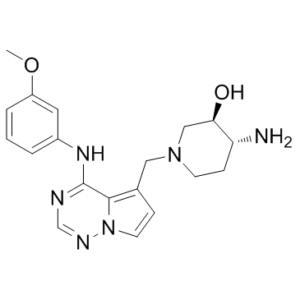
BMS-690514 is a novel, potent and orally bioavailable inhibitor of EGFR [human epidermal growth factor receptor (HER) 1] and VEGFR (vascular endothelial growth factor receptors) with IC50s of 5, 20 and 60 nM for EGFR, HER 2 and HER 4, respectively. In order to treat solid tumors, BMS-690514 is presently being studied as an oral medication. To describe the pharmacokinetics and metabolism, research was done both in vitro and in vivo. BMS-690514's human pharmacokinetics and effective doses were estimated by combining in vitro and in vivo pharmacokinetic data with antitumor efficacy in nude mice research. In rats, BMS-690514 had an oral bioavailability of 78%, in mice it was approximately 100%, in monkeys it was 8%, and in dogs it was 29%. The high systemic clearance in monkeys, which was also in line with the clearance predicted by using in vitro data from monkey liver microsomes, may be the cause of the low oral bioavailability in that species. The preclinical ADME characteristics of BMS-690514 point to a high oral bioavailability in humans and a variety of metabolic pathways, such as glucuronidation and oxidation.
Physicochemical Properties
| Molecular Formula | C19H24N6O2 |
| Molecular Weight | 368.43 |
| Exact Mass | 368.196 |
| Elemental Analysis | C, 61.94; H, 6.57; N, 22.81; O, 8.69 |
| CAS # | 859853-30-8 |
| Related CAS # | 859853-30-8 |
| PubChem CID | 11349170 |
| Appearance | White to off-white solid powder |
| Density | 1.4±0.1 g/cm3 |
| Index of Refraction | 1.705 |
| LogP | -0.52 |
| Hydrogen Bond Donor Count | 3 |
| Hydrogen Bond Acceptor Count | 7 |
| Rotatable Bond Count | 5 |
| Heavy Atom Count | 27 |
| Complexity | 483 |
| Defined Atom Stereocenter Count | 2 |
| SMILES | C(N1CC[C@@H](N)[C@H](O)C1)C1C=CN2C=1C(=NC=N2)NC1C=CC=C(OC)C=1 |
| InChi Key | CSGQVNMSRKWUSH-IAGOWNOFSA-N |
| InChi Code | InChI=1S/C19H24N6O2/c1-27-15-4-2-3-14(9-15)23-19-18-13(5-8-25(18)22-12-21-19)10-24-7-6-16(20)17(26)11-24/h2-5,8-9,12,16-17,26H,6-7,10-11,20H2,1H3,(H,21,22,23)/t16-,17-/m1/s1 |
| Chemical Name | (3R,4R)-4-amino-1-[[4-(3-methoxyanilino)pyrrolo[2,1-f][1,2,4]triazin-5-yl]methyl]piperidin-3-ol |
| Synonyms | BMS690514; BMS 690514; BMS-690514 |
| HS Tariff Code | 2934.99.9001 |
| Storage |
Powder-20°C 3 years 4°C 2 years In solvent -80°C 6 months -20°C 1 month |
| Shipping Condition | Room temperature (This product is stable at ambient temperature for a few days during ordinary shipping and time spent in Customs) |
Biological Activity
| Targets | EGFR (IC50 = 5 nM); HER2 (IC50 = 20 nM); HER4 (IC50 = 60 nM) |
| ln Vitro | Human involvement of growth factor receptor (HER)/ErbB, angiogenic signaling through VEGFR2, lymphangiogenesis through VEGFR3, and it has also been demonstrated to target VEGFR1, Flt-3, and Lck are among the major signal traps that are controlled by BMS-690514. -690514 has a moderate potential to be a P-gp substrate and a moderate range of permeability in Caco-2 cells [2]. Members of the VEGFR family are inhibited by BMS-690514, with IC50 values ranging from 25 to 50 nM. BMS-690514 inhibits the proliferation of Exon 19 exported NSCLC cancers (HCC4006, HCC827, and PC9) with IC50 values ranging from 2 to 35 nM. These tumors are particularly susceptible to this drug. Additionally, EGFR-positive tumor cell lines (DiFi, NCI-H2073, A431) exhibit strong susceptibility to BMS-690514. It was also shown that tumor cell lines that depend on HER2 signaling are extremely sensitive to BMS-690514. BMS-690514 exhibits a significant degree of HER2 gene sensitivity. With IC50 values ranging from 20 to 60 nM, BMS-690514 has an impact on the breast and adenocarcinoma cell lines N87, SNU-216, AU565, BT474, KPL4, and HCC202 [1]. |
| ln Vivo | It has been demonstrated that BMS-690514 works well in a variety of xenogeneic tumor transplants. In animal models, BMS-690514 effectively and well-tolerated suppresses tumor cell proliferation and tumor blood flow [1]. It has been found that BMS-690514 has a borderline bioavailability of 78% in mice, 100% in specific gravity, 8% in monkeys, and 29% in dogs. The blood-brain barrier can be crossed by BMS-690514 at a ratio of one brain width. Preclinical ADME characteristics of -690514 show good human wound bioavailability and support oxidative and formaldehyde pathways, among other routes [2]. |
| Animal Protocol |
Rats: Male Sprague-Dawley rats receive BMS-690514 orally by gavage (10 mg/kg) or intraarterially (IA) for 10 minutes. The vehicles used for dosing are PO, PEG400/10mM acetate buffer (pH 5.0, 2 mL/kg) (10:90) and IA, 10mM acetate buffer (pH 5.0, 1 mL/kg). Predose, at 0.17 (or 0.25 for PO), 0.5, 0.75, 1, 2, 4, 6, 8, 12, and 24 hours after the dose are the times at which serial plasma samples are taken. Rats are given an overnight fast and fed four hours after the dose. In a 2-week toxicology study, the brain uptake of BMS-690514 (3, 10, and 30 mg/kg/day) is examined following the final dosage. Three volumes of ice-cooled water are used to weigh and homogenize brain samples. LC/MS/MS is used to determine the concentrations of BMS-690514 in brain homogenates and plasma[2]. Mice: Male balb-c mice are used to study the pharmacokinetics of BMS-690514. 18 mice in total are split into two groups and given either a single IV bolus dose of 1 mg/kg or an oral gavage dose of 5 mg/kg of BMS-690514. The vehicle used is Tween-80/PG/water (10:40:50) for both IV (0.1 mL/mouse) and PO (0.2 mL/mouse) doses. Blood levels of BMS-690514 are assessed at 0.05 (or 0.25 in the case of PO), 0.5, 1, 3, 6, 8, and 24 hours after the dosage. The mice are given their dose six hours after fasting through the night. Each mouse has three blood samples obtained through retro-orbital bleeding, with three mice per time point. For each of the three mice, only one sample is collected at the 24-hour mark. For pharmacokinetic analysis, composite serum concentration–time profiles are created[2]. |
| References |
[1]. Antitumor and antiangiogenic activities of BMS-690514, an inhibitor of human EGF and VEGF receptor kinase families. Clin Cancer Res. 2011 Jun 15;17(12):4031-41. [2]. Preclinical pharmacokinetics and in vitro metabolism of BMS-690514, a potent inhibitor of EGFR and VEGFR2. J Pharm Sci. 2010 Aug;99(8):3579-93. |
| Additional Infomation |
BMS-690514 has been investigated for the treatment of Breast Cancer. Pan HER/VEGFR2 Receptor Tyrosine Kinase Inhibitor BMS-690514 is a pyrrolotriazine-based compound and a pan inhibitor of receptor tyrosine kinases with potential antineoplastic activity. Pan HER/VEGFR2 receptor tyrosine kinase inhibitor BMS-690514 binds to human epidermal growth factor receptors (EGFR) 1, 2 and 4 (HER1, HER2 and HER4) and vascular endothelial growth factor receptor 1, 2 and 3 (VEGFR-1, -2 and -3), all of which are frequently overexpressed by a variety of tumor types. Binding of this agent to these receptors may result in the inhibition of tumor cell proliferation; the inhibition of endothelial cell migration and proliferation and angiogenesis; and tumor cell death. |
Solubility Data
| Solubility (In Vitro) | DMSO: ≥ 25 mg/mL (~67.9 mM) |
| Solubility (In Vivo) |
Solubility in Formulation 1: ≥ 2.5 mg/mL (6.79 mM) (saturation unknown) in 10% DMSO + 40% PEG300 + 5% Tween80 + 45% Saline (add these co-solvents sequentially from left to right, and one by one), clear solution. For example, if 1 mL of working solution is to be prepared, you can add 100 μL of 25.0 mg/mL clear DMSO stock solution to 400 μL PEG300 and mix evenly; then add 50 μL Tween-80 to the above solution and mix evenly; then add 450 μL normal saline to adjust the volume to 1 mL. Preparation of saline: Dissolve 0.9 g of sodium chloride in 100 mL ddH₂ O to obtain a clear solution. Solubility in Formulation 2: ≥ 2.5 mg/mL (6.79 mM) (saturation unknown) in 10% DMSO + 90% (20% SBE-β-CD in Saline) (add these co-solvents sequentially from left to right, and one by one), clear solution. For example, if 1 mL of working solution is to be prepared, you can add 100 μL of 25.0 mg/mL clear DMSO stock solution to 900 μL of 20% SBE-β-CD physiological saline solution and mix evenly. Preparation of 20% SBE-β-CD in Saline (4°C,1 week): Dissolve 2 g SBE-β-CD in 10 mL saline to obtain a clear solution. Solubility in Formulation 3: ≥ 2.5 mg/mL (6.79 mM) (saturation unknown) in 10% DMSO + 90% Corn Oil (add these co-solvents sequentially from left to right, and one by one), clear solution. For example, if 1 mL of working solution is to be prepared, you can add 100 μL of 25.0 mg/mL clear DMSO stock solution to 900 μL of corn oil and mix evenly. (Please use freshly prepared in vivo formulations for optimal results.) |
| Preparing Stock Solutions | 1 mg | 5 mg | 10 mg | |
| 1 mM | 2.7142 mL | 13.5711 mL | 27.1422 mL | |
| 5 mM | 0.5428 mL | 2.7142 mL | 5.4284 mL | |
| 10 mM | 0.2714 mL | 1.3571 mL | 2.7142 mL |