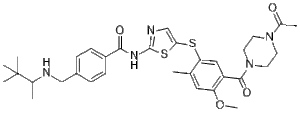
BMS-509744 (BMS509744) is a novel, potent and selective inhibitor of interleukin-2 inducible T cell kinase (ITK) with the potential for immunosuppressive and inflammatory diseases. Its IC50 of 19 nM indicates that it inhibits ITK. It exhibits selectivity over Tec family kinases by 200-fold and selectivity over other tested kinases by 55-fold. BMS-509744 inhibits the spread of HIV infection in vitro and lowers HIV infection of primary CD4+ T cells. In vitro, BMS-509744 also decreases the generation of IL-2 and T cell proliferation.
Physicochemical Properties
| Molecular Formula | C32H41N5O4S2 |
| Molecular Weight | 623.82904 |
| Exact Mass | 623.26 |
| Elemental Analysis | C, 61.61; H, 6.62; N, 11.23; O, 10.26; S, 10.28 |
| CAS # | 439575-02-7 |
| Related CAS # | 439575-02-7 |
| PubChem CID | 11467730 |
| Appearance | White to light yellow solid powder |
| Density | 1.3±0.1 g/cm3 |
| Index of Refraction | 1.635 |
| LogP | 4.55 |
| Hydrogen Bond Donor Count | 2 |
| Hydrogen Bond Acceptor Count | 8 |
| Rotatable Bond Count | 10 |
| Heavy Atom Count | 43 |
| Complexity | 949 |
| Defined Atom Stereocenter Count | 0 |
| SMILES | CC(C(C)(C)C)NCC1=CC=C(C(NC2=NC=C(SC3=CC(C(N4CCN(C(C)=O)CC4)=O)=C(OC)C=C3C)S2)=O)C=C1 |
| InChi Key | ZHXNIYGJAOPMSO-UHFFFAOYSA-N |
| InChi Code | InChI=1S/C32H41N5O4S2/c1-20-16-26(41-7)25(30(40)37-14-12-36(13-15-37)22(3)38)17-27(20)42-28-19-34-31(43-28)35-29(39)24-10-8-23(9-11-24)18-33-21(2)32(4,5)6/h8-11,16-17,19,21,33H,12-15,18H2,1-7H3,(H,34,35,39) |
| Chemical Name | N-[5-[5-(4-acetylpiperazine-1-carbonyl)-4-methoxy-2-methylphenyl]sulfanyl-1,3-thiazol-2-yl]-4-[(3,3-dimethylbutan-2-ylamino)methyl]benzamide |
| Synonyms | CHEMBL209148; BMS509744; BMS-509744; BMS 509744 |
| HS Tariff Code | 2934.99.9001 |
| Storage |
Powder-20°C 3 years 4°C 2 years In solvent -80°C 6 months -20°C 1 month |
| Shipping Condition | Room temperature (This product is stable at ambient temperature for a few days during ordinary shipping and time spent in Customs) |
Biological Activity
| Targets |
Itk (IC50 = 19 nM)
BMS-509744 targets interleukin-2-inducible T-cell kinase (Itk) (recombinant human Itk: IC50 = 16 nM for kinase activity inhibition [1] ; >60-fold selectivity over Btk (Tec family kinase, IC50 = 1000 nM) [1] ; no significant inhibition of Src family kinases (Lck: IC50 > 1000 nM, Zap70: IC50 > 1000 nM, Syk: IC50 > 1000 nM) [1] ) |
| ln Vitro |
BMS-509744 inhibits T-cell receptor-induced processes in vitro in both human and mouse cells, such as PLCγ1 tyrosine phosphorylation, calcium mobilization, IL-2 secretion, and T-cell proliferation. BMS-488516 and BMS-509744, with IC50 values of 19 and 96 nM, respectively, potently inhibit Itk in vitro. According to their competitive ATP-binding kinetics, both substances bind to the Itk kinase domain's ATP binding site[1]. 1. BMS-509744 potently inhibited recombinant human Itk kinase activity with an IC50 of 16 nM in a peptide-based phosphorylation assay; it exhibited >60-fold selectivity for Itk over Btk (IC50 = 1000 nM) and no detectable inhibition of Lck, Zap70, or Syk at concentrations up to 10 μM [1] 2. In primary human CD4+ T cells, BMS-509744 (10-1000 nM) dose-dependently suppressed CD3/CD28-induced T-cell proliferation with an IC50 of 82 nM, as measured by [³H]thymidine incorporation assay [1] 3. The compound (100 nM) reduced CD3/CD28-induced production of pro-inflammatory cytokines in human T cells by 70% (IL-2), 65% (IFN-γ), and 55% (TNF-α), as quantified by sandwich ELISA [1] 4. Western blot analysis in Jurkat T cells showed that BMS-509744 (100 nM) blocked Itk-mediated phosphorylation of PLCγ1 (Tyr783) by 80% within 5 minutes of CD3 stimulation, and inhibited downstream activation of ERK1/2 (45%) and JNK (50%) at 15 minutes post-stimulation [1] 5. BMS-509744 (1-10 μM) had no cytotoxicity in primary human T cells or Jurkat T cells, with cell viability >95% after 72-hour treatment (trypan blue exclusion assay) [1] |
| ln Vivo |
BMS-509744 and BMS-488516 inhibit the IL-2 production that is brought about by giving mice anti-T-cell receptor antibodies. BMS-509744, regardless of the quantity of induction antibody, demonstrates a 50% inhibitory capacity at 50 mg/kg. In a mouse model of ovalbumin-induced allergy/asthma, BMS-509744 also significantly reduces lung inflammation[1]. 1. In ovalbumin (OVA)-induced murine allergic lung inflammation model, oral administration of BMS-509744 (3, 10, 30 mg/kg once daily for 7 days) dose-dependently reduced airway hyperresponsiveness (AHR) to methacholine by 30%, 55%, and 75% respectively, as assessed by whole-body plethysmography (enhanced pause, Penh values) [1] 2. BMS-509744 (10 mg/kg PO) decreased the total number of inflammatory cells in bronchoalveolar lavage fluid (BALF) by 60%, with specific reductions of 70% (eosinophils), 50% (neutrophils), and 45% (lymphocytes) [1] 3. The 30 mg/kg oral dose of BMS-509744 reduced OVA-induced Th2 cytokine levels in BALF by 70% (IL-4), 65% (IL-5), and 60% (IL-13), and decreased lung tissue eotaxin-1 expression by 55% (qPCR analysis) [1] 4. Histopathological examination of lung tissues revealed that BMS-509744 (10 mg/kg PO) reduced peribronchial/perivascular inflammation by 65% and mucus hypersecretion (PAS staining) by 50% compared to vehicle controls [1] |
| Enzyme Assay |
Kinase tests are used to calculate the BMS-509744 activity (IC50). The kinase reactions are carried out with 10 ng of enzyme for 10 min in the presence of 10 μM GST-SLP-76 and different ATP concentrations. The amounts of BMS-509744 1. Recombinant human Itk kinase activity assay: Purified recombinant human Itk catalytic domain protein was incubated with a biotinylated PLCγ1-derived peptide substrate, [γ-³²P]ATP (10 μM), and serial dilutions of BMS-509744 (0.001-10 μM) in kinase buffer (25 mM Tris-HCl, 10 mM MgCl2, 1 mM DTT, pH 7.5) at 30°C for 30 minutes; the reaction was terminated with 50 mM EDTA, and phosphorylated peptides were captured on streptavidin-coated filters and washed thoroughly; radioactivity of the bound fraction was measured by liquid scintillation counting, and IC50 values for Itk inhibition were calculated from dose-response curves [1] 2. Tec family kinase selectivity assay: Recombinant human Btk, Txk, and Rlk proteins were incubated with their respective peptide substrates, [γ-³²P]ATP, and BMS-509744 (0.01-10 μM) under the same conditions as the Itk assay; kinase activity was quantified by liquid scintillation counting to determine IC50 values and calculate selectivity ratios relative to Itk [1] 3. Src family kinase inhibition assay: Recombinant human Lck and Zap70 proteins were incubated with peptide substrates, [γ-³²P]ATP, and BMS-509744 (0.1-10 μM) in kinase buffer at 30°C for 30 minutes; phosphorylated products were detected and quantified to evaluate off-target inhibition of Src family kinases [1] |
| Cell Assay |
1. Primary human T-cell proliferation assay: CD4+ T cells were purified from peripheral blood mononuclear cells (PBMCs) of healthy donors by negative selection; cells were seeded in 96-well plates at 2×10⁵ cells/well and stimulated with anti-CD3 (1 μg/mL) and anti-CD28 (0.5 μg/mL) antibodies in the presence of BMS-509744 (0.01-10 μM); after 72 hours of incubation at 37°C with 5% CO₂, [³H]thymidine (1 μCi/well) was added for the final 18 hours; cells were harvested, and radioactivity was measured by liquid scintillation counting to calculate proliferation inhibition rates and IC50 values [1] 2. Cytokine production ELISA assay: Purified human CD4+ T cells were stimulated with anti-CD3/CD28 in the presence of BMS-509744 (10-1000 nM) for 48 hours; cell culture supernatants were collected, and concentrations of IL-2, IFN-γ, and TNF-α were measured by sandwich ELISA; cytokine levels were normalized to vehicle-treated controls to determine inhibition percentages [1] 3. Itk signaling western blot assay: Jurkat T cells were seeded in 6-well plates at 1×10⁶ cells/well and pretreated with BMS-509744 (10-1000 nM) for 30 minutes at 37°C; cells were then stimulated with anti-CD3 (1 μg/mL) for 5, 15, and 30 minutes; whole-cell lysates were prepared, separated by SDS-PAGE, and probed with antibodies against phospho-Itk (Tyr511), phospho-PLCγ1 (Tyr783), phospho-ERK1/2 (Thr202/Tyr204), phospho-JNK (Thr183/Tyr185), and total actin (loading control); band intensities were quantified by densitometry to assess the inhibition of TCR signaling pathways [1] 4. Cell viability trypan blue assay: Jurkat T cells and primary human CD4+ T cells were treated with BMS-509744 (1-10 μM) for 72 hours at 37°C; cells were stained with trypan blue, and viable (trypan blue-negative) cells were counted using a hemocytometer; cell viability was calculated as the percentage of viable cells relative to the total cell count [1] |
| Animal Protocol |
Mice: The BMS-509744 and BMS-488516 compounds, or the vehicle (H2O:ethanol:Tween 80) 90:5:5, are injected subcutaneously into Balb/c mice 15 minutes prior to the intravenous injection of anti-CD3 antibody. Ninety minutes after the anti-CD3 antibody is administered, serum is taken for IL-2 and compound levels. Mass spectrometry is used to measure compound levels, and ELISA is used to measure IL-2[1]. 1. Ovalbumin (OVA)-induced murine allergic lung inflammation model: Female BALB/c mice (6-8 weeks old) were sensitized by intraperitoneal injection of OVA (10 μg) adsorbed to aluminum hydroxide (2 mg) on days 0 and 7; from days 14 to 20, mice were challenged with aerosolized OVA (1% in saline) for 30 minutes daily; BMS-509744 was formulated in 0.5% methylcellulose + 0.1% Tween 80 and administered orally via gavage at 3, 10, or 30 mg/kg (volume: 10 mL/kg) 1 hour before each OVA challenge; control mice received the vehicle formulation alone [1] 2. Airway hyperresponsiveness (AHR) measurement: On day 21, mice were anesthetized with pentobarbital, and airway resistance was measured in response to increasing concentrations of methacholine (0, 3.125, 6.25, 12.5, 25 mg/mL) using whole-body plethysmography; enhanced pause (Penh) values were recorded as an indicator of AHR, and the area under the curve (AUC) of Penh values was calculated for each treatment group [1] 3. Bronchoalveolar lavage fluid (BALF) analysis: Mice were euthanized on day 21, and BALF was collected by instilling and aspirating PBS (0.5 mL) into the trachea three times; total inflammatory cells were counted with a hemocytometer, and differential cell counts (eosinophils, neutrophils, lymphocytes, macrophages) were performed on Wright-Giemsa-stained cytospin preparations; BALF supernatants were analyzed for IL-4, IL-5, IL-13, and eotaxin-1 by ELISA [1] 4. Lung tissue histopathology: Lungs were excised, fixed in 10% formalin, embedded in paraffin, and sectioned into 5 μm slices; sections were stained with hematoxylin and eosin (H&E) to evaluate peribronchial and perivascular inflammation, and with periodic acid-Schiff (PAS) to assess mucus production; slides were scored blindly by a pathologist on a 0-4 scale for inflammation severity and mucus hypersecretion [1] |
| Toxicity/Toxicokinetics |
1. BMS-509744 showed no cytotoxicity in primary human T cells or Jurkat T cells at concentrations up to 10 μM, with cell viability >95% after 72-hour treatment [1] 2. In BALB/c mice treated with BMS-509744 (30 mg/kg PO daily for 7 days), no significant changes in body weight, food intake, or clinical signs of toxicity (e.g., lethargy, ruffled fur) were observed [1] |
| References |
[1]. Selective Itk inhibitors block T-cell activation and murine lung inflammation. Biochemistry.?2004 Aug 31;43(34):11056-62. |
| Additional Infomation |
N-[5-[[5-[(4-acetyl-1-piperazinyl)-oxomethyl]-4-methoxy-2-methylphenyl]thio]-2-thiazolyl]-4-[(3,3-dimethylbutan-2-ylamino)methyl]benzamide is a member of benzamides. 1. BMS-509744 is a potent and selective small-molecule inhibitor of Itk, a Tec family kinase that plays a critical role in T-cell receptor (TCR) signaling and Th2 cell differentiation [1] 2. The mechanism of action of BMS-509744 involves competitive binding to the ATP-binding pocket of Itk, which inhibits its kinase activity and blocks downstream TCR signaling events (including PLCγ1 phosphorylation and MAPK pathway activation), thereby suppressing T-cell proliferation and pro-inflammatory cytokine production [1] 3. BMS-509744 exhibits efficacy in a murine model of allergic lung inflammation, indicating its potential therapeutic application in Th2-mediated inflammatory diseases such as asthma and allergic rhinitis [1] |
Solubility Data
| Solubility (In Vitro) | DMSO: ~21.9 mg/mL (~35.1 mM) |
| Solubility (In Vivo) |
Solubility in Formulation 1: ≥ 2.5 mg/mL (4.01 mM) (saturation unknown) in 10% DMSO + 40% PEG300 + 5% Tween80 + 45% Saline (add these co-solvents sequentially from left to right, and one by one), clear solution. For example, if 1 mL of working solution is to be prepared, you can add 100 μL of 25.0 mg/mL clear DMSO stock solution to 400 μL PEG300 and mix evenly; then add 50 μL Tween-80 to the above solution and mix evenly; then add 450 μL normal saline to adjust the volume to 1 mL. Preparation of saline: Dissolve 0.9 g of sodium chloride in 100 mL ddH₂ O to obtain a clear solution. Solubility in Formulation 2: ≥ 2.5 mg/mL (4.01 mM) (saturation unknown) in 10% DMSO + 90% (20% SBE-β-CD in Saline) (add these co-solvents sequentially from left to right, and one by one), clear solution. For example, if 1 mL of working solution is to be prepared, you can add 100 μL of 25.0 mg/mL clear DMSO stock solution to 900 μL of 20% SBE-β-CD physiological saline solution and mix evenly. Preparation of 20% SBE-β-CD in Saline (4°C,1 week): Dissolve 2 g SBE-β-CD in 10 mL saline to obtain a clear solution. (Please use freshly prepared in vivo formulations for optimal results.) |
| Preparing Stock Solutions | 1 mg | 5 mg | 10 mg | |
| 1 mM | 1.6030 mL | 8.0150 mL | 16.0300 mL | |
| 5 mM | 0.3206 mL | 1.6030 mL | 3.2060 mL | |
| 10 mM | 0.1603 mL | 0.8015 mL | 1.6030 mL |