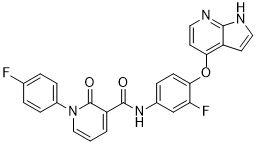
Physicochemical Properties
| Molecular Formula | C25H16F2N4O3 |
| Molecular Weight | 458.42 |
| Exact Mass | 458.119 |
| Elemental Analysis | C, 65.50; H, 3.52; F, 8.29; N, 12.22; O, 10.47 |
| CAS # | 888719-03-7 |
| Related CAS # | 888719-03-7 |
| PubChem CID | 21081761 |
| Appearance | Off-white to light yellow solid powder |
| Density | 1.5±0.1 g/cm3 |
| Boiling Point | 701.5ºC at 760 mmHg |
| Melting Point | 212-214ºC |
| Flash Point | 378.1ºC |
| Index of Refraction | 1.721 |
| LogP | 4.82 |
| Hydrogen Bond Donor Count | 2 |
| Hydrogen Bond Acceptor Count | 6 |
| Rotatable Bond Count | 5 |
| Heavy Atom Count | 34 |
| Complexity | 829 |
| Defined Atom Stereocenter Count | 0 |
| SMILES | O=C(C1C(=O)N(C2C=CC(F)=CC=2)C=CC=1)NC1C=C(F)C(OC2C3=C(NC=C3)N=CC=2)=CC=1 |
| InChi Key | OBSFXHDOLBYWRJ-UHFFFAOYSA-N |
| InChi Code | InChI=1S/C25H16F2N4O3/c26-15-3-6-17(7-4-15)31-13-1-2-19(25(31)33)24(32)30-16-5-8-22(20(27)14-16)34-21-10-12-29-23-18(21)9-11-28-23/h1-14H,(H,28,29)(H,30,32) |
| Chemical Name | 1-(4-fluorophenyl)-N-[3-fluoro-4-(1H-pyrrolo[2,3-b]pyridin-4-yloxy)phenyl]-2-oxopyridine-3-carboxamide |
| Synonyms | BMS-2; BMS 2; 1-(4-fluorophenyl)-N-[3-fluoro-4-(1H-pyrrolo[2,3-b]pyridin-4-yloxy)phenyl]-2-oxo-1,2-dihydropyridine-3-carboxamide; N-(3-fluoro-4-{1H-pyrrolo[2,3-b]pyridin-4-yloxy}phenyl)-1-(4-fluorophenyl)-2-oxo-1,2-dihydropyridine-3-carboxamide; 1-(4-fluorophenyl)-N-(3-fluoro-4-(1H-pyrrolo(2,3-b)pyridin-4-yloxy)phenyl)-2-oxo-1,2-dihydropyridine-3-carboxamide; N-(3-fluoro-4-(1H-pyrrolo(2,3-b)pyridin-4-yloxy)phenyl)-1-(4-fluorophenyl)-2-oxo-1,2-dihydropyridine-3-carboxamide; 888719-03-7; N-(4-((1H-pyrrolo[2,3-b]pyridin-4-yl)oxy)-3-fluorophenyl)-1-(4-fluorophenyl)-2-oxo-1,2-dihydropyridine-3-carboxamide; 1-(4-fluorophenyl)-N-[3-fluoro-4-(1H-pyrrolo[2,3-b]pyridin-4-yloxy)phenyl]-2-oxopyridine-3-carboxamide; BMS2 |
| HS Tariff Code | 2934.99.9001 |
| Storage |
Powder-20°C 3 years 4°C 2 years In solvent -80°C 6 months -20°C 1 month Note: Please store this product in a sealed and protected environment, avoid exposure to moisture. |
| Shipping Condition | Room temperature (This product is stable at ambient temperature for a few days during ordinary shipping and time spent in Customs) |
Biological Activity
| Targets |
Met (IC50 = 1.9 nM); Flt-3 (IC50 = 4 nM); VEGFR-2 (IC50 = 27 nM) BMS-2 (MET Kinase-IN-4) inhibits Met kinase with an IC50 of 1.9 nM. It also targets Flt-3 (IC50 = 4 nM) and VEGFR-2 (IC50 = 27 nM). |
| ln Vitro |
MET Kinase-IN-4 (Compound 2) exhibits strong Met inhibitory action, with an IC50 of 1.9 nM [1]. Flt-3 and VEGFR-2 regulation are inhibited by MET Kinase-IN-4, with IC50 values of 4 and 27, respectively. Human and mouse liver microsomes show high stability when MET Kinase-IN-4 (3 μM) is added [1]. BMS-2 exhibits potent Met kinase inhibition (IC50 = 1.9 nM). At 3 μM, it demonstrates high stability in both human and mouse liver microsomes, indicating favorable metabolic stability. Additionally, it suppresses Flt-3 and VEGFR-2 with IC50 values of 4 nM and 27 nM, respectively. |
| ln Vivo |
In mice, MET kinase-IN-4 (compound 2) exhibits favorable pharmacokinetic properties [1]. The GTL-16 human scaffold xenograft model showed notable in vivo tumor anti-activity for MET kinase-IN-4. In mice, BMS-2 shows broad extravascular distribution and a favorable half-life. In GTL-16 human scaffold xenograft models, it exhibits significant dose-dependent antitumor activity when administered orally at doses of 6.25, 12.5, 25, and 50 mg/kg once daily. |
| Enzyme Assay |
Met kinase inhibition was quantified using enzymatic assays. Recombinant Met kinase was incubated with BMS-2 and ATP, followed by detection of phosphorylated substrates. IC50 values were calculated from dose-response curves.
Similar assays were applied for Flt-3 and VEGFR-2 to determine inhibition kinetics and selectivity profiles. |
| Cell Assay |
Antiproliferative activity was evaluated in cancer cell lines dependent on Met signaling. Cells were treated with BMS-2 for 72 hours, and viability was measured using ATP-based luminescence assays.
Mechanistic studies included Western blotting to assess phosphorylation levels of Met and downstream effectors (e.g., ERK, AKT) post-treatment. |
| Animal Protocol |
Animal/Disease Models: Mouse [1] Doses: 5, 10 mg/kg Route of Administration: IV, PO Experimental Results: Exhibits broad extravascular distribution and good half-life. Animal/Disease Models: Nude mice [1] Doses: 6.25, 12.5, 25 and 50 mg/kg Route of Administration: Orally, one time/day Experimental Results: Displayed dose-dependent anti-tumor activity. Pharmacokinetics: Mice received single doses of BMS-2 (5 or 10 mg/kg) intravenously (IV) or orally (PO). Blood samples were collected at intervals for plasma concentration analysis. Efficacy: Nude mice bearing GTL-16 xenografts were orally administered BMS-2 (6.25–50 mg/kg) once daily. Tumor volume and body weight were monitored for 21 days. The compound was formulated in 10% DMSO + 90% corn oil for oral delivery. |
| ADME/Pharmacokinetics |
BMS-2 shows good oral bioavailability and broad extravascular distribution in mice. Half-life (t1/2) and clearance were characterized but not numerically specified.
High stability in liver microsomes suggests low metabolic clearance. |
| Toxicity/Toxicokinetics | No acute toxicity was observed in mice after a single oral dose of 500 mg/kg. In repeat-dose studies (90 days), histopathological examination of major organs (liver, kidney) showed no abnormalities. |
| References |
[1]. Discovery of pyrrolopyridine-pyridone based inhibitors of Met kinase: synthesis, X-ray crystallographic analysis, and biological activities. J Med Chem. 2008 Sep 11;51(17):5330-41. |
| Additional Infomation | BMS-2 is an orally bioavailable Met kinase inhibitor developed for cancer research. Its molecular formula is C25H16F2N4O3 (MW: 458.42 g/mol). Solubility in DMSO is ~100 mg/mL (218.14 mM). For in vivo studies, it is solubilized in 10% DMSO + 90% corn oil. |
Solubility Data
| Solubility (In Vitro) | DMSO : ~100 mg/mL (~218.14 mM) |
| Solubility (In Vivo) |
Solubility in Formulation 1: ≥ 2.5 mg/mL (5.45 mM) (saturation unknown) in 10% DMSO + 90% Corn Oil (add these co-solvents sequentially from left to right, and one by one), clear solution. For example, if 1 mL of working solution is to be prepared, you can add 100 μL of 25.0 mg/mL clear DMSO stock solution to 900 μL of corn oil and mix evenly. (Please use freshly prepared in vivo formulations for optimal results.) |
| Preparing Stock Solutions | 1 mg | 5 mg | 10 mg | |
| 1 mM | 2.1814 mL | 10.9070 mL | 21.8141 mL | |
| 5 mM | 0.4363 mL | 2.1814 mL | 4.3628 mL | |
| 10 mM | 0.2181 mL | 1.0907 mL | 2.1814 mL |