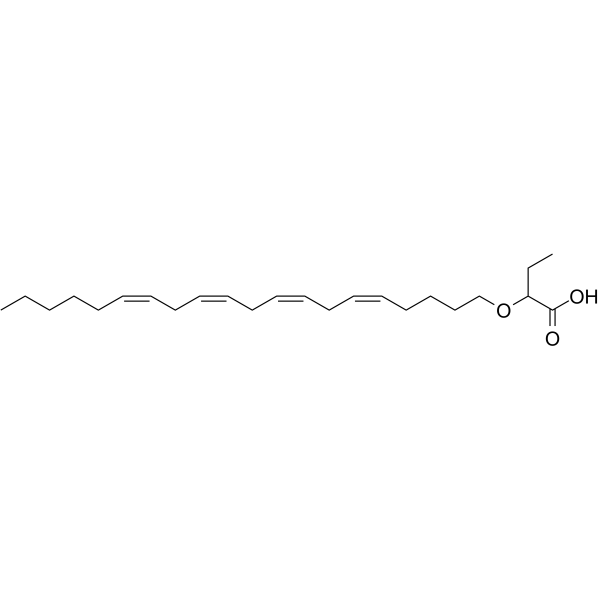
Physicochemical Properties
| Molecular Formula | C24H40O3 |
| Molecular Weight | 376.57260799408 |
| Exact Mass | 376.297 |
| CAS # | 2099120-74-6 |
| PubChem CID | 129209358 |
| Appearance | Colorless to light yellow liquid(Density:0.94 g/cm3) |
| LogP | 7.5 |
| Hydrogen Bond Donor Count | 1 |
| Hydrogen Bond Acceptor Count | 3 |
| Rotatable Bond Count | 18 |
| Heavy Atom Count | 27 |
| Complexity | 447 |
| Defined Atom Stereocenter Count | 0 |
| SMILES | CCCCC/C=C\C/C=C\C/C=C\C/C=C\CCCCOC(CC)C(=O)O |
| InChi Key | JJBSGIKIKLMNBG-GKFVBPDJSA-N |
| InChi Code | InChI=1S/C24H40O3/c1-3-5-6-7-8-9-10-11-12-13-14-15-16-17-18-19-20-21-22-27-23(4-2)24(25)26/h8-9,11-12,14-15,17-18,23H,3-7,10,13,16,19-22H2,1-2H3,(H,25,26)/b9-8-,12-11-,15-14-,18-17- |
| Chemical Name | 2-[(5Z,8Z,11Z,14Z)-icosa-5,8,11,14-tetraenoxy]butanoic acid |
| Synonyms | BIZ-114; BIZ114 |
| HS Tariff Code | 2934.99.9001 |
| Storage |
Powder-20°C 3 years 4°C 2 years In solvent -80°C 6 months -20°C 1 month |
| Shipping Condition | Room temperature (This product is stable at ambient temperature for a few days during ordinary shipping and time spent in Customs) |
Biological Activity
| ln Vitro | Polyunsaturated fatty acids and their metabolites have a variety of significant biological functions because they are involved in numerous physiological and pathological processes. They have an impact on lipid metabolism and plasma lipids. They are integrated into the membranes of cells, where they affect many cell processes. In addition to controlling and influencing gene expression, they are also implicated in inflammatory disorders. The potential treatment and/or prevention of ophthalmic problems, specifically retinal disorders such diabetic retinopathy and age-related macular degeneration, as well as ocular inflammatory diseases, lies in the fatty acid derivatives[1]. |
| References | [1]. Anne Kristin Holmeide. pid compounds and compositions and their opthalmic use. WO2017093732A1. |
Solubility Data
| Solubility (In Vitro) | DMSO : ~250 mg/mL (~663.89 mM) |
| Solubility (In Vivo) |
Solubility in Formulation 1: ≥ 2.33 mg/mL (6.19 mM) (saturation unknown) in 10% DMSO + 40% PEG300 + 5% Tween80 + 45% Saline (add these co-solvents sequentially from left to right, and one by one), clear solution. For example, if 1 mL of working solution is to be prepared, you can add 100 μL of 23.3 mg/mL clear DMSO stock solution to 400 μL PEG300 and mix evenly; then add 50 μL Tween-80 to the above solution and mix evenly; then add 450 μL normal saline to adjust the volume to 1 mL. Preparation of saline: Dissolve 0.9 g of sodium chloride in 100 mL ddH₂ O to obtain a clear solution. Solubility in Formulation 2: ≥ 2.33 mg/mL (6.19 mM) (saturation unknown) in 10% DMSO + 90% Corn Oil (add these co-solvents sequentially from left to right, and one by one), clear solution. For example, if 1 mL of working solution is to be prepared, you can add 100 μL of 23.3 mg/mL clear DMSO stock solution to 900 μL of corn oil and mix evenly. (Please use freshly prepared in vivo formulations for optimal results.) |
| Preparing Stock Solutions | 1 mg | 5 mg | 10 mg | |
| 1 mM | 2.6555 mL | 13.2777 mL | 26.5555 mL | |
| 5 mM | 0.5311 mL | 2.6555 mL | 5.3111 mL | |
| 10 mM | 0.2656 mL | 1.3278 mL | 2.6555 mL |