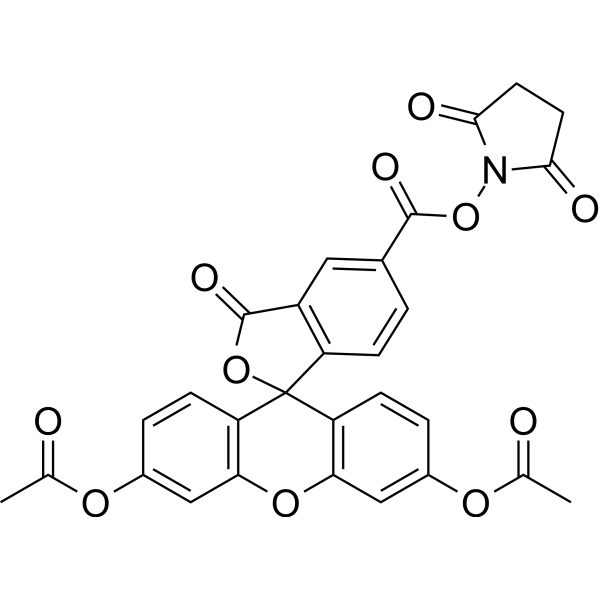
5-Carboxyfluorescein diacetate N-succinimidyl ester is a cell permeable dye (Ex=492 nm, Em=517 nm) used to label cells by covalently binding to intracellular molecules. 5-Carboxyfluorescein diacetate N-succinimidyl ester is used to track lymphocyte migration and proliferation.
Physicochemical Properties
| Molecular Formula | C29H19NO11 |
| Molecular Weight | 557.46126 |
| Exact Mass | 557.095 |
| Elemental Analysis | C, 62.48; H, 3.44; N, 2.51; O, 31.57 |
| CAS # | 150206-05-6 |
| PubChem CID | 4104744 |
| Appearance | White to off-white solid powder |
| Density | 1.6±0.1 g/cm3 |
| Boiling Point | 757.9±70.0 °C at 760 mmHg |
| Melting Point | 152-154ºC(lit.) |
| Flash Point | 412.2±35.7 °C |
| Vapour Pressure | 0.0±2.6 mmHg at 25°C |
| Index of Refraction | 1.701 |
| LogP | 0.5 |
| Hydrogen Bond Donor Count | 0 |
| Hydrogen Bond Acceptor Count | 11 |
| Rotatable Bond Count | 7 |
| Heavy Atom Count | 41 |
| Complexity | 1100 |
| Defined Atom Stereocenter Count | 0 |
| SMILES | CC(=O)OC1=CC2=C(C=C1)C3(C4=C(C=C(C=C4)C(=O)ON5C(=O)CCC5=O)C(=O)O3)C6=C(C=C(C=C6)OC(=O)C)O2 |
| InChi Key | SRSXVRUMXPCNAJ-UHFFFAOYSA-N |
| InChi Code | InChI=1S/C29H19NO11/c1-14(31)37-17-4-7-21-23(12-17)39-24-13-18(38-15(2)32)5-8-22(24)29(21)20-6-3-16(11-19(20)28(36)40-29)27(35)41-30-25(33)9-10-26(30)34/h3-8,11-13H,9-10H2,1-2H3 |
| Chemical Name | (2,5-dioxopyrrolidin-1-yl) 3',6'-diacetyloxy-3-oxospiro[2-benzofuran-1,9'-xanthene]-5-carboxylate |
| Synonyms | 150206-05-6; 5-CFDA N-succinimidyl ester; 5-Carboxy-fluorescein diacetate N-succinimidyl ester; 5-(((2,5-Dioxopyrrolidin-1-yl)oxy)carbonyl)-3-oxo-3H-spiro[isobenzofuran-1,9'-xanthene]-3',6'-diyl diacetate; 5(6)-(N-Succinimidyloxycarbonyl)-3',6',o,o'-diacetylfluorescein; (2,5-dioxopyrrolidin-1-yl) 3',6'-diacetyloxy-3-oxospiro[2-benzofuran-1,9'-xanthene]-5-carboxylate; 5-Carboxyfluorescein diacetate N-succinimidyl ester; MFCD00037466; |
| HS Tariff Code | 2934.99.9001 |
| Storage |
Powder-20°C 3 years 4°C 2 years In solvent -80°C 6 months -20°C 1 month Note: This product requires protection from light (avoid light exposure) during transportation and storage. |
| Shipping Condition | Room temperature (This product is stable at ambient temperature for a few days during ordinary shipping and time spent in Customs) |
Biological Activity
| Targets | Fluorescent Dye |
| ln Vitro |
Standardized Cell Labeling Protocol (Note: This represents an optimized methodology that may require adaptation based on experimental conditions)[1] Step-by-Step Procedure 1. Working Solution Preparation o Prepare a 50 μM labeling solution by diluting the stock reagent in sterile PBS buffer 2. Cell Labeling Process o Add 110 μL of working solution per 1 mL cell suspension (achieving 5 μM final concentration) o Immediately mix thoroughly by pipetting or vortexing for 10 seconds 3. Reaction Termination o Incubate at ambient temperature (22-25°C) for exactly 5 minutes o Quench the reaction by adding 10 mL of ice-cold PBS supplemented with 5% FBS per 1 mL reaction volume 4. Primary Centrifugation o Pellet cells at 300 ×g for 5 minutes at 20°C o Carefully aspirate supernatant without disturbing the cell pellet 5. Wash Cycles o Resuspend cells in 10 mL wash buffer (PBS + 5% FBS) per 1 mL original volume o Repeat centrifugation and washing procedure three times total 6. Final Processing o Perform final centrifugation at 300 ×g for 5 minutes at 20°C o Completely remove all supernatant before proceeding to downstream applications Critical Technical Notes • Due to the rapid kinetics of labeling: • Pre-chill all buffers to 4°C prior to use • Maintain consistent timing between samples • Use mechanical mixing for uniform reagent distribution • For optimal labeling uniformity: • Maintain cell density between 0.5-2×10⁶ cells/mL during labeling • Avoid cell clumping by gentle trituration • Protocol optimization recommendations: • Include a concentration gradient test (2-10 μM) for initial validation • Verify labeling efficiency by flow cytometry or microscopy • Adjust FBS concentration (2-10%) based on cell sensitivity |
| References |
[1]. Use of the intracellular fluorescent dye CFSE to monitor lymphocyte migration and proliferation. Curr Protoc Immunol. 2009 Feb:Chapter 4:4.9.1-4.9.13. |
| Additional Infomation |
Fluorescent Dyes:
Chemicals that emit light after excitation by light. The wave length of the emitted light is usually longer than that of the incident light. Fluorochromes are substances that cause fluorescence in other substances, i.e., dyes used to mark or label other compounds with fluorescent tags. The stable incorporation of the intracellular fluorescent dye 5-(and -6)-carboxyfluorescein diacetate succinimidyl ester (CFSE) into cells provides a powerful tool to monitor cell migration, and to quantify cell division, because of the sequential decrease in fluorescent labeling in daughter cells. CFSE-labeled lymphocytes have been used to analyze the relationship between cell division and differentiation of cell function, and cell proliferation versus apoptosis, both in vivo and in vitro, and have allowed analysis of the site of response to antigens in vivo. [1] |
Solubility Data
| Solubility (In Vitro) | DMSO : ~20.83 mg/mL (~37.37 mM) |
| Solubility (In Vivo) |
Note: Listed below are some common formulations that may be used to formulate products with low water solubility (e.g. < 1 mg/mL), you may test these formulations using a minute amount of products to avoid loss of samples. Injection Formulations (e.g. IP/IV/IM/SC) Injection Formulation 1: DMSO : Tween 80: Saline = 10 : 5 : 85 (i.e. 100 μL DMSO stock solution → 50 μL Tween 80 → 850 μL Saline) *Preparation of saline: Dissolve 0.9 g of sodium chloride in 100 mL ddH ₂ O to obtain a clear solution. Injection Formulation 2: DMSO : PEG300 :Tween 80 : Saline = 10 : 40 : 5 : 45 (i.e. 100 μL DMSO → 400 μLPEG300 → 50 μL Tween 80 → 450 μL Saline) Injection Formulation 3: DMSO : Corn oil = 10 : 90 (i.e. 100 μL DMSO → 900 μL Corn oil) Example: Take the Injection Formulation 3 (DMSO : Corn oil = 10 : 90) as an example, if 1 mL of 2.5 mg/mL working solution is to be prepared, you can take 100 μL 25 mg/mL DMSO stock solution and add to 900 μL corn oil, mix well to obtain a clear or suspension solution (2.5 mg/mL, ready for use in animals). Injection Formulation 4: DMSO : 20% SBE-β-CD in saline = 10 : 90 [i.e. 100 μL DMSO → 900 μL (20% SBE-β-CD in saline)] *Preparation of 20% SBE-β-CD in Saline (4°C,1 week): Dissolve 2 g SBE-β-CD in 10 mL saline to obtain a clear solution. Injection Formulation 5: 2-Hydroxypropyl-β-cyclodextrin : Saline = 50 : 50 (i.e. 500 μL 2-Hydroxypropyl-β-cyclodextrin → 500 μL Saline) Injection Formulation 6: DMSO : PEG300 : castor oil : Saline = 5 : 10 : 20 : 65 (i.e. 50 μL DMSO → 100 μLPEG300 → 200 μL castor oil → 650 μL Saline) Injection Formulation 7: Ethanol : Cremophor : Saline = 10: 10 : 80 (i.e. 100 μL Ethanol → 100 μL Cremophor → 800 μL Saline) Injection Formulation 8: Dissolve in Cremophor/Ethanol (50 : 50), then diluted by Saline Injection Formulation 9: EtOH : Corn oil = 10 : 90 (i.e. 100 μL EtOH → 900 μL Corn oil) Injection Formulation 10: EtOH : PEG300:Tween 80 : Saline = 10 : 40 : 5 : 45 (i.e. 100 μL EtOH → 400 μLPEG300 → 50 μL Tween 80 → 450 μL Saline) Oral Formulations Oral Formulation 1: Suspend in 0.5% CMC Na (carboxymethylcellulose sodium) Oral Formulation 2: Suspend in 0.5% Carboxymethyl cellulose Example: Take the Oral Formulation 1 (Suspend in 0.5% CMC Na) as an example, if 100 mL of 2.5 mg/mL working solution is to be prepared, you can first prepare 0.5% CMC Na solution by measuring 0.5 g CMC Na and dissolve it in 100 mL ddH2O to obtain a clear solution; then add 250 mg of the product to 100 mL 0.5% CMC Na solution, to make the suspension solution (2.5 mg/mL, ready for use in animals). Oral Formulation 3: Dissolved in PEG400 Oral Formulation 4: Suspend in 0.2% Carboxymethyl cellulose Oral Formulation 5: Dissolve in 0.25% Tween 80 and 0.5% Carboxymethyl cellulose Oral Formulation 6: Mixing with food powders Note: Please be aware that the above formulations are for reference only. InvivoChem strongly recommends customers to read literature methods/protocols carefully before determining which formulation you should use for in vivo studies, as different compounds have different solubility properties and have to be formulated differently. (Please use freshly prepared in vivo formulations for optimal results.) |
| Preparing Stock Solutions | 1 mg | 5 mg | 10 mg | |
| 1 mM | 1.7939 mL | 8.9693 mL | 17.9385 mL | |
| 5 mM | 0.3588 mL | 1.7939 mL | 3.5877 mL | |
| 10 mM | 0.1794 mL | 0.8969 mL | 1.7939 mL |