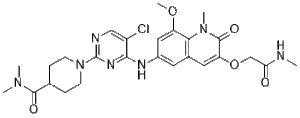
BI-3812 (BI3812) is novel, highly potent and efficacious BCL6 inhibitor with potential antitumor activity. It inhibits the BTB domain of BCL6 with an IC50 of ≤3 nM. The transcription factor BCL6 is a known driver of oncogenesis in lymphoid malignancies, including diffuse large B cell lymphoma (DLBCL). Disruption of its interaction with transcriptional repressors interferes with the oncogenic effects of BCL6. This work establishes the BTB domain as a highly druggable structure, paving the way for the use of other members of this protein family as drug targets. The magnitude of effects elicited by this class of BCL6-degrading compounds exceeds that of our equipotent non-degrading inhibitors, suggesting opportunities for the development of BCL6-based lymphoma therapeutics.
Physicochemical Properties
| Molecular Formula | C26H32CLN7O5 |
| Molecular Weight | 558.029184341431 |
| Exact Mass | 557.215 |
| CAS # | 2166387-64-8 |
| PubChem CID | 134691741 |
| Appearance | Off-white to pink solid powder |
| LogP | 2.2 |
| Hydrogen Bond Donor Count | 2 |
| Hydrogen Bond Acceptor Count | 9 |
| Rotatable Bond Count | 8 |
| Heavy Atom Count | 39 |
| Complexity | 928 |
| Defined Atom Stereocenter Count | 0 |
| SMILES | ClC1C=NC(=NC=1NC1C=C(C2=C(C=C(C(N2C)=O)OCC(NC)=O)C=1)OC)N1CCC(C(N(C)C)=O)CC1 |
| InChi Key | XCGYXEVLQIIEJH-UHFFFAOYSA-N |
| InChi Code | InChI=1S/C26H32ClN7O5/c1-28-21(35)14-39-20-11-16-10-17(12-19(38-5)22(16)33(4)25(20)37)30-23-18(27)13-29-26(31-23)34-8-6-15(7-9-34)24(36)32(2)3/h10-13,15H,6-9,14H2,1-5H3,(H,28,35)(H,29,30,31) |
| Chemical Name | 1-(5-Chloro-4-((8-methoxy-1-methyl-3-(2-(methylamino)-2-oxoethoxy)-2-oxo-1,2-dihydroquinolin-6-yl)amino)pyrimidin-2-yl)-N,N-dimethylpiperidine-4-carboxamide |
| Synonyms | BI3812; BI 3812; BI-3812 |
| HS Tariff Code | 2934.99.9001 |
| Storage |
Powder-20°C 3 years 4°C 2 years In solvent -80°C 6 months -20°C 1 month |
| Shipping Condition | Room temperature (This product is stable at ambient temperature for a few days during ordinary shipping and time spent in Customs) |
Biological Activity
| Targets |
BI-3812 is a potent inhibitor of the BTB (Broad-Complex, Tramtrack, and Bric a brac) domain of the oncogenic transcription factor BCL6 (B-cell lymphoma 6) [1]. BCL6 BTB domain (IC₅₀ ≤ 3 nM in ULight biochemical assay; cellular binding IC₅₀ = 40 nM in LUMIER assay) [1] |
| ln Vitro |
BI-3812 is a highly potent and efficacious BCL6 inhibitor probe compound. It effectively inhibits the interaction between the BCL6 BTB domain and transcriptional co-repressors (e.g., NCOR1) in cellular assays (LUMIER), with an IC₅₀ of 40 nM. Unlike the degrader compound BI-3802, BI-3812 does not induce ubiquitination and proteasome-dependent degradation of BCL6 protein in various diffuse large B cell lymphoma (DLBCL) cell lines (SU-DHL-4, Farage, OCI-Ly1, BJAB). It is classified as a "non-degrader," causing minimal reduction (<30%) in BCL6 protein levels even at high concentrations. In transcriptional studies, treatment with BI-3812 induced de-repression of known BCL6 target genes (e.g., PRDM1, IRF4, PTPN6) in DLBCL cell lines, but the magnitude of induction was consistently weaker compared to the degrader BI-3802. In long-term proliferation assays across several DLBCL cell lines (e.g., SU-DHL-4, Farage, OCI-Ly7, OCI-Ly1), BI-3812 showed only marginal anti-proliferative effects, which were observable only at concentrations far above its biochemical and cellular IC₅₀ values for BCL6 inhibition. Cells not expressing BCL6, such as Toledo cells, were insensitive to BI-3812. The structurally related but low-affinity BCL6 binder BI-5273 had no effect on proliferation, confirming the on-target activity of BI-3812 [1]. Hydrogen deuterium exchange mass spectrometry (HDX MS) analysis indicated that binding of BI-3812 to the BCL6 BTB domain protected regions close to the binding site from deuterium exchange, but showed less protection in remote regions compared to the degrader BI-3802, suggesting differences in protein stabilization effects [1]. A chemoaffinity pulldown experiment with an immobilized analog of the degrader BI-3802 identified BCL6 as the major target in DLBCL cells; no other BTB/POZ domain-containing proteins were identified, suggesting selectivity within this protein family for the related compound series [1] |
| ln Vivo | BCL6 reagent BI-3812 has an IC50 of less than 3 nM. For the inhibition of BCL6, BI-3812 has an IC50 value of 40 nM[1]. |
| Cell Assay |
BCL6 degradation was quantified in SU-DHL-4 cells. Cells were suspended and treated with compounds at logarithmic dose series using a digital dispenser. After 90 minutes of incubation, cells were lysed. BCL6 protein levels in the lysates were analyzed using capillary electrophoresis (Wes system) with anti-BCL6 and anti-GAPDH antibodies for normalization, generating dose-response curves and DC₅₀ (degradation potency) values [1]. Long-term proliferation assays were performed in DLBCL cell lines. Cells were seeded and maintained at constant compound concentrations in multi-well plates. They were passaged periodically to maintain density, and cumulative cell numbers were calculated by multiplying split ratios over time to generate growth curves [1]. Cellular target engagement was measured using LUMIER (luminescence-based mammalian interactome) assays. HEK293T cells were co-transfected with expression constructs for Renilla luciferase-tagged BCL6 (containing the BTB domain) and Firefly luciferase-tagged co-repressor NCOR1. After compound treatment, cells were lysed, and the lysate was subjected to immunoprecipitation using anti-Renilla antibody. The co-precipitated Firefly luciferase activity (representing the BCL6-NCOR1 interaction) was measured and normalized to the Renilla luciferase activity in the input lysate [1]. For qPCR analysis of gene expression, cells were treated in 96-well plates, lysed, and mRNA levels were quantified using reverse transcription-quantitative PCR with gene-specific primers. Data were normalized to GAPDH mRNA levels [1]. To study domain requirements for degradation, various mutant and chimeric constructs of BCL6 (e.g., lacking the zinc finger domain or fused to heterologous DNA-binding domains) were transiently transfected into HEK293 cells. Protein levels were assessed by western blotting after compound treatment [1] . |
| References |
[1]. Chemically Induced Degradation of the Oncogenic Transcription Factor BCL6. Cell Rep. 2017 Sep 19;20(12):2860-2875. |
| Additional Infomation |
BI-3812 is highlighted as a highly potent and efficacious BCL6 inhibitor probe compound. It is structurally closely related to the degrader BI-3802 but functions as a "non-degrader," allowing for the dissection of biological effects caused by BCL6 inhibition versus BCL6 protein degradation. The study demonstrates that while both inhibitor and degrader compounds de-repress a similar set of BCL6 target genes, the anti-proliferative effects in DLBCL cell lines are significantly stronger with the degrader. BI-3812, by inhibiting the BTB domain without causing degradation, provides a tool to study the specific consequences of disrupting BCL6's co-repressor interactions [1]. The research establishes the BCL6 BTB domain as a highly druggable target. The discovery of potent, non-degrading inhibitors like BI-3812 and degraders like BI-3802 from the same chemical series offers new routes for investigating BCL6 biology and developing potential lymphoma therapeutics [1] |
Solubility Data
| Solubility (In Vitro) | DMSO : ~20.83 mg/mL (~37.33 mM) |
| Solubility (In Vivo) |
Solubility in Formulation 1: 2.08 mg/mL (3.73 mM) in 10% DMSO + 40% PEG300 + 5% Tween80 + 45% Saline (add these co-solvents sequentially from left to right, and one by one), suspension solution; with sonication. For example, if 1 mL of working solution is to be prepared, you can add 100 μL of 20.8 mg/mL clear DMSO stock solution to 400 μL PEG300 and mix evenly; then add 50 μL Tween-80 to the above solution and mix evenly; then add 450 μL normal saline to adjust the volume to 1 mL. Preparation of saline: Dissolve 0.9 g of sodium chloride in 100 mL ddH₂ O to obtain a clear solution. Solubility in Formulation 2: ≥ 2.08 mg/mL (3.73 mM) (saturation unknown) in 10% DMSO + 90% Corn Oil (add these co-solvents sequentially from left to right, and one by one), clear solution. For example, if 1 mL of working solution is to be prepared, you can add 100 μL of 20.8 mg/mL clear DMSO stock solution to 900 μL of corn oil and mix evenly. (Please use freshly prepared in vivo formulations for optimal results.) |
| Preparing Stock Solutions | 1 mg | 5 mg | 10 mg | |
| 1 mM | 1.7920 mL | 8.9601 mL | 17.9202 mL | |
| 5 mM | 0.3584 mL | 1.7920 mL | 3.5840 mL | |
| 10 mM | 0.1792 mL | 0.8960 mL | 1.7920 mL |