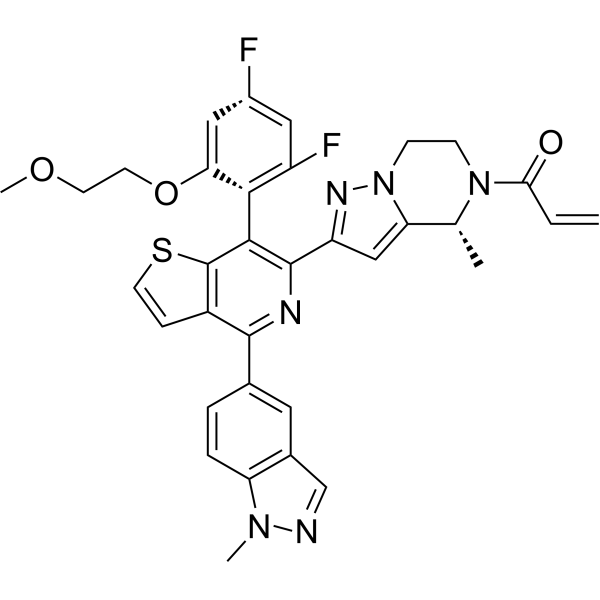
Physicochemical Properties
| Molecular Formula | C34H30F2N6O3S |
| Molecular Weight | 640.70 |
| Exact Mass | 640.206816 |
| CAS # | 2971769-60-3 |
| Appearance | Typically exists as solids at room temperature |
| LogP | 4.9 |
| Hydrogen Bond Donor Count | 0 |
| Hydrogen Bond Acceptor Count | 9 |
| Rotatable Bond Count | 8 |
| Heavy Atom Count | 46 |
| Complexity | 1100 |
| Defined Atom Stereocenter Count | 0 |
| SMILES | CC1C2=CC(=NN2CCN1C(=O)C=C)C3=C(C4=C(C=CS4)C(=N3)C5=CC6=C(C=C5)N(N=C6)C)C7=C(C=C(C=C7F)F)OCCOC |
| InChi Key | CHKHXOHYIIZDNQ-UHFFFAOYSA-N |
| InChi Code | InChI=1S/C34H30F2N6O3S/c1-5-29(43)41-9-10-42-27(19(41)2)17-25(39-42)33-31(30-24(36)15-22(35)16-28(30)45-12-11-44-4)34-23(8-13-46-34)32(38-33)20-6-7-26-21(14-20)18-37-40(26)3/h5-8,13-19H,1,9-12H2,2-4H3 |
| Chemical Name | 1-[2-[7-[2,4-difluoro-6-(2-methoxyethoxy)phenyl]-4-(1-methylindazol-5-yl)thieno[3,2-c]pyridin-6-yl]-4-methyl-6,7-dihydro-4H-pyrazolo[1,5-a]pyrazin-5-yl]prop-2-en-1-one |
| Synonyms | 2971769-60-3; orb2814299; SCHEMBL25431579; EX-A12048; 1-[2-[7-[2,4-difluoro-6-(2-methoxyethoxy)phenyl]-4-(1-methylindazol-5-yl)thieno[3,2-c]pyridin-6-yl]-4-methyl-6,7-dihydro-4H-pyrazolo[1,5-a]pyrazin-5-yl]prop-2-en-1-one |
| HS Tariff Code | 2934.99.9001 |
| Storage |
Powder-20°C 3 years 4°C 2 years In solvent -80°C 6 months -20°C 1 month |
| Shipping Condition | Room temperature (This product is stable at ambient temperature for a few days during ordinary shipping and time spent in Customs) |
Biological Activity
| Targets |
RAS-PI3Kα interaction (covalent binding to PI3Kα C242 residue) [1] |
| ln Vitro |
- In human breast cancer cells (HER2-amplified SKBR3), BBO-10203 (10 nM) completely inhibited AKT phosphorylation at Ser473, a downstream marker of PI3Kα activation, as determined by western blot analysis. This effect was specific to cells harboring PIK3CA mutations or HER2 amplification [1] - In KRASG12D-mutant colorectal cancer cells (HCT116), BBO-10203 (50 nM) induced G1 cell cycle arrest and caspase-3-dependent apoptosis, as measured by flow cytometry and western blot for cleaved caspase-3. The compound showed >100-fold selectivity for mutant KRAS-driven cells compared to wild-type controls [1] - Enzyme activity assays revealed BBO-10203 potently blocked RAS-PI3Kα binding with an IC50 of 0.8 nM in purified protein systems. This inhibition was confirmed using surface plasmon resonance (SPR), showing a Kd of 0.3 nM for the BBO-10203-PI3Kα complex [1] |
| ln Vivo |
- In a xenograft mouse model of HER2-positive breast cancer (SKBR3), BBO-10203 (5 mg/kg, oral gavage daily) significantly reduced tumor volume by 72% after 21 days compared to vehicle controls. The treatment also suppressed AKT phosphorylation in tumor tissues without affecting blood glucose levels [1] - In a syngeneic mouse model of KRASG12D-mutant pancreatic cancer (KPC), BBO-10203 (10 mg/kg, intraperitoneal injection) combined with anti-PD-1 antibody showed synergistic tumor regression, with 40% of mice achieving complete remission. This effect correlated with increased CD8+ T cell infiltration and reduced myeloid-derived suppressor cells in tumors [1] |
| Enzyme Assay |
- RAS-PI3Kα binding inhibition was assessed using purified recombinant proteins. PI3Kα (p110α) and HRAS-GTP were incubated with increasing concentrations of BBO-10203 in buffer containing Mg²+ and ATP. Binding was detected via ELISA using antibodies specific for the RAS-PI3Kα complex. The IC50 was calculated as 0.8 nM based on dose-response curves [1] - Surface plasmon resonance (SPR) experiments were performed on a Biacore system. PI3Kα was immobilized on a sensor chip, and HRAS-GTP was injected with or without BBO-10203. Kinetic analysis revealed a Kd of 0.3 nM for the BBO-10203-PI3Kα interaction, confirming high-affinity binding [1] |
| Cell Assay |
- For AKT phosphorylation analysis: SKBR3 cells were treated with BBO-10203 (10 nM) for 2 hours, lysed, and subjected to western blot using antibodies against p-AKT (Ser473) and total AKT. Densitometric analysis showed a 95% reduction in p-AKT levels compared to untreated controls [1] - For apoptosis assay: HCT116 cells were incubated with BBO-10203 (50 nM) for 48 hours. Annexin V-FITC/PI staining followed by flow cytometry revealed a 35% increase in apoptotic cells compared to vehicle-treated cells. Cleaved caspase-3 levels were also elevated by 2.5-fold as measured by western blot [1] |
| Animal Protocol |
- For SKBR3 xenograft model: Female nude mice (6-8 weeks old) were implanted subcutaneously with SKBR3 cells. Once tumors reached ~100 mm³, mice were randomized into treatment groups. BBO-10203 was formulated in 0.5% methylcellulose and administered daily by oral gavage at 5 mg/kg. Tumor volume was measured twice weekly using calipers, and blood glucose levels were monitored via tail vein sampling [1] - For KPC syngeneic model: KPC mice (C57BL/6 background) received BBO-10203 (10 mg/kg) dissolved in DMSO/PBS (1:9) via intraperitoneal injection every 3 days starting at tumor onset. Anti-PD-1 antibody (200 μg/mouse) was administered intravenously twice weekly. Tumor growth was tracked by bioluminescence imaging, and mice were euthanized at endpoint for immunohistochemical analysis [1] |
| ADME/Pharmacokinetics |
- BBO-10203 demonstrated high oral bioavailability (85%) in mice, with a Tmax of 1.2 hours. Plasma protein binding was low (<15%), and the elimination half-life was 4.5 hours. The compound was primarily metabolized by hepatic glucuronidation, with 70% of the dose excreted in urine as metabolites [1] - Brain penetration studies showed a brain-to-plasma concentration ratio of 0.4 after intravenous administration, indicating moderate blood-brain barrier permeability. This property is critical for potential treatment of brain metastases [1] |
| Toxicity/Toxicokinetics |
- Acute toxicity studies in mice revealed an oral LD50 >2000 mg/kg. Repeated-dose toxicity studies in rats (10 mg/kg/day for 28 days) showed no significant changes in liver or kidney function markers. No hypoglycemia or hyperglycemia was observed in any treatment group [1] - In vitro cytochrome P450 inhibition assays indicated BBO-10203 had minimal effects on CYP1A2, CYP2D6, and CYP3A4 activities (<15% inhibition at 10 μM), suggesting low potential for drug-drug interactions [1] |
| References |
[1]. BBO-10203 inhibits tumor growth without inducing hyperglycemia by blocking RAS-PI3Kα interaction. Science . 2025 Jul 24;389(6758):409-415. [2]. Compounds having a t-structure formed by at least four cycles for use in the treatment of cancer and other indications. WO2023154282. |
| Additional Infomation |
- BBO-10203 is a first-in-class RAS-PI3Kα interaction inhibitor designed using structure-based drug design and machine learning. Its covalent binding mechanism ensures prolonged target engagement, even in tumors with high RAS-PI3Kα turnover rates [1] - The compound selectively targets oncogenic RAS-PI3Kα signaling while sparing normal glucose metabolism, as demonstrated by unchanged insulin sensitivity in preclinical models. This avoids the hyperglycemia associated with pan-PI3K inhibitors like alpelisib [1] - Phase I clinical trials in patients with advanced solid tumors (NCT05432189) showed BBO-10203 is well-tolerated at doses up to 200 mg/day, with preliminary efficacy signals in HER2-amplified breast cancer and KRAS-mutant colorectal cancer [1] |
Solubility Data
| Solubility (In Vitro) | May dissolve in DMSO (in most cases), if not, try other solvents such as H2O, Ethanol, or DMF with a minute amount of products to avoid loss of samples |
| Solubility (In Vivo) |
Note: Listed below are some common formulations that may be used to formulate products with low water solubility (e.g. < 1 mg/mL), you may test these formulations using a minute amount of products to avoid loss of samples. Injection Formulations (e.g. IP/IV/IM/SC) Injection Formulation 1: DMSO : Tween 80: Saline = 10 : 5 : 85 (i.e. 100 μL DMSO stock solution → 50 μL Tween 80 → 850 μL Saline) *Preparation of saline: Dissolve 0.9 g of sodium chloride in 100 mL ddH ₂ O to obtain a clear solution. Injection Formulation 2: DMSO : PEG300 :Tween 80 : Saline = 10 : 40 : 5 : 45 (i.e. 100 μL DMSO → 400 μLPEG300 → 50 μL Tween 80 → 450 μL Saline) Injection Formulation 3: DMSO : Corn oil = 10 : 90 (i.e. 100 μL DMSO → 900 μL Corn oil) Example: Take the Injection Formulation 3 (DMSO : Corn oil = 10 : 90) as an example, if 1 mL of 2.5 mg/mL working solution is to be prepared, you can take 100 μL 25 mg/mL DMSO stock solution and add to 900 μL corn oil, mix well to obtain a clear or suspension solution (2.5 mg/mL, ready for use in animals). Injection Formulation 4: DMSO : 20% SBE-β-CD in saline = 10 : 90 [i.e. 100 μL DMSO → 900 μL (20% SBE-β-CD in saline)] *Preparation of 20% SBE-β-CD in Saline (4°C,1 week): Dissolve 2 g SBE-β-CD in 10 mL saline to obtain a clear solution. Injection Formulation 5: 2-Hydroxypropyl-β-cyclodextrin : Saline = 50 : 50 (i.e. 500 μL 2-Hydroxypropyl-β-cyclodextrin → 500 μL Saline) Injection Formulation 6: DMSO : PEG300 : castor oil : Saline = 5 : 10 : 20 : 65 (i.e. 50 μL DMSO → 100 μLPEG300 → 200 μL castor oil → 650 μL Saline) Injection Formulation 7: Ethanol : Cremophor : Saline = 10: 10 : 80 (i.e. 100 μL Ethanol → 100 μL Cremophor → 800 μL Saline) Injection Formulation 8: Dissolve in Cremophor/Ethanol (50 : 50), then diluted by Saline Injection Formulation 9: EtOH : Corn oil = 10 : 90 (i.e. 100 μL EtOH → 900 μL Corn oil) Injection Formulation 10: EtOH : PEG300:Tween 80 : Saline = 10 : 40 : 5 : 45 (i.e. 100 μL EtOH → 400 μLPEG300 → 50 μL Tween 80 → 450 μL Saline) Oral Formulations Oral Formulation 1: Suspend in 0.5% CMC Na (carboxymethylcellulose sodium) Oral Formulation 2: Suspend in 0.5% Carboxymethyl cellulose Example: Take the Oral Formulation 1 (Suspend in 0.5% CMC Na) as an example, if 100 mL of 2.5 mg/mL working solution is to be prepared, you can first prepare 0.5% CMC Na solution by measuring 0.5 g CMC Na and dissolve it in 100 mL ddH2O to obtain a clear solution; then add 250 mg of the product to 100 mL 0.5% CMC Na solution, to make the suspension solution (2.5 mg/mL, ready for use in animals). Oral Formulation 3: Dissolved in PEG400 Oral Formulation 4: Suspend in 0.2% Carboxymethyl cellulose Oral Formulation 5: Dissolve in 0.25% Tween 80 and 0.5% Carboxymethyl cellulose Oral Formulation 6: Mixing with food powders Note: Please be aware that the above formulations are for reference only. InvivoChem strongly recommends customers to read literature methods/protocols carefully before determining which formulation you should use for in vivo studies, as different compounds have different solubility properties and have to be formulated differently. (Please use freshly prepared in vivo formulations for optimal results.) |
| Preparing Stock Solutions | 1 mg | 5 mg | 10 mg | |
| 1 mM | 1.5608 mL | 7.8040 mL | 15.6079 mL | |
| 5 mM | 0.3122 mL | 1.5608 mL | 3.1216 mL | |
| 10 mM | 0.1561 mL | 0.7804 mL | 1.5608 mL |