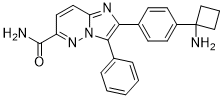
BAY1125976 (BAY-1125976) is a novel, orally bioavailable and selective allosteric inhibitor of Akt1/Akt2 with potential anticancer activity. With IC50 values of 5.2 nM and 18 nM at 10 M ATP, respectively, it inhibits the activity of Akt1 and Akt2. In mouse models, BAY-1125976 shows high efficacy against AKT signaling-dependent tumor growth. By attaching to an allosteric binding pocket created by the kinase and PH domains, BAY 1125976 potently and specifically inhibited the activity of full-length AKT1 and AKT2. A large selection of human cancer cell lines were inhibited in vitro by BAY 1125976 for cell proliferation. In both cell line and patient-derived xenograft models, such as the KPL4 breast cancer model (PIK3CAH1074R mutant), the MCF7 and HBCx-2 breast cancer models, the AKTE17K mutant-driven prostate cancer (LAPC-4) and anal cancer (AXF 984) models, BAY 1125976 demonstrated significant in vivo efficacy.
Physicochemical Properties
| Molecular Formula | C23H21N5O |
| Molecular Weight | 383.4457 |
| Exact Mass | 383.174 |
| Elemental Analysis | C, 72.04; H, 5.52; N, 18.26; O, 4.17 |
| CAS # | 1402608-02-9 |
| Related CAS # | 1402608-02-9; |
| PubChem CID | 70817911 |
| Appearance | Light yellow to yellow solid powder |
| Density | 1.4±0.1 g/cm3 |
| Index of Refraction | 1.736 |
| LogP | 1.6 |
| Hydrogen Bond Donor Count | 2 |
| Hydrogen Bond Acceptor Count | 4 |
| Rotatable Bond Count | 4 |
| Heavy Atom Count | 29 |
| Complexity | 594 |
| Defined Atom Stereocenter Count | 0 |
| SMILES | O=C(C1C([H])=C([H])C2=NC(=C(C3C([H])=C([H])C([H])=C([H])C=3[H])N2N=1)C1C([H])=C([H])C(=C([H])C=1[H])C1(C([H])([H])C([H])([H])C1([H])[H])N([H])[H])N([H])[H] |
| InChi Key | JBGYKRAZYDNCNV-UHFFFAOYSA-N |
| InChi Code | InChI=1S/C23H21N5O/c24-22(29)18-11-12-19-26-20(21(28(19)27-18)16-5-2-1-3-6-16)15-7-9-17(10-8-15)23(25)13-4-14-23/h1-3,5-12H,4,13-14,25H2,(H2,24,29) |
| Chemical Name | Imidazo[1,2-b]pyridazine-6-carboxamide, 2-[4-(1-aminocyclobutyl)phenyl]-3-phenyl- |
| Synonyms | BAY1125976; BAY 1125976; BAY-1125976 |
| HS Tariff Code | 2934.99.9001 |
| Storage |
Powder-20°C 3 years 4°C 2 years In solvent -80°C 6 months -20°C 1 month |
| Shipping Condition | Room temperature (This product is stable at ambient temperature for a few days during ordinary shipping and time spent in Customs) |
Biological Activity
| Targets |
Akt1 (IC50 = 5.2 nM, at 10 μM ATP); Akt2 (IC50 = 18 nM, at 10 μM ATP); Akt3 (IC50 = 427 nM, at 10 μM ATP) BAY 1125976 inhibits activation of AKT in cell lines carrying the AKT-activating mutation E17K. In KU-19-19 bladder cancer cells activation by phosphorylation is inhibited at AKT1-S473 and 4EBPI-T70 with IC50 values of 35 and 100 nM, respectively. AKT1-S473, T308, and 4EBP1-T70 phosphorylation in the prostate cancer cell line LAPC-4 is inhibited by compounds with IC50 values of 0.8, 5.6, and 35 nM, respectively. BAY 1125976 treatment of LAPC-4 cells inhibits PRAS40 phosphorylation at T246 as a direct target of AKT1 activity with an IC50 of 141 nM. The breast cancer cell lines BT-474, T47D, MCF7, ZR-75-1, EVSA-T, MDA-MB-453, KPL-4, and BT20, as well as the prostate cancer cell lines LNCaP and LAPC-4, are all inhibited by BAY 1125976 with submicromolar IC50 values. Breast cancer luminal cell lines treated with BAY 1125976 exhibit a marked inhibition of cell proliferation[1]. |
| ln Vitro |
BAY 1125976 inhibits activation of AKT in cell lines carrying the AKT-activating mutation E17K. In KU-19-19 bladder cancer cells activation by phosphorylation is inhibited at AKT1-S473 and 4EBPI-T70 with IC50 values of 35 and 100 nM, respectively. AKT1-S473, T308, and 4EBP1-T70 phosphorylation in the prostate cancer cell line LAPC-4 is inhibited by compounds with IC50 values of 0.8, 5.6, and 35 nM, respectively. BAY 1125976 treatment of LAPC-4 cells inhibits PRAS40 phosphorylation at T246 as a direct target of AKT1 activity with an IC50 of 141 nM. The breast cancer cell lines BT-474, T47D, MCF7, ZR-75-1, EVSA-T, MDA-MB-453, KPL-4, and BT20, as well as the prostate cancer cell lines LNCaP and LAPC-4, are all inhibited by BAY 1125976 with submicromolar IC50 values. Breast cancer luminal cell lines treated with BAY 1125976 exhibit a marked inhibition of cell proliferation[1]. BAY-1125976 is a potent and selective allosteric inhibitor of full-length AKT1 and AKT2, but shows significantly weaker activity against AKT3 and truncated AKT proteins lacking the pleckstrin homology (PH) domain. In cellular assays, it inhibits phosphorylation of AKT at T308 (IC50 = 0.9 nM in KPL-4 cells) and S473 (IC50 = 1.1 nM in KPL-4 cells), as well as downstream substrates such as 4EBP1 at T70 (IC50 = 35 nM). In AKT1E17K-mutant cell lines, it inhibits p-AKT-S473 (IC50 = 35 nM in KU-19-19; 0.8 nM in LAPC-4) and p-PRAS40-T246 (IC50 ≈ 141 nM in LAPC-4). BAY-1125976 exhibits antiproliferative activity in a panel of cancer cell lines, particularly those with PI3K/AKT pathway alterations (e.g., PIK3CA mutations, PTEN loss, AKT1E17K), with IC50 values ranging from 0.02 µM to >10 µM (Table 1). Sensitivity is higher in luminal breast cancer and prostate cancer cell lines expressing hormone receptors.[1] |
| ln Vivo |
In mice bearing KPL-4 tumors, BAY 1125976 treatment at various doses has powerful antitumor efficacy. After daily oral administration of either 25 or 50 mg/kg of BAY 1125976 with T/Cvolume ratios of 0.14 or 0.08, respectively, a distinct, statistically significant dose-response is seen. In MCF7-implanted nude mice, daily administration of 25 or 50 mg/kg BAY 1125976 significantly inhibits tumor growth when compared to the control, with T/Cvolume and T/Cweight values of 0.25 and 0.25, respectively. In vivo, BAY 1125976 exhibits strong antitumor activity in AKT1E17K mutated models[1]. Oral administration of BAY-1125976 demonstrates significant antitumor efficacy in multiple xenograft models. In the KPL-4 breast cancer model, daily doses of 25 and 50 mg/kg resulted in T/Cvolume ratios of 0.14 and 0.08, respectively. In the MCF7 breast cancer model, doses of 25 and 50 mg/kg yielded T/Cvolume values of 0.25. In the LAPC-4 prostate cancer model (AKT1E17K), doses of 25 and 50 mg/kg led to T/Cvolume values of 0.32 and 0.27, respectively. In patient-derived xenograft models with AKT1E17K mutation (HBCx-2 breast cancer and AXF 984 anal cancer), BAY-1125976 induced tumor regression or marked growth inhibition.[1] |
| Enzyme Assay |
PEG/water (60/40), pH 4.0, is used as a vehicle for BAY 1125976. The selectivity of BAY 1125976 is assessed using two different kinase panels: the 230 kinase panel; and the 468 kinase panel. In the 230 kinase panel, kinase activity is determined after incubation with 10 μM BAY 1125976. An additional incubation with 1 μM and 0.1 μM BAY 1125976 is performed for the kinases where 10 μM BAY 1125976 shows an inhibition over 70%. All tests are performed at 10 μM ATP. The 468-kinase panel covered AGC, CAMK, CMGC, CK1, STE, TK, TKL, lipid, and atypical kinase families. The profiling is performed by combining the test compound with DNA-tagged kinase and immobilized ligands. The final kinase concentrations are measured by quantitative PCR. The inhibitory activity of BAY-1125976 against recombinant full-length AKT1, AKT2, AKT3, and truncated variants (APH-AKT1, APH-AKT2) was assessed using TR-FRET-based in vitro kinase assays. The assays quantified phosphorylation of a biotinylated peptide substrate by the recombinant kinase enzyme. Different ATP concentrations (10 µM and 2 mM) were used to evaluate potency under varying conditions. Surface plasmon resonance spectroscopy was performed to characterize binding kinetics of BAY-1125976 to active and inactive full-length AKT1 and a PH-domain-deleted variant.[1] |
| Cell Assay |
Mice: Female NMRI (nu/nu) mice s.c. injected with 3 x 10⁶/100 μL KPL-4 breast cancer cells are used to study the mode-of-action of BAY 1125976. The treatment is started when tumors reaches 232-358 mm3 in size and the mice receive a single oral dose of 25 or 50 mg/kg BAY 1125976. For determination of plasma concentration-time profiles, blood is drawn from the animals at different time points after compound administration. Cellular inhibition of AKT signaling was evaluated in cancer cell lines (e.g., KPL-4, KU-19-19, LAPC-4). Cells were treated with BAY-1125976, and phosphorylation levels of AKT (T308, S473) and downstream targets (4EBP1, PRAS40) were measured using immunoassays or Western blotting. Antiproliferative activity was determined using a luminescent cell viability assay. Cells were seeded in 96-well plates, treated with compound for a specified duration, and viability was assessed using a reagent that generates luminescence proportional to the amount of ATP present.[1] |
| Animal Protocol |
Female 5-7 week old NMRI nude (nu/nu) mice, Male 8-10 week old SCID (scid/scid) mice, Female athymic nude Foxn1nu mice, Female 5-week-old Foxn1nu nude (nu/nu) mice. 5, 10, 15, 25, 50 mg/kg Oral gavage For efficacy studies, immunodeficient mice were inoculated subcutaneously with tumor cells or patient-derived tumor fragments. When tumors reached a specified volume (e.g., ~100–200 mm³), mice were randomized into treatment groups. BAY-1125976 was formulated in PEG/water (60/40, pH 4.0) and administered orally (per os) either once daily (QD) or twice daily (BID) at doses ranging from 5 to 50 mg/kg, depending on the study. Treatment duration varied from 16 to 29 days. In some models, hormone supplementation (estradiol or testosterone pellets) was used. Tumor volumes were measured regularly with calipers, and tumor weights were recorded at study termination. Blood samples were collected at various time points for pharmacokinetic and pharmacodynamic analyses.[1] |
| ADME/Pharmacokinetics |
Plasma concentrations of BAY-1125976 were measured in tumor-bearing mice after oral administration. Unbound plasma concentrations remained above the cellular p-AKT IC50 for over 24 hours after a single 25 or 50 mg/kg dose. The unbound fraction in plasma was determined by equilibrium analysis.[1] |
| Toxicity/Toxicokinetics |
Treatment with BAY-1125976 was generally well-tolerated. Dose-dependent and transient body weight loss was observed. A dose-dependent and transient increase in blood glucose levels occurred, considered an on-target effect due to AKT2 inhibition.[1] |
| References |
[1]. BAY 1125976, a selective allosteric AKT1/2 inhibitor, exhibits high efficacy on AKT signaling-dependent tumor growth in mouse models. Int J Cancer. 2017 Jan 15;140(2):449-459. |
| Additional Infomation |
AKT 1/2 Inhibitor BAY1125976 is an orally bioavailable inhibitor of the serine/threonine protein kinase AKT (protein kinase B) isoforms 1 and 2 (AKT1/2) with potential antineoplastic activity. AKT1/2 inhibitor BAY1125976 selectively binds to and inhibits the phosphorylation and activity of AKT1/2 in a non-ATP competitive manner, which may result in the inhibition of the phosphatidylinositol 3 (PI3K)/AKT/mammalian target of rapamycin (mTOR) signaling pathway. This may lead to both the reduction of cell proliferation and the induction of cell apoptosis in AKT-overexpressing tumor cells. The AKT signaling pathway is often deregulated in cancer and is associated with tumor cell proliferation, survival and migration. BAY-1125976 is a novel, orally bioavailable, allosteric inhibitor of AKT1 and AKT2. It binds to a pocket formed by the kinase and PH domains, stabilizing the inactive conformation and preventing phosphorylation and activation of AKT. It shows high selectivity over other kinases, minimizing off-target effects commonly seen with ATP-competitive inhibitors. It is particularly effective in tumor models with hyperactivated PI3K/AKT/mTOR signaling, such as those with PIK3CA mutations, PTEN loss, or the AKT1E17K mutation. A phase I clinical trial (NCT01915576) was initiated based on these preclinical data.[1] |
Solubility Data
| Solubility (In Vitro) | DMSO: 11~25 mg/mL (28.7 mM~65.2 mM) |
| Solubility (In Vivo) |
Solubility in Formulation 1: ≥ 2.5 mg/mL (6.52 mM) (saturation unknown) in 10% DMSO + 40% PEG300 +5% Tween-80 + 45% Saline (add these co-solvents sequentially from left to right, and one by one), clear solution. For example, if 1 mL of working solution is to be prepared, you can add 100 μL of 25.0 mg/mL clear DMSO stock solution to 400 μL PEG300 and mix evenly; then add 50 μL Tween-80 + to the above solution and mix evenly; then add 450 μL normal saline to adjust the volume to 1 mL. Preparation of saline: Dissolve 0.9 g of sodium chloride in 100 mL ddH₂ O to obtain a clear solution. (Please use freshly prepared in vivo formulations for optimal results.) |
| Preparing Stock Solutions | 1 mg | 5 mg | 10 mg | |
| 1 mM | 2.6079 mL | 13.0395 mL | 26.0790 mL | |
| 5 mM | 0.5216 mL | 2.6079 mL | 5.2158 mL | |
| 10 mM | 0.2608 mL | 1.3040 mL | 2.6079 mL |