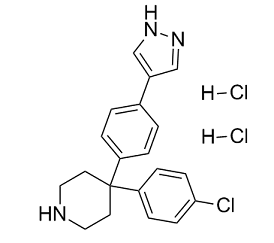
AT7867 Dihydrochloride is a novel, highly potent and ATP-competitive inhibitor of Akt1/Akt2/Akt3 and p70S6K/PKA with IC50s of 32 nM/17 nM/47 nM and 85 nM/20 nM in cell-free assays, respectively. There is not much activity outside the AGC kinase family. Multiple human cancer cell lines were affected by AT7867's ability to inhibit cell proliferation; however, it is most effective against the MES-SA uterine, MDA-MB-468, MCF-7 breast, HCT116, and HT29 colon lines (IC50, 0.9–3 μM). Additionally, AT7867 inhibited GSK3 in all of the tested cell lines (IC50 =2-4 μM). AT7867 suppressed AKT signaling and brought on apoptosis in U87MG human glioblastoma cells in a time- and concentration-dependent manner.
Physicochemical Properties
| Molecular Formula | C20H22CL3N3 |
| Molecular Weight | 410.7678 |
| Exact Mass | 409.087 |
| Elemental Analysis | C, 58.48; H, 5.40; Cl, 25.89; N, 10.23 |
| CAS # | 1431697-86-7 |
| Related CAS # | AT7867;857531-00-1 |
| PubChem CID | 71576653 |
| Appearance | White to off-white solid powder |
| Hydrogen Bond Donor Count | 4 |
| Hydrogen Bond Acceptor Count | 2 |
| Rotatable Bond Count | 3 |
| Heavy Atom Count | 26 |
| Complexity | 394 |
| Defined Atom Stereocenter Count | 0 |
| SMILES | ClC1C([H])=C([H])C(=C([H])C=1[H])C1(C2C([H])=C([H])C(C3C([H])=NN([H])C=3[H])=C([H])C=2[H])C([H])([H])C([H])([H])N([H])C([H])([H])C1([H])[H].Cl[H].Cl[H] |
| InChi Key | ICUAUJBVBVIUAE-UHFFFAOYSA-N |
| InChi Code | InChI=1S/C20H20ClN3.2ClH/c21-19-7-5-18(6-8-19)20(9-11-22-12-10-20)17-3-1-15(2-4-17)16-13-23-24-14-16/h1-8,13-14,22H,9-12H2,(H,23,24)2*1H |
| Chemical Name | 4-(4-chlorophenyl)-4-[4-(1H-pyrazol-4-yl)phenyl]piperidine;dihydrochloride |
| Synonyms | AT7867 Dihydrochloride; AT-7867 Dihydrochloride; AT 7867 Dihydrochloride |
| HS Tariff Code | 2934.99.03.00 |
| Storage |
Powder-20°C 3 years 4°C 2 years In solvent -80°C 6 months -20°C 1 month Note: Please store this product in a sealed and protected environment, avoid exposure to moisture. |
| Shipping Condition | Room temperature (This product is stable at ambient temperature for a few days during ordinary shipping and time spent in Customs) |
Biological Activity
| Targets | Akt2 (IC50 = 17 nM); p70S6K (IC50 = 85 nM); Akt1 (IC50 = 32 nM); Akt3 (IC50 = 47 nM); PKA (IC50 = 20 nM) |
| ln Vitro | The inhibition of AKT2 by AT7867 is shown to be ATP-competitive with a Ki of 18nM.Additionally, AT7867 exhibits strong activity against the structurally related AGC kinases p70S6K and PKA, but exhibits a distinct window of selectivity when it comes to kinases from other kinase subfamilies. Studies on the inhibition of in vitro growth demonstrate that AT7867 inhibits proliferation in a number of human cancer cell lines. Inhibiting proliferation with AT7867 appears to be most effective in the MES-SA uterine, MDA-MB-468 and MCF-7 breast, HCT116 and HT29 colon, and MDA-MB-468 and MCF-7 cell lines (IC50 values range from 0.9 to 3 M), and least effective in the two prostate cell lines (IC50 values range from 10 to 12 μM) [1]. |
| ln Vivo | Following oral administration at 20 mg/kg, the elimination of AT7867 from plasma appears to be similar to that observed after i.v. administration. Following an oral dose of 20 mg/kg of AT7867, plasma levels stay above 0.5 M for at least 6 hours. The bioavailability through the oral route is calculated to be 44% under the assumption that linear pharmacokinetics occur after intravenous administration. Therefore, this model is used for in vivo pharmacodynamic (PD) biomarker studies. Athymic mice with MES-SA tumors are given doses of AT7867 (90 mg/kg p.o. or 20 mg/kg i.p.) after pharmacokinetic and tolerability studies, and the phosphorylation status of GSK3β and S6RP in tumors is tracked over time. |
| Enzyme Assay | The radiometric filter binding method is used for the kinase assays for AKT2, PKA, p70S6K, and CDK2/cyclinA. In the compound's presence, assay reactions are set up. For AKT2, the AKT2 enzyme is incubated for 4 hours with 25 μM AKTide-2T peptide (HARKRERTYSFGHHA), 20 mM MOPS, pH 7.2, 5 mM EDTA, 15 mM MgCl2, 1 mM sodium orthovanadate, 1 mM DTT, 10 μg/mL BSA, and 30 μM ATP (1.16 Ci/mmol). For the PKA assay, the PKA enzyme and 50 μM peptide (GRTGRRNSI) are incubated for 20 minutes in a solution containing 2 mM MOPS, pH 7.2, 25 mM β-glycerophosphate, 5 mM EDTA, 15 mM MgCl2, 1 mM orthovanadate, 1 mM DTT, and 40 μM ATP (0.88 Ci/mmol). For CDK2, the CDK2/cyclinA enzyme and 0.12 g/ml histone H1 are incubated for 4 hours in 20 mM MOPS, pH 7.2, 25 mM -β-glycerophosphate, 5 mM EDTA, 15 mM MgCl2, 1 mM sodium orthovanadate, 1 mM DTT, and 0.1 mg/ml BSA and 45 μM ATP (0.78 Ci/mmol). Orthophosphoric acid is used to stop assay reactions, and the stopped reaction mixture is then transferred to Millipore MAPH filter plates where it is filtered. After washing the plates and adding scintillant, the radioactivity is then determined using scintillation counting on a Packard TopCount. IC50 values are computed using the GraphPad Prism software from replicate curves. All other enzyme assays are carried out in addition to AKT1 and 3 assays[1]. |
| Cell Assay | Before being treated with AT7867, cells are grown for 24 hours in 10% FBS-supplemented medium in 96-well microplates at a density of 16,000 cells per well. For an hour, the cells receive AT7867 or vehicle control. After that, cells are fixed with 3% paraformaldehyde, 0.25% glutaraldehyde, and 0.25% Triton-X100, washed, and blocked with 5% milk in tris-buffered saline with 0.1% Tween-20 (TBST) before being incubated with a phospho-GSK3 (serine 9) antibody overnight. The plates are then washed, a secondary antibody is added, and DELFIA reagents are used to enhance the signal. Using non-linear regression analysis and a sigmoidal dose-response (variable slope) equation, the IC50 value for each inhibitor is determined in GraphPad Prism after normalizing the europium counts to the protein concentration[1]. |
| Animal Protocol | Mice: The intravenous and oral doses are prepared in a solution containing 5% ethanol, 100% PG, 5% CremophorEL, and 80% PBS for pharmacokinetic studies. The formulation for the subcutaneous dose is 10% PG and 25% (20%, v/v) Solutol. Prior to MELK-8a analysis, plasma samples are collected at predetermined intervals and kept frozen (20 °C). MELK-8a drug levels in plasma are quantified using an LC-MS/MS technique[1]. A standard calibration line made with AT7867 is used to quantify sample extracts, and an inhibitor-specific liquid chromatography tandem mass spectrometry (LC-MS/MS) technique is used for this. The parameters of pharmacokinetics are established. |
| References |
[1]. AT7867 is a potent and oral inhibitor of AKT and p70 S6 kinase that induces pharmacodynamic changes and inhibits human tumor xenograft growth. Mol Cancer Ther, 2010, 9(5), 1100-1110. |
Solubility Data
| Solubility (In Vitro) | H2O: ~2.3 mg/mL (~5.5 mM) |
| Solubility (In Vivo) |
Solubility in Formulation 1: ≥ 3.25 mg/mL (7.91 mM) (saturation unknown) in 10% DMSO + 40% PEG300 + 5% Tween80 + 45% Saline (add these co-solvents sequentially from left to right, and one by one), clear solution. For example, if 1 mL of working solution is to be prepared, you can add 100 μL of 32.5 mg/mL clear DMSO stock solution to 400 μL of PEG300 and mix evenly; then add 50 μL of Tween-80 to the above solution and mix evenly; then add 450 μL of normal saline to adjust the volume to 1 mL. Preparation of saline: Dissolve 0.9 g of sodium chloride in 100 mL ddH₂ O to obtain a clear solution. Solubility in Formulation 2: ≥ 3.25 mg/mL (7.91 mM) (saturation unknown) in 10% DMSO + 90% (20% SBE-β-CD in Saline) (add these co-solvents sequentially from left to right, and one by one), clear solution. For example, if 1 mL of working solution is to be prepared, you can add 100 μL of 32.5 mg/mL clear DMSO stock solution to 900 μL of 20% SBE-β-CD physiological saline solution and mix evenly. Preparation of 20% SBE-β-CD in Saline (4°C,1 week): Dissolve 2 g SBE-β-CD in 10 mL saline to obtain a clear solution. Solubility in Formulation 3: ≥ 3.25 mg/mL (7.91 mM) (saturation unknown) in 10% DMSO + 90% Corn Oil (add these co-solvents sequentially from left to right, and one by one), clear solution. For example, if 1 mL of working solution is to be prepared, you can add 100 μL of 32.5 mg/mL clear DMSO stock solution to 900 μL of corn oil and mix evenly. (Please use freshly prepared in vivo formulations for optimal results.) |
| Preparing Stock Solutions | 1 mg | 5 mg | 10 mg | |
| 1 mM | 2.4345 mL | 12.1723 mL | 24.3445 mL | |
| 5 mM | 0.4869 mL | 2.4345 mL | 4.8689 mL | |
| 10 mM | 0.2434 mL | 1.2172 mL | 2.4345 mL |