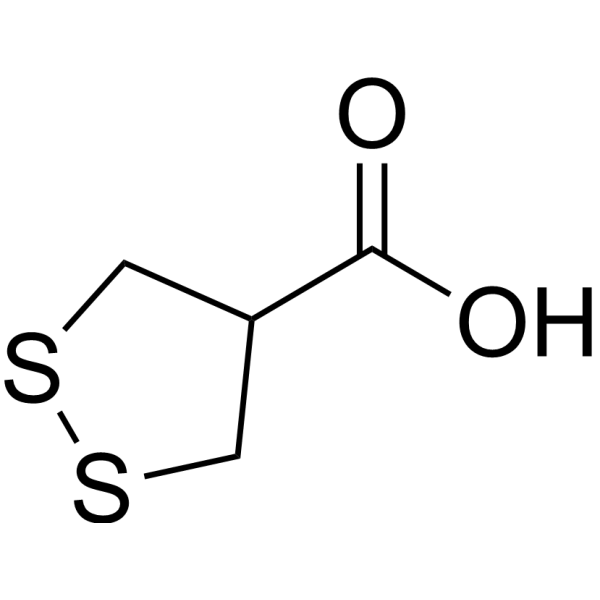
Physicochemical Properties
| Molecular Formula | C4H6O2S2 |
| Molecular Weight | 150.21924 |
| Exact Mass | 149.981 |
| CAS # | 2224-02-4 |
| PubChem CID | 16682 |
| Appearance | Light yellow to yellow solid powder |
| Density | 1.503g/cm3 |
| Boiling Point | 323.9ºC at 760mmHg |
| Melting Point | 75.7 - 76.5 °C |
| Flash Point | 149.7ºC |
| Vapour Pressure | 5.19E-05mmHg at 25°C |
| Index of Refraction | 1.645 |
| LogP | 1.082 |
| Hydrogen Bond Donor Count | 1 |
| Hydrogen Bond Acceptor Count | 4 |
| Rotatable Bond Count | 1 |
| Heavy Atom Count | 8 |
| Complexity | 98.2 |
| Defined Atom Stereocenter Count | 0 |
| InChi Key | AYGMEFRECNWRJC-UHFFFAOYSA-N |
| InChi Code | InChI=1S/C4H6O2S2/c5-4(6)3-1-7-8-2-3/h3H,1-2H2,(H,5,6) |
| Chemical Name | dithiolane-4-carboxylic acid |
| HS Tariff Code | 2934.99.9001 |
| Storage |
Powder-20°C 3 years 4°C 2 years In solvent -80°C 6 months -20°C 1 month Note: Please store this product in a sealed and protected environment (e.g. under nitrogen), avoid exposure to moisture. |
| Shipping Condition | Room temperature (This product is stable at ambient temperature for a few days during ordinary shipping and time spent in Customs) |
Biological Activity
| ln Vitro |
Asparagusic acid is poisonous to a variety of plant parasitic nematodes and has a significant role in asparagus resistance[2]. In lettuce and other seedlings, asparagusic acid suppresses growth at 6.67×10⁻⁷ M to 6.67×10⁻⁷ M[3]. Asparagusic acid exhibited potent nematicidal activity in vitro against plant-parasitic nematodes. At a concentration of 100 μg/mL, it caused 90% mortality of the tested nematodes within 24 hours of exposure [2] Asparagusic acid (10 μM–50 μM) dose-dependently inhibited the growth of etiolated young asparagus shoots in vitro. At 50 μM, it suppressed shoot elongation by 65% and reduced fresh weight by 58% compared to the control group [3] |
| ln Vivo |
In etiolated young asparagus plants, Asparagusic acid (endogenous concentration ~8 μM in shoots) acted as a natural growth inhibitor, suppressing internode elongation and limiting excessive shoot growth under dark conditions [3] In potted asparagus plants, exogenous application of Asparagusic acid (20 μM via root irrigation) reduced root colonization by plant-parasitic nematodes by 72% after 14 days, demonstrating in vivo nematicidal efficacy [2] |
| Cell Assay |
Plant cell growth inhibition assay: Etiolated asparagus shoot segments (1 cm in length) were prepared and cultured in liquid medium containing different concentrations of Asparagusic acid (10 μM–50 μM) in the dark at 25°C. After 7 days of incubation, shoot elongation length and fresh weight were measured to calculate the growth inhibition rate [3] Nematicidal activity assay: Plant-parasitic nematodes were collected and suspended in aqueous solutions of Asparagusic acid (50 μg/mL–200 μg/mL). The nematode suspension was incubated at 25°C, and mortality was recorded at 24-hour intervals by observing nematode motility under a microscope [2] |
| References |
[1]. Asparagusic acid. Phytochemistry. 2014 Jan;97:5-10. [2]. Identification of asparagusic acid as a nematicide occurring naturally in the roots of asparagus. Chemistry Letters (1975), (1), 43-4. [3]. Asparagusic acid, a new plant growth inhibitor in etiolated young asparagus shoots. Plant and Cell Physiology (1972), 13(5), 923-25. |
| Additional Infomation |
Asparagusic acid is a sulfur-containing carboxylic acid, a dithiolanecarboxylic acid and a member of dithiolanes. It is a conjugate acid of an asparagusate. It derives from a hydride of a 1,2-dithiolane. Asparagusic acid has been reported in Asparagus officinalis with data available. Asparagusic acid is a naturally occurring sulfur-containing heterocyclic compound, primarily isolated from the roots, shoots, and other tissues of Asparagus officinalis (asparagus) [1] The compound features a 1,2-dithiolane ring structure, which is proposed to contribute to its biological activities by mediating redox reactions or interacting with sulfhydryl groups of target biomolecules [1] As a natural nematicide, Asparagusic acid plays a role in the defense of asparagus plants against parasitic nematode infestations [2] Asparagusic acid functions as an endogenous plant growth regulator in asparagus, modulating shoot growth under etiolating conditions to adapt to light limitation [3] |
Solubility Data
| Solubility (In Vitro) | DMSO : ≥ 46 mg/mL (~306.22 mM) |
| Solubility (In Vivo) |
Solubility in Formulation 1: ≥ 2.5 mg/mL (16.64 mM) (saturation unknown) in 10% DMSO + 40% PEG300 + 5% Tween80 + 45% Saline (add these co-solvents sequentially from left to right, and one by one), clear solution. For example, if 1 mL of working solution is to be prepared, you can add 100 μL of 25.0 mg/mL clear DMSO stock solution to 400 μL PEG300 and mix evenly; then add 50 μL Tween-80 to the above solution and mix evenly; then add 450 μL normal saline to adjust the volume to 1 mL. Preparation of saline: Dissolve 0.9 g of sodium chloride in 100 mL ddH₂ O to obtain a clear solution. Solubility in Formulation 2: ≥ 2.5 mg/mL (16.64 mM) (saturation unknown) in 10% DMSO + 90% (20% SBE-β-CD in Saline) (add these co-solvents sequentially from left to right, and one by one), clear solution. For example, if 1 mL of working solution is to be prepared, you can add 100 μL of 25.0 mg/mL clear DMSO stock solution to 900 μL of 20% SBE-β-CD physiological saline solution and mix evenly. Preparation of 20% SBE-β-CD in Saline (4°C,1 week): Dissolve 2 g SBE-β-CD in 10 mL saline to obtain a clear solution. Solubility in Formulation 3: ≥ 2.5 mg/mL (16.64 mM) (saturation unknown) in 10% DMSO + 90% Corn Oil (add these co-solvents sequentially from left to right, and one by one), clear solution. For example, if 1 mL of working solution is to be prepared, you can add 100 μL of 25.0 mg/mL clear DMSO stock solution to 900 μL of corn oil and mix evenly. Solubility in Formulation 4: 2.5 mg/mL (16.64 mM) in 5% DMSO + 40% PEG300 + 5% Tween80 + 50% Saline (add these co-solvents sequentially from left to right, and one by one), suspension solution; with ultrasonication. Preparation of saline: Dissolve 0.9 g of sodium chloride in 100 mL ddH₂ O to obtain a clear solution. Solubility in Formulation 5: ≥ 2.5 mg/mL (16.64 mM) (saturation unknown) in 5% DMSO + 95% (20% SBE-β-CD in Saline) (add these co-solvents sequentially from left to right, and one by one), clear solution. Preparation of 20% SBE-β-CD in Saline (4°C,1 week): Dissolve 2 g SBE-β-CD in 10 mL saline to obtain a clear solution. Solubility in Formulation 6: ≥ 0.5 mg/mL (3.33 mM) (saturation unknown) in 1% DMSO 99% Saline (add these co-solvents sequentially from left to right, and one by one), clear solution. Preparation of saline: Dissolve 0.9 g of sodium chloride in 100 mL ddH₂ O to obtain a clear solution. (Please use freshly prepared in vivo formulations for optimal results.) |
| Preparing Stock Solutions | 1 mg | 5 mg | 10 mg | |
| 1 mM | 6.6569 mL | 33.2845 mL | 66.5690 mL | |
| 5 mM | 1.3314 mL | 6.6569 mL | 13.3138 mL | |
| 10 mM | 0.6657 mL | 3.3285 mL | 6.6569 mL |