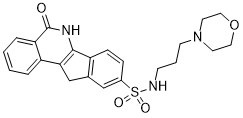
INO-1001 (also known as INO1001; INO 1001) is a novel isoindolinone based compound which acts as a potent inhibitor of the nuclear enzyme poly (ADP-ribose) polymerase (PARP) with chemosensitization and radiosensitization properties. INO-1001 inhibits PARP, which may result in inhibition of tumor cell DNA repair mechanisms and, so, tumor cell resistance to chemotherapy and radiation therapy. PARP enzymes are activated by DNA breaks and have been implicated in the repair of DNA single-strand breaks (SSB). as of 7/29/2016, many vendors are selling INO-1001 with wrong structure (3-aminobenzamide, CAS# 3544-24-9)
Physicochemical Properties
| Molecular Formula | C23H25N3O4S |
| Molecular Weight | 439.53 |
| Exact Mass | 439.157 |
| CAS # | 501364-82-5 |
| Related CAS # | 501364-82-5 |
| PubChem CID | 9889396 |
| Appearance | Light yellow to yellow solid powder |
| LogP | 3.921 |
| Hydrogen Bond Donor Count | 2 |
| Hydrogen Bond Acceptor Count | 6 |
| Rotatable Bond Count | 6 |
| Heavy Atom Count | 31 |
| Complexity | 815 |
| Defined Atom Stereocenter Count | 0 |
| InChi Key | LTZVLHHIAUKGBP-UHFFFAOYSA-N |
| InChi Code | InChI=1S/C23H25N3O4S/c27-23-20-5-2-1-4-19(20)21-15-16-14-17(6-7-18(16)22(21)25-23)31(28,29)24-8-3-9-26-10-12-30-13-11-26/h1-2,4-7,14,24H,3,8-13,15H2,(H,25,27) |
| Chemical Name | N-(3-morpholinopropyl)-5-oxo-6,11-dihydro-5H-indeno[1,2-c]isoquinoline-9-sulfonamide |
| Synonyms | IN01001 INO-1001 INO 1001 |
| HS Tariff Code | 2934.99.9001 |
| Storage |
Powder-20°C 3 years 4°C 2 years In solvent -80°C 6 months -20°C 1 month |
| Shipping Condition | Room temperature (This product is stable at ambient temperature for a few days during ordinary shipping and time spent in Customs) |
Biological Activity
| ln Vitro | In Chinese hamster chromosomal AA8 (CHO) cells, the IC50 of INO-1001 is 0.05 μM [1]. |
| References |
[1]. Radiosensitization of human and rodent cell lines by INO-1001, a novel inhibitor of poly(ADP-ribose) polymerase. Cancer Lett. 2004 Mar 18;205(2):155-60. [2]. INO-1001, a novel inhibitor of poly(ADP-ribose) polymerase, enhances tumor response to doxorubicin. Invest New Drugs. 2008 Feb;26(1):1-5. Epub 2007 Jul 13. |
| Additional Infomation | See also: Ino-1001 (annotation moved to). |
Solubility Data
| Solubility (In Vitro) | DMSO : ~31.25 mg/mL (~71.10 mM) |
| Solubility (In Vivo) |
Solubility in Formulation 1: ≥ 2.08 mg/mL (4.73 mM) (saturation unknown) in 10% DMSO + 40% PEG300 + 5% Tween80 + 45% Saline (add these co-solvents sequentially from left to right, and one by one), clear solution. For example, if 1 mL of working solution is to be prepared, you can add 100 μL of 20.8 mg/mL clear DMSO stock solution to 400 μL PEG300 and mix evenly; then add 50 μL Tween-80 to the above solution and mix evenly; then add 450 μL normal saline to adjust the volume to 1 mL. Preparation of saline: Dissolve 0.9 g of sodium chloride in 100 mL ddH₂ O to obtain a clear solution. Solubility in Formulation 2: ≥ 2.08 mg/mL (4.73 mM) (saturation unknown) in 10% DMSO + 90% Corn Oil (add these co-solvents sequentially from left to right, and one by one), clear solution. For example, if 1 mL of working solution is to be prepared, you can add 100 μL of 20.8 mg/mL clear DMSO stock solution to 900 μL of corn oil and mix evenly. (Please use freshly prepared in vivo formulations for optimal results.) |
| Preparing Stock Solutions | 1 mg | 5 mg | 10 mg | |
| 1 mM | 2.2752 mL | 11.3758 mL | 22.7516 mL | |
| 5 mM | 0.4550 mL | 2.2752 mL | 4.5503 mL | |
| 10 mM | 0.2275 mL | 1.1376 mL | 2.2752 mL |