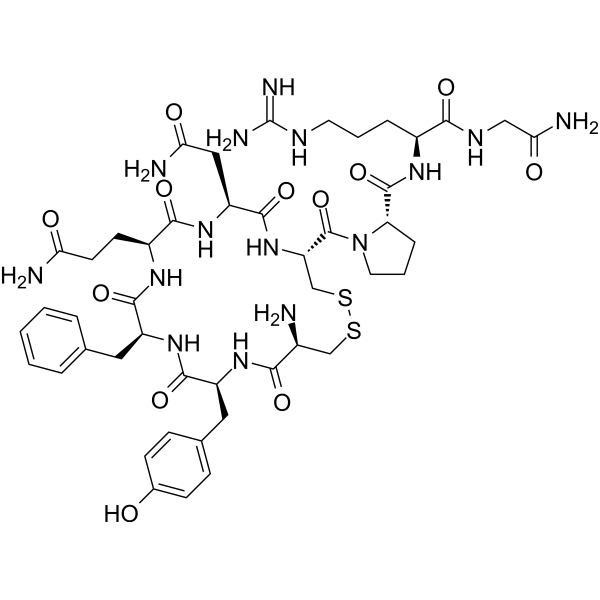
Physicochemical Properties
| Molecular Formula | C46H65N15O12S2 |
| Molecular Weight | 1084.23 |
| Exact Mass | 1083.437 |
| CAS # | 113-79-1 |
| Related CAS # | Argipressin diacetate;75499-44-4;Argipressin acetate;129979-57-3 |
| PubChem CID | 644077 |
| Appearance | White to off-white solid powder |
| Density | 1.6±0.1 g/cm3 |
| Flash Point | 113℃ |
| Index of Refraction | 1.724 |
| LogP | -5.99 |
| Hydrogen Bond Donor Count | 14 |
| Hydrogen Bond Acceptor Count | 16 |
| Rotatable Bond Count | 19 |
| Heavy Atom Count | 75 |
| Complexity | 2070 |
| Defined Atom Stereocenter Count | 8 |
| SMILES | C1=CC=C(CC2NC(=O)C(CC3=CC=C(O)C=C3)NC(=O)C(N)CSSCC(C(N3C(C(NC(C(NCC(N)=O)=O)CCC/N=C(\N)/N)=O)CCC3)=O)NC(=O)C(CC(N)=O)NC(=O)C(CCC(N)=O)NC2=O)C=C1 |
| HS Tariff Code | 2934.99.9001 |
| Storage |
Powder-20°C 3 years 4°C 2 years In solvent -80°C 6 months -20°C 1 month Note: Please store this product in a sealed and protected environment (e.g. under nitrogen), avoid exposure to moisture and light. |
| Shipping Condition | Room temperature (This product is stable at ambient temperature for a few days during ordinary shipping and time spent in Customs) |
Biological Activity
| ln Vitro | Arbopressin binds to A7r5 arterial aortic smooth muscle cells via vasopressin uptake V1, with a Kd of 1.31 nM. Additionally, it promotes immunological response against S-100 in non-cultured DRG cells, AVP-induced [Ca2+]i signaling, and intracellular calcium release in A7r5 cells (EC50=5 nM) [1]. The lowest effective dose of argipressin required to elicit a [Ca2+]i response in DRG cultured neuronal cells is 100 pM[2]. |
| References |
[1]. Multiple signaling pathways of V1-vascular vasopressin receptors of A7r5 cells. Endocrinology. 1991 Dec;129(6):2845-56. [2]. Vasopressin-induced intracellular Ca²⁺ concentration responses in non-neuronal cells of the rat dorsal root ganglion. Brain Res. 2012 Nov 5;1483:1-12. [3]. Role of vasopressin in current anesthetic practice. Korean J Anesthesiol. 2017 Jun; 70(3): 245–257. |
| Additional Infomation |
Argipressin is the predominant form of mammalian vasopressin (antidiuretic hormone). It is a nonapeptide containing an arginine at residue 8 and two disulfide-linked cysteines at residues of 1 and 6. It has a role as a cardiovascular drug, a hematologic agent and a mitogen. It is a conjugate base of an argipressin(2+). Argipressin is a synthetic peptide identical to the endogenous nonapeptide hormone with antidiuretic property. Synthesized in the hypothalamus and stored/released from the posterior lobe of the pituitary, argipressin's primary function is regulating extracellular fluid volume. This agent can also act as a vasoconstrictor, increasing blood pressure and systemic vascular resistance. The predominant form of mammalian antidiuretic hormone. It is a nonapeptide containing an ARGININE at residue 8 and two disulfide-linked cysteines at residues of 1 and 6. Arg-vasopressin is used to treat DIABETES INSIPIDUS or to improve vasomotor tone and BLOOD PRESSURE. |
Solubility Data
| Solubility (In Vitro) | H2O : ~100 mg/mL (~92.23 mM) |
| Solubility (In Vivo) |
Note: Listed below are some common formulations that may be used to formulate products with low water solubility (e.g. < 1 mg/mL), you may test these formulations using a minute amount of products to avoid loss of samples. Injection Formulations (e.g. IP/IV/IM/SC) Injection Formulation 1: DMSO : Tween 80: Saline = 10 : 5 : 85 (i.e. 100 μL DMSO stock solution → 50 μL Tween 80 → 850 μL Saline) *Preparation of saline: Dissolve 0.9 g of sodium chloride in 100 mL ddH ₂ O to obtain a clear solution. Injection Formulation 2: DMSO : PEG300 :Tween 80 : Saline = 10 : 40 : 5 : 45 (i.e. 100 μL DMSO → 400 μLPEG300 → 50 μL Tween 80 → 450 μL Saline) Injection Formulation 3: DMSO : Corn oil = 10 : 90 (i.e. 100 μL DMSO → 900 μL Corn oil) Example: Take the Injection Formulation 3 (DMSO : Corn oil = 10 : 90) as an example, if 1 mL of 2.5 mg/mL working solution is to be prepared, you can take 100 μL 25 mg/mL DMSO stock solution and add to 900 μL corn oil, mix well to obtain a clear or suspension solution (2.5 mg/mL, ready for use in animals). Injection Formulation 4: DMSO : 20% SBE-β-CD in saline = 10 : 90 [i.e. 100 μL DMSO → 900 μL (20% SBE-β-CD in saline)] *Preparation of 20% SBE-β-CD in Saline (4°C,1 week): Dissolve 2 g SBE-β-CD in 10 mL saline to obtain a clear solution. Injection Formulation 5: 2-Hydroxypropyl-β-cyclodextrin : Saline = 50 : 50 (i.e. 500 μL 2-Hydroxypropyl-β-cyclodextrin → 500 μL Saline) Injection Formulation 6: DMSO : PEG300 : castor oil : Saline = 5 : 10 : 20 : 65 (i.e. 50 μL DMSO → 100 μLPEG300 → 200 μL castor oil → 650 μL Saline) Injection Formulation 7: Ethanol : Cremophor : Saline = 10: 10 : 80 (i.e. 100 μL Ethanol → 100 μL Cremophor → 800 μL Saline) Injection Formulation 8: Dissolve in Cremophor/Ethanol (50 : 50), then diluted by Saline Injection Formulation 9: EtOH : Corn oil = 10 : 90 (i.e. 100 μL EtOH → 900 μL Corn oil) Injection Formulation 10: EtOH : PEG300:Tween 80 : Saline = 10 : 40 : 5 : 45 (i.e. 100 μL EtOH → 400 μLPEG300 → 50 μL Tween 80 → 450 μL Saline) Oral Formulations Oral Formulation 1: Suspend in 0.5% CMC Na (carboxymethylcellulose sodium) Oral Formulation 2: Suspend in 0.5% Carboxymethyl cellulose Example: Take the Oral Formulation 1 (Suspend in 0.5% CMC Na) as an example, if 100 mL of 2.5 mg/mL working solution is to be prepared, you can first prepare 0.5% CMC Na solution by measuring 0.5 g CMC Na and dissolve it in 100 mL ddH2O to obtain a clear solution; then add 250 mg of the product to 100 mL 0.5% CMC Na solution, to make the suspension solution (2.5 mg/mL, ready for use in animals). Oral Formulation 3: Dissolved in PEG400 Oral Formulation 4: Suspend in 0.2% Carboxymethyl cellulose Oral Formulation 5: Dissolve in 0.25% Tween 80 and 0.5% Carboxymethyl cellulose Oral Formulation 6: Mixing with food powders Note: Please be aware that the above formulations are for reference only. InvivoChem strongly recommends customers to read literature methods/protocols carefully before determining which formulation you should use for in vivo studies, as different compounds have different solubility properties and have to be formulated differently. (Please use freshly prepared in vivo formulations for optimal results.) |
| Preparing Stock Solutions | 1 mg | 5 mg | 10 mg | |
| 1 mM | 0.9223 mL | 4.6116 mL | 9.2231 mL | |
| 5 mM | 0.1845 mL | 0.9223 mL | 1.8446 mL | |
| 10 mM | 0.0922 mL | 0.4612 mL | 0.9223 mL |