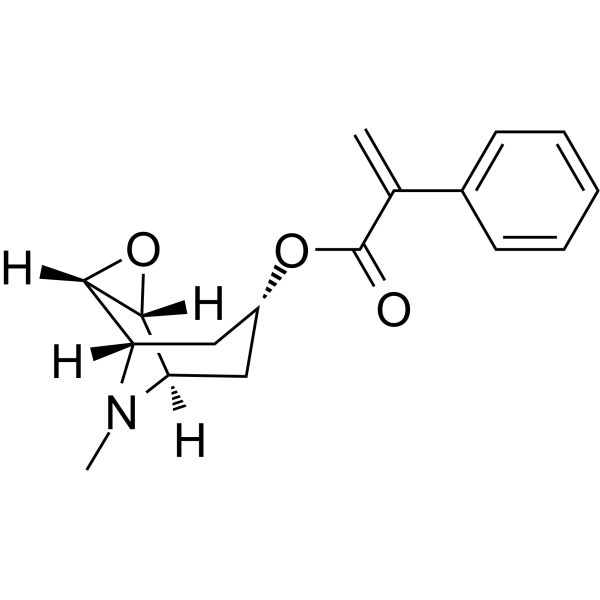
Physicochemical Properties
| Molecular Formula | C17H19NO3 |
| Molecular Weight | 285.33766 |
| Exact Mass | 285.136 |
| CAS # | 535-26-2 |
| PubChem CID | 3083622 |
| Appearance | White to off-white solid powder |
| Density | 1.25g/cm3 |
| Boiling Point | 415.5ºC at 760mmHg |
| Melting Point | 95-98ºC |
| Flash Point | 205.1ºC |
| Index of Refraction | 1.604 |
| LogP | 1.793 |
| Hydrogen Bond Donor Count | 0 |
| Hydrogen Bond Acceptor Count | 4 |
| Rotatable Bond Count | 4 |
| Heavy Atom Count | 21 |
| Complexity | 439 |
| Defined Atom Stereocenter Count | 4 |
| SMILES | CN1[C@@H]2CC(C[C@H]1[C@H]3[C@@H]2O3)OC(=O)C(=C)C4=CC=CC=C4 |
| InChi Key | JJNVDCBKBUSUII-LHIUVBILSA-N |
| InChi Code | InChI=1S/C17H19NO3/c1-10(11-6-4-3-5-7-11)17(19)20-12-8-13-15-16(21-15)14(9-12)18(13)2/h3-7,12-16H,1,8-9H2,2H3/t12?,13-,14+,15-,16+ |
| Chemical Name | [(1S,2S,4R,5R)-9-methyl-3-oxa-9-azatricyclo[3.3.1.02,4]nonan-7-yl] 2-phenylprop-2-enoate |
| Synonyms | Apohyoscine; 535-26-2; UNII-RQ98RV32RG; 1alphaH,5alphaH-Tropan-3alpha-ol, 6beta,7beta-epoxy-, atropate (ester); Aposcopolamin; ((3S,6S)-6-hydroxy-8-methyl-8-azabicyclo(3.2.1)octan-3-yl) (2R)-3-hydroxy-2-phenyl-propanoate; (1R,2R,4S,5S,7R)-9-Methyl-3-oxa-9-azatricyclo(3.3.1.0,)nonan-7-yl 2-phenylprop-2-enoic acid; (1R,2R,4S,5S,7R)-9-Methyl-3-oxa-9-azatricyclo[3.3.1.0,]nonan-7-yl 2-phenylprop-2-enoic acid; |
| HS Tariff Code | 2934.99.9001 |
| Storage |
Powder-20°C 3 years 4°C 2 years In solvent -80°C 6 months -20°C 1 month Note: This product requires protection from light (avoid light exposure) during transportation and storage. |
| Shipping Condition | Room temperature (This product is stable at ambient temperature for a few days during ordinary shipping and time spent in Customs) |
Biological Activity
| Targets | ACHE; ADRA2A; CHRM2 |
| ln Vitro | Aposcopolamine is one of the components of Kai - Xin - San. Molecular docking shows that it can be closely bound to AChE, ADRA2A and CHRM2, which may be one of the mechanisms of Kai - Xin - San in the treatment of Alzheimer 's disease. |
| References |
[1]. Integrated meta-analysis, network pharmacology, and molecular docking to investigate the efficacy and potential pharmacological mechanism of Kai-Xin-San on Alzheimer's disease. Pharm Biol. 2020 Dec;58(1):932-943. |
| Additional Infomation | Aposcopolamine is one of the components of Kai - Xin - San. Molecular docking shows that it can be closely bound to AChE, ADRA2A and CHRM2, which may be one of the mechanisms of Kai - Xin - San in the treatment of Alzheimer 's disease. |
Solubility Data
| Solubility (In Vitro) | DMSO : ~25 mg/mL (~87.61 mM) |
| Solubility (In Vivo) |
Solubility in Formulation 1: 2.5 mg/mL (8.76 mM) in 10% DMSO + 40% PEG300 +5% Tween-80 + 45% Saline (add these co-solvents sequentially from left to right, and one by one), clear solution; with sonication. For example, if 1 mL of working solution is to be prepared, you can add 100 μL of 25.0 mg/mL clear DMSO stock solution to 400 μL PEG300 and mix evenly; then add 50 μL Tween-80 + to the above solution and mix evenly; then add 450 μL normal saline to adjust the volume to 1 mL. Preparation of saline: Dissolve 0.9 g of sodium chloride in 100 mL ddH₂ O to obtain a clear solution. (Please use freshly prepared in vivo formulations for optimal results.) |
| Preparing Stock Solutions | 1 mg | 5 mg | 10 mg | |
| 1 mM | 3.5046 mL | 17.5230 mL | 35.0459 mL | |
| 5 mM | 0.7009 mL | 3.5046 mL | 7.0092 mL | |
| 10 mM | 0.3505 mL | 1.7523 mL | 3.5046 mL |