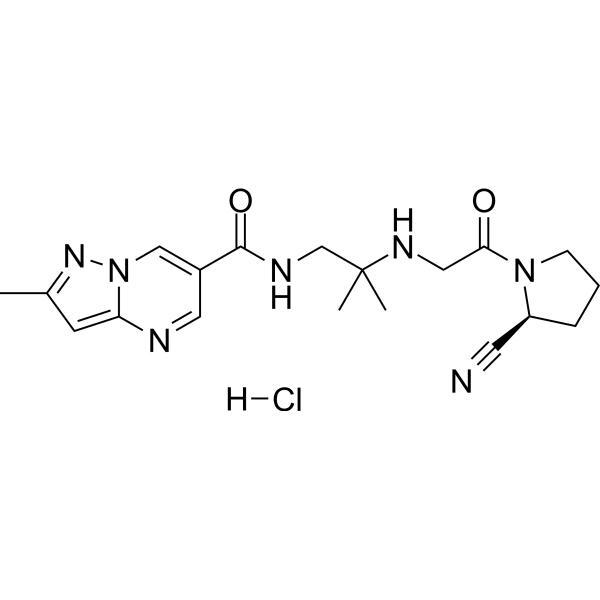
Physicochemical Properties
| Molecular Formula | C19H26CLN7O2 |
| Molecular Weight | 419.908442020416 |
| Exact Mass | 419.183 |
| CAS # | 1359670-56-6 |
| Related CAS # | Anagliptin;739366-20-2 |
| PubChem CID | 54764334 |
| Appearance | Typically exists as solid at room temperature |
| Hydrogen Bond Donor Count | 3 |
| Hydrogen Bond Acceptor Count | 6 |
| Rotatable Bond Count | 6 |
| Heavy Atom Count | 29 |
| Complexity | 643 |
| Defined Atom Stereocenter Count | 1 |
| SMILES | Cl.O=C(CNC(C)(C)CNC(C1C=NC2=CC(C)=NN2C=1)=O)N1CCC[C@H]1C#N |
| InChi Key | SRIIFFBJIKZICS-UHFFFAOYSA-N |
| InChi Code | InChI=1S/C19H25N7O2.ClH/c1-13-7-16-21-9-14(11-26(16)24-13)18(28)22-12-19(2,3)23-10-17(27)25-6-4-5-15(25)8-20;/h7,9,11,15,23H,4-6,10,12H2,1-3H3,(H,22,28);1H |
| Chemical Name | N-[2-[[2-(2-cyanopyrrolidin-1-yl)-2-oxoethyl]amino]-2-methylpropyl]-2-methylpyrazolo[1,5-a]pyrimidine-6-carboxamide;hydrochloride |
| HS Tariff Code | 2934.99.9001 |
| Storage |
Powder-20°C 3 years 4°C 2 years In solvent -80°C 6 months -20°C 1 month |
| Shipping Condition | Room temperature (This product is stable at ambient temperature for a few days during ordinary shipping and time spent in Customs) |
Biological Activity
| ln Vitro | Anagliptin (SK-0403) (0-100 μM; 24 hours) inhibits the proliferation of smooth muscle cells induced by s-DPP-4 [2]. In cultured monocytes, anagliptin (100 μM; 10 min) decreases TNF-α production [2]. In HepG2 cells, anagliptin (0.001-10 μM; 24 hours) significantly (by 21%) inhibits the activity of the sterol regulatory element-binding protein [3]. |
| ln Vivo | In apolipoprotein E (apoE)-deficient mice, alogliptin (SK-0403) (0.3%; diet; 16 weeks) decreases atherosclerotic lesions without raising the amount of circulating EPCs [2]. In a mouse model of hyperlipidemia, alogliptin (0.3%; in diet; 4 weeks) shows lipid-lowering effects [3]. |
| Cell Assay |
Cell proliferation assay[2] Cell Types: rat smooth muscle cells (SMC) Tested Concentrations: 1, 10 and 100 μM Incubation Duration: 24 hrs (hours) Experimental Results: Attenuated s-DPP-4-induced SMC proliferation in a dose-dependent manner. Inhibits LPS-induced ERK phosphorylation and Dramatically inhibits LPS-induced NF-κBp65 nuclear translocation. Western Blot Analysis[2] Cell Types: Rat Smooth Muscle Cells (SMC) Tested Concentrations: 100 μM Incubation Duration: 10 minutes Experimental Results: Blocks s-DPP-4-induced early but not late ERK phosphorylation. |
| Animal Protocol |
Animal/Disease Models: Male low-density lipoprotein receptor-deficient mice (B6.129S7-Ldlrtm1Her/J) [3] Doses: 0.3% Route of Administration: Diet, 4 weeks Experimental Results: Dramatically diminished plasma total cholesterol (lowered by 14 %) and triglyceride levels (27% reduction). Dramatically lowers LDL and VLDL cholesterol. Sterol regulatory element binding protein 2 messenger RNA expression levels were Dramatically diminished at night. Animal/Disease Models: Male SD (SD (Sprague-Dawley)) rat and Beagle dog [1] Doses: 0.2, 0.5, 1 and 10 mg/kg Route of Administration: Oral or intravenous (iv) (iv)injection (pharmacokinetic/PK/PK study) Experimental Results: Alogliptin hydrochloride Selected PK parameters in rats and dogs [1] ] Compound class CLtot (l/h/kg) Vdss (l/h/kg) Cmaxc (ng/ml) Tmaxc (h) T1/2 (h) AUC ( ng/h/ml) BA (%) Alogliptin hydrochloridea Rat 2.00 (iv) 0.68 (iv) 309 (62) (po) 0.8 (2.3) (po) 1.9 (po) 1160 (po) 23 ( po) Dog 0.65 (iv) 0.83 (iv) 261 (po) 1.5 (po) ) 1.0 (po) 824 (po) 100 (po) a Rat alogliptin hydrochloride dose, 1 mg/kg, intravenous (iv) (iv)inject |
| References |
[1]. Discovery and pharmacological characterization of N-[2-({2-[(2S)-2-cyanopyrrolidin-1-yl]-2-oxoethyl}amino)-2-methylpropyl]-2-methylpyrazolo[1,5-a]pyrimidine-6-carboxamide hydrochloride (anagliptin hydrochloride salt) as a potent and selective DPP-IV inhibitor. Bioorg Med Chem. 2011 Dec 1;19(23):7221-7. [2]. Anagliptin, a DPP-4 inhibitor, suppresses proliferation of vascular smooth muscles and monocyte inflammatory reaction and attenuates atherosclerosis in male apo E-deficient mice. Endocrinology. 2013 Mar;154(3):1260-70. [3]. Mechanism of lipid-lowering action of the dipeptidyl peptidase-4 inhibitor, anagliptin, in low-density lipoprotein receptor-deficient mice. J Diabetes Investig. 2017 Mar;8(2):155-160. |
Solubility Data
| Solubility (In Vitro) | May dissolve in DMSO (in most cases), if not, try other solvents such as H2O, Ethanol, or DMF with a minute amount of products to avoid loss of samples |
| Solubility (In Vivo) |
Note: Listed below are some common formulations that may be used to formulate products with low water solubility (e.g. < 1 mg/mL), you may test these formulations using a minute amount of products to avoid loss of samples. Injection Formulations (e.g. IP/IV/IM/SC) Injection Formulation 1: DMSO : Tween 80: Saline = 10 : 5 : 85 (i.e. 100 μL DMSO stock solution → 50 μL Tween 80 → 850 μL Saline) *Preparation of saline: Dissolve 0.9 g of sodium chloride in 100 mL ddH ₂ O to obtain a clear solution. Injection Formulation 2: DMSO : PEG300 :Tween 80 : Saline = 10 : 40 : 5 : 45 (i.e. 100 μL DMSO → 400 μLPEG300 → 50 μL Tween 80 → 450 μL Saline) Injection Formulation 3: DMSO : Corn oil = 10 : 90 (i.e. 100 μL DMSO → 900 μL Corn oil) Example: Take the Injection Formulation 3 (DMSO : Corn oil = 10 : 90) as an example, if 1 mL of 2.5 mg/mL working solution is to be prepared, you can take 100 μL 25 mg/mL DMSO stock solution and add to 900 μL corn oil, mix well to obtain a clear or suspension solution (2.5 mg/mL, ready for use in animals). Injection Formulation 4: DMSO : 20% SBE-β-CD in saline = 10 : 90 [i.e. 100 μL DMSO → 900 μL (20% SBE-β-CD in saline)] *Preparation of 20% SBE-β-CD in Saline (4°C,1 week): Dissolve 2 g SBE-β-CD in 10 mL saline to obtain a clear solution. Injection Formulation 5: 2-Hydroxypropyl-β-cyclodextrin : Saline = 50 : 50 (i.e. 500 μL 2-Hydroxypropyl-β-cyclodextrin → 500 μL Saline) Injection Formulation 6: DMSO : PEG300 : castor oil : Saline = 5 : 10 : 20 : 65 (i.e. 50 μL DMSO → 100 μLPEG300 → 200 μL castor oil → 650 μL Saline) Injection Formulation 7: Ethanol : Cremophor : Saline = 10: 10 : 80 (i.e. 100 μL Ethanol → 100 μL Cremophor → 800 μL Saline) Injection Formulation 8: Dissolve in Cremophor/Ethanol (50 : 50), then diluted by Saline Injection Formulation 9: EtOH : Corn oil = 10 : 90 (i.e. 100 μL EtOH → 900 μL Corn oil) Injection Formulation 10: EtOH : PEG300:Tween 80 : Saline = 10 : 40 : 5 : 45 (i.e. 100 μL EtOH → 400 μLPEG300 → 50 μL Tween 80 → 450 μL Saline) Oral Formulations Oral Formulation 1: Suspend in 0.5% CMC Na (carboxymethylcellulose sodium) Oral Formulation 2: Suspend in 0.5% Carboxymethyl cellulose Example: Take the Oral Formulation 1 (Suspend in 0.5% CMC Na) as an example, if 100 mL of 2.5 mg/mL working solution is to be prepared, you can first prepare 0.5% CMC Na solution by measuring 0.5 g CMC Na and dissolve it in 100 mL ddH2O to obtain a clear solution; then add 250 mg of the product to 100 mL 0.5% CMC Na solution, to make the suspension solution (2.5 mg/mL, ready for use in animals). Oral Formulation 3: Dissolved in PEG400 Oral Formulation 4: Suspend in 0.2% Carboxymethyl cellulose Oral Formulation 5: Dissolve in 0.25% Tween 80 and 0.5% Carboxymethyl cellulose Oral Formulation 6: Mixing with food powders Note: Please be aware that the above formulations are for reference only. InvivoChem strongly recommends customers to read literature methods/protocols carefully before determining which formulation you should use for in vivo studies, as different compounds have different solubility properties and have to be formulated differently. (Please use freshly prepared in vivo formulations for optimal results.) |
| Preparing Stock Solutions | 1 mg | 5 mg | 10 mg | |
| 1 mM | 2.3815 mL | 11.9073 mL | 23.8146 mL | |
| 5 mM | 0.4763 mL | 2.3815 mL | 4.7629 mL | |
| 10 mM | 0.2381 mL | 1.1907 mL | 2.3815 mL |