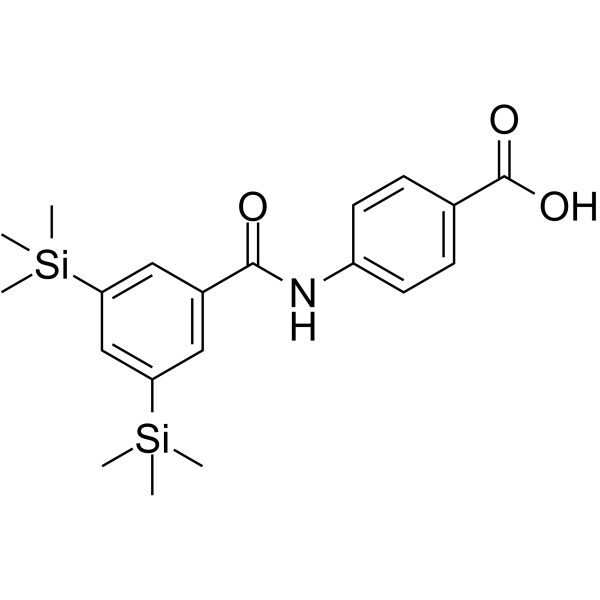
Physicochemical Properties
| Molecular Formula | C20H27NO3SI2 |
| Molecular Weight | 385.60428 |
| Exact Mass | 385.152 |
| CAS # | 125973-56-0 |
| PubChem CID | 9800306 |
| Appearance | White to off-white solid powder |
| Density | 1.1±0.1 g/cm3 |
| Boiling Point | 403.3±45.0 °C at 760 mmHg |
| Flash Point | 197.7±28.7 °C |
| Vapour Pressure | 0.0±1.0 mmHg at 25°C |
| Index of Refraction | 1.550 |
| LogP | 7.73 |
| Hydrogen Bond Donor Count | 2 |
| Hydrogen Bond Acceptor Count | 3 |
| Rotatable Bond Count | 5 |
| Heavy Atom Count | 26 |
| Complexity | 494 |
| Defined Atom Stereocenter Count | 0 |
| InChi Key | VVTNSTLJOVCBDL-UHFFFAOYSA-N |
| InChi Code | InChI=1S/C20H27NO3Si2/c1-25(2,3)17-11-15(12-18(13-17)26(4,5)6)19(22)21-16-9-7-14(8-10-16)20(23)24/h7-13H,1-6H3,(H,21,22)(H,23,24) |
| Chemical Name | 4-[[3,5-bis(trimethylsilyl)benzoyl]amino]benzoic acid |
| HS Tariff Code | 2934.99.9001 |
| Storage |
Powder-20°C 3 years 4°C 2 years In solvent -80°C 6 months -20°C 1 month |
| Shipping Condition | Room temperature (This product is stable at ambient temperature for a few days during ordinary shipping and time spent in Customs) |
Biological Activity
| ln Vitro | In human epithelial ovarian cancer-derived cell lines, amsilarotene (0, 10, 25 μM; 24 hours) causes apoptosis in a concentration-dependent manner [2]. The proliferation of BxPC-3 and MIAPaCa-2 cells is inhibited by amsilarotene (10, 20 μM; 0, 3, 6, and 9 days) [3]. The fraction of G1-phase sensitive BxPC-3 cells increases in response to amsilarotene (10 μM; 48 hours) [3]. Over a period of 24 to 72 hours, amsilarotene (10 μM; 0, 3, 6, 24, 48, and 72 hours) suppresses the phosphorylation of the retinoblastoma gene product (RB) in BxPC-3 cells [3]. |
| ln Vivo | Amsilarotene (8 mg/kg/day, orally, for 30 days) suppresses RMG-II tumor growth in nude mice [2]. |
| Cell Assay |
Apoptosis analysis[2] Cell Types: RMG-I, RMG-II, RTSG, RMUG-S, RMUG-L and KF Cell Tested Concentrations: 0, 10, 25 μM Incubation Duration: 24 hrs (hours) Experimental Results: Induced at certain concentrations Apoptosis was dependent on all cell lines except KF cells. Cell proliferation assay [3] Cell Types: BxPC-3, MIAPaCa-2, AsPC-1 Cell Tested Concentrations: 10 and 20 μM Incubation Duration: 0, 3, 6 and 9 days. Experimental Results: Inhibited the proliferation of BxPC-3 and MIAPaCa-2 cells, but not inhibited the proliferation of AsPC-1 cells. Cell cycle analysis [3] Cell Types: Sensitive BxPC-3 cells Tested Concentrations: 10 μM Incubation Duration: 48 hrs (hours) Experimental Results: The proportion of cells in G1 phase increased from 43% to 86% of untreated control cells |
| Animal Protocol |
Animal/Disease Models: 6weeks old female BALB/c nu/nu subcutaneousRMG-II tumor mice [2] Doses: 8 mg/kg/day Route of Administration: Oral administration for 30 days Experimental Results: Maximum tumor growth inhibition effect was seen after administration On day 31, relative tumor volume (RTV) diminished by 45%. |
| References |
[1]. Differential effects of synthetic nuclear retinoid receptor-selective retinoids on the growth of human non-small cell lung carcinoma cells. Cancer Res. 1997 Nov 1;57(21):4931-9. [2]. A novel retinoid, 4-[3,5-bis (trimethylsilyl) benzamido] benzoic acid (TAC-101), induces apoptosis of human ovarian carcinoma cells and shows potential as a new antitumor agent for clear cell adenocarcinoma. Gynecol Oncol. 2004 Sep;94(3):. [3]. Induction of cell-cycle arrest and apoptosis by a novel retinobenzoic-acid derivative, TAC-101, in human pancreatic-cancer cells. Int J Cancer. 1999 May 17;81(4):637-44. |
| Additional Infomation | Amsilarotene is a retinobenzoic acid with potential antineoplastic activity. Amsilarotene inhibits retinoblastoma-gene product (RB) phosphorylation and increases the presence of 2 cyclin-dependent kinase (CDK) inhibitors, resulting in cell cycle arrest. This agent also causes a cytotoxic decline in cyclin A and thymidylate synthase expression. |
Solubility Data
| Solubility (In Vitro) | DMSO : ~100 mg/mL (~259.34 mM) |
| Solubility (In Vivo) |
Solubility in Formulation 1: ≥ 2.5 mg/mL (6.48 mM) (saturation unknown) in 10% DMSO + 40% PEG300 + 5% Tween80 + 45% Saline (add these co-solvents sequentially from left to right, and one by one), clear solution. For example, if 1 mL of working solution is to be prepared, you can add 100 μL of 25.0 mg/mL clear DMSO stock solution to 400 μL PEG300 and mix evenly; then add 50 μL Tween-80 to the above solution and mix evenly; then add 450 μL normal saline to adjust the volume to 1 mL. Preparation of saline: Dissolve 0.9 g of sodium chloride in 100 mL ddH₂ O to obtain a clear solution. Solubility in Formulation 2: 2.5 mg/mL (6.48 mM) in 10% DMSO + 90% (20% SBE-β-CD in Saline) (add these co-solvents sequentially from left to right, and one by one), suspension solution; with ultrasonication. For example, if 1 mL of working solution is to be prepared, you can add 100 μL of 25.0 mg/mL clear DMSO stock solution to 900 μL of 20% SBE-β-CD physiological saline solution and mix evenly. Preparation of 20% SBE-β-CD in Saline (4°C,1 week): Dissolve 2 g SBE-β-CD in 10 mL saline to obtain a clear solution. Solubility in Formulation 3: ≥ 2.5 mg/mL (6.48 mM) (saturation unknown) in 10% DMSO + 90% Corn Oil (add these co-solvents sequentially from left to right, and one by one), clear solution. For example, if 1 mL of working solution is to be prepared, you can add 100 μL of 25.0 mg/mL clear DMSO stock solution to 900 μL of corn oil and mix evenly. (Please use freshly prepared in vivo formulations for optimal results.) |
| Preparing Stock Solutions | 1 mg | 5 mg | 10 mg | |
| 1 mM | 2.5934 mL | 12.9668 mL | 25.9336 mL | |
| 5 mM | 0.5187 mL | 2.5934 mL | 5.1867 mL | |
| 10 mM | 0.2593 mL | 1.2967 mL | 2.5934 mL |