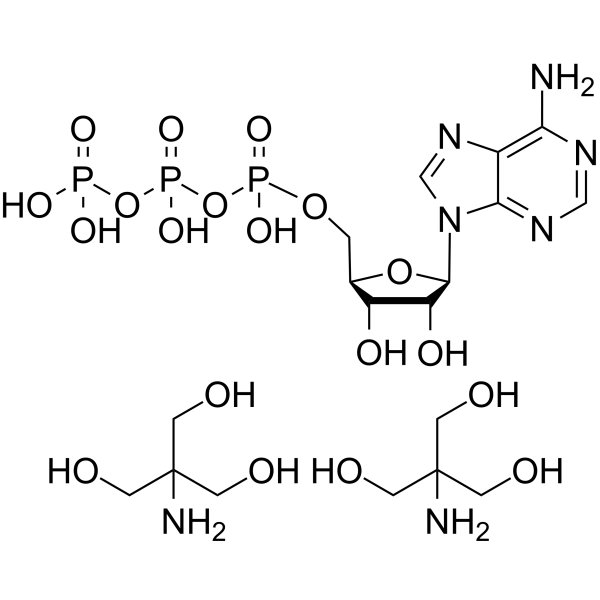
Physicochemical Properties
| Molecular Formula | C10H16N5O13P3 |
| Molecular Weight | 507.18 |
| Exact Mass | 767.154 |
| CAS # | 102047-34-7 |
| Related CAS # | ATP;56-65-5;ATP disodium trihydrate;51963-61-2;ATP dimagnesium;74804-12-9;ATP dipotassium;42373-41-1 |
| PubChem CID | 45052362 |
| Appearance | Typically exists as solid at room temperature |
| Hydrogen Bond Donor Count | 15 |
| Hydrogen Bond Acceptor Count | 25 |
| Rotatable Bond Count | 14 |
| Heavy Atom Count | 47 |
| Complexity | 854 |
| Defined Atom Stereocenter Count | 4 |
| SMILES | O.OCC(CO)(N)CO.OCC(CO)(N)CO.OP(OP(OP(OC[C@H]1O[C@@H](N2C=NC3=C(N=CN=C23)N)[C@H](O)[C@@H]1O)(O)=O)(O)=O)(O)=O |
| InChi Key | RFLPQCVEEHGPOA-IDIVVRGQSA-N |
| InChi Code | InChI=1S/C10H16N5O13P3.2C4H11NO3/c11-8-5-9(13-2-12-8)15(3-14-5)10-7(17)6(16)4(26-10)1-25-30(21,22)28-31(23,24)27-29(18,19)20;2*5-4(1-6,2-7)3-8/h2-4,6-7,10,16-17H,1H2,(H,21,22)(H,23,24)(H2,11,12,13)(H2,18,19,20);2*6-8H,1-3,5H2/t4-,6-,7-,10-;;/m1../s1 |
| Chemical Name | 2-amino-2-(hydroxymethyl)propane-1,3-diol;[[(2R,3S,4R,5R)-5-(6-aminopurin-9-yl)-3,4-dihydroxyoxolan-2-yl]methoxy-hydroxyphosphoryl] phosphono hydrogen phosphate |
| Synonyms | ATP ditromethamine; Adenosine 5'-triphosphate tris from |
| HS Tariff Code | 2934.99.9001 |
| Storage |
Powder-20°C 3 years 4°C 2 years In solvent -80°C 6 months -20°C 1 month |
| Shipping Condition | Room temperature (This product is stable at ambient temperature for a few days during ordinary shipping and time spent in Customs) |
Biological Activity
| Targets | Endogenous Metabolite |
| ln Vitro | In vitro studies suggest that extracellular nucleotides and nucleosides may be important regulators of inflammatory and immune responses. Most studies with adenosine 5'-triphosphate (ATP) have been performed in cell lines, which are remote from the human situation. The purpose of the present study was to determine the effects of ATP on TNF-alpha, IL-6 and IL-10 release in stimulated whole blood. Blood samples were drawn from healthy volunteers and incubated with ATP and lipopolysaccharide (LPS) + phytohemagglutinin (PHA) for 24 h. Contrary to expectations, ATP at 100 microM and 300 microM induced a reduction in TNF-alpha secretion by 32+/-8% (mean +/- SEM) and 65+/-4%, respectively. Furthermore, these ATP concentrations induced an increase in IL-10 secretion by 48+/-5% and 62+/-7% in whole blood. The ATP analogue adenosine 5'-O-(3-thiotriphosphate) (ATP-gamma-S) and adenosine 5'-diphosphate (ADP) also inhibited TNF-alpha release, but only ADP showed a stimulatory effect on IL-10. Co-treatment with adenosine deaminase did not reverse the ATP effect on TNF-alpha and IL-10. These results show, for the first time, that ATP inhibits the inflammatory response in stimulated whole blood as indicated by inhibition of TNF-alpha and stimulation of IL-10 release and that this effect is predominantly mediated by ATP and not by adenosine[1]. |
| References |
[1]. Immunoregulatory effects of adenosine 5'-triphosphate on cytokine release from stimulated whole blood. Eur J Immunol. 2005 Mar;35(3):852-8. [2]. Adenosine 5'-triphosphate and adenosine as endogenous signaling molecules in immunity and inflammation. Pharmacol Ther. 2006 Nov;112(2):358-404. |
| Additional Infomation | Human health is under constant threat of a wide variety of dangers, both self and nonself. The immune system is occupied with protecting the host against such dangers in order to preserve human health. For that purpose, the immune system is equipped with a diverse array of both cellular and non-cellular effectors that are in continuous communication with each other. The naturally occurring nucleotide adenosine 5'-triphosphate (ATP) and its metabolite adenosine (Ado) probably constitute an intrinsic part of this extensive immunological network through purinergic signaling by their cognate receptors, which are widely expressed throughout the body. This review provides a thorough overview of the effects of ATP and Ado on major immune cell types. The overwhelming evidence indicates that ATP and Ado are important endogenous signaling molecules in immunity and inflammation. Although the role of ATP and Ado during the course of inflammatory and immune responses in vivo appears to be extremely complex, we propose that their immunological role is both interdependent and multifaceted, meaning that the nature of their effects may shift from immunostimulatory to immunoregulatory or vice versa depending on extracellular concentrations as well as on expression patterns of purinergic receptors and ecto-enzymes. Purinergic signaling thus contributes to the fine-tuning of inflammatory and immune responses in such a way that the danger to the host is eliminated efficiently with minimal damage to healthy tissues.[2] |
Solubility Data
| Solubility (In Vitro) | May dissolve in DMSO (in most cases), if not, try other solvents such as H2O, Ethanol, or DMF with a minute amount of products to avoid loss of samples |
| Solubility (In Vivo) |
Note: Listed below are some common formulations that may be used to formulate products with low water solubility (e.g. < 1 mg/mL), you may test these formulations using a minute amount of products to avoid loss of samples. Injection Formulations (e.g. IP/IV/IM/SC) Injection Formulation 1: DMSO : Tween 80: Saline = 10 : 5 : 85 (i.e. 100 μL DMSO stock solution → 50 μL Tween 80 → 850 μL Saline) *Preparation of saline: Dissolve 0.9 g of sodium chloride in 100 mL ddH ₂ O to obtain a clear solution. Injection Formulation 2: DMSO : PEG300 :Tween 80 : Saline = 10 : 40 : 5 : 45 (i.e. 100 μL DMSO → 400 μLPEG300 → 50 μL Tween 80 → 450 μL Saline) Injection Formulation 3: DMSO : Corn oil = 10 : 90 (i.e. 100 μL DMSO → 900 μL Corn oil) Example: Take the Injection Formulation 3 (DMSO : Corn oil = 10 : 90) as an example, if 1 mL of 2.5 mg/mL working solution is to be prepared, you can take 100 μL 25 mg/mL DMSO stock solution and add to 900 μL corn oil, mix well to obtain a clear or suspension solution (2.5 mg/mL, ready for use in animals). Injection Formulation 4: DMSO : 20% SBE-β-CD in saline = 10 : 90 [i.e. 100 μL DMSO → 900 μL (20% SBE-β-CD in saline)] *Preparation of 20% SBE-β-CD in Saline (4°C,1 week): Dissolve 2 g SBE-β-CD in 10 mL saline to obtain a clear solution. Injection Formulation 5: 2-Hydroxypropyl-β-cyclodextrin : Saline = 50 : 50 (i.e. 500 μL 2-Hydroxypropyl-β-cyclodextrin → 500 μL Saline) Injection Formulation 6: DMSO : PEG300 : castor oil : Saline = 5 : 10 : 20 : 65 (i.e. 50 μL DMSO → 100 μLPEG300 → 200 μL castor oil → 650 μL Saline) Injection Formulation 7: Ethanol : Cremophor : Saline = 10: 10 : 80 (i.e. 100 μL Ethanol → 100 μL Cremophor → 800 μL Saline) Injection Formulation 8: Dissolve in Cremophor/Ethanol (50 : 50), then diluted by Saline Injection Formulation 9: EtOH : Corn oil = 10 : 90 (i.e. 100 μL EtOH → 900 μL Corn oil) Injection Formulation 10: EtOH : PEG300:Tween 80 : Saline = 10 : 40 : 5 : 45 (i.e. 100 μL EtOH → 400 μLPEG300 → 50 μL Tween 80 → 450 μL Saline) Oral Formulations Oral Formulation 1: Suspend in 0.5% CMC Na (carboxymethylcellulose sodium) Oral Formulation 2: Suspend in 0.5% Carboxymethyl cellulose Example: Take the Oral Formulation 1 (Suspend in 0.5% CMC Na) as an example, if 100 mL of 2.5 mg/mL working solution is to be prepared, you can first prepare 0.5% CMC Na solution by measuring 0.5 g CMC Na and dissolve it in 100 mL ddH2O to obtain a clear solution; then add 250 mg of the product to 100 mL 0.5% CMC Na solution, to make the suspension solution (2.5 mg/mL, ready for use in animals). Oral Formulation 3: Dissolved in PEG400 Oral Formulation 4: Suspend in 0.2% Carboxymethyl cellulose Oral Formulation 5: Dissolve in 0.25% Tween 80 and 0.5% Carboxymethyl cellulose Oral Formulation 6: Mixing with food powders Note: Please be aware that the above formulations are for reference only. InvivoChem strongly recommends customers to read literature methods/protocols carefully before determining which formulation you should use for in vivo studies, as different compounds have different solubility properties and have to be formulated differently. (Please use freshly prepared in vivo formulations for optimal results.) |
| Preparing Stock Solutions | 1 mg | 5 mg | 10 mg | |
| 1 mM | 1.9717 mL | 9.8584 mL | 19.7169 mL | |
| 5 mM | 0.3943 mL | 1.9717 mL | 3.9434 mL | |
| 10 mM | 0.1972 mL | 0.9858 mL | 1.9717 mL |