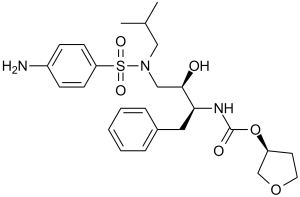
Amprenavir (formerly VX-478; trade name Agenerase and Prozei), an FDA approved drug for treating HIV infections, is a potent PXR-selective agonist and an HIV protease inhibitor. Its IC50 value for HIV-1 protease is 0.6 nM, and its IC50 value for HIV-2 protease is 19 nM. It is also said to be an inhibitor of cytochrome P450 3A4. Patients with primary HIV infection can benefit from the effective treatment of HIV disease with amprenavir. On April 15, 1999, the FDA approved a twice-daily dose for it, as opposed to an eight-hour interval.
Physicochemical Properties
| Molecular Formula | C25H35N3O6S | |
| Molecular Weight | 505.63 | |
| Exact Mass | 505.224 | |
| Elemental Analysis | C, 59.39; H, 6.98; N, 8.31; O, 18.99; S, 6.34 | |
| CAS # | 161814-49-9 | |
| Related CAS # | Amprenavir-d4;1217661-20-5;Amprenavir-d4-1;2738376-78-6 | |
| PubChem CID | 65016 | |
| Appearance | White to off-white solid powder | |
| Density | 1.3±0.1 g/cm3 | |
| Boiling Point | 722.5±70.0 °C at 760 mmHg | |
| Melting Point | 72-74ºC | |
| Flash Point | 390.8±35.7 °C | |
| Vapour Pressure | 0.0±2.5 mmHg at 25°C | |
| Index of Refraction | 1.602 | |
| LogP | 4.68 | |
| Hydrogen Bond Donor Count | 3 | |
| Hydrogen Bond Acceptor Count | 8 | |
| Rotatable Bond Count | 12 | |
| Heavy Atom Count | 35 | |
| Complexity | 745 | |
| Defined Atom Stereocenter Count | 3 | |
| SMILES | S(C1C([H])=C([H])C(=C([H])C=1[H])N([H])[H])(N(C([H])([H])C([H])(C([H])([H])[H])C([H])([H])[H])C([H])([H])[C@]([H])([C@]([H])(C([H])([H])C1C([H])=C([H])C([H])=C([H])C=1[H])N([H])C(=O)O[C@]1([H])C([H])([H])OC([H])([H])C1([H])[H])O[H])(=O)=O |
|
| InChi Key | YMARZQAQMVYCKC-OEMFJLHTSA-N | |
| InChi Code | InChI=1S/C25H35N3O6S/c1-18(2)15-28(35(31,32)22-10-8-20(26)9-11-22)16-24(29)23(14-19-6-4-3-5-7-19)27-25(30)34-21-12-13-33-17-21/h3-11,18,21,23-24,29H,12-17,26H2,1-2H3,(H,27,30)/t21-,23-,24+/m0/s1 | |
| Chemical Name | [(3S)-oxolan-3-yl] N-[(2S,3R)-4-[(4-aminophenyl)sulfonyl-(2-methylpropyl)amino]-3-hydroxy-1-phenylbutan-2-yl]carbamate | |
| Synonyms |
|
|
| HS Tariff Code | 2934.99.9001 | |
| Storage |
Powder-20°C 3 years 4°C 2 years In solvent -80°C 6 months -20°C 1 month |
|
| Shipping Condition | Room temperature (This product is stable at ambient temperature for a few days during ordinary shipping and time spent in Customs) |
Biological Activity
| Targets |
PXR; HIV protease (IC50 = 14.6 ng/mL) Amprenavir is a potent inhibitor of human immunodeficiency virus type 1 (HIV-1) protease, with an IC50 of 0.6 nM for wild-type HIV-1 protease in cell-free enzyme assays and an EC50 of 7 nM for HIV-1 (strain IIIB) replication in H9 lymphocytes [1] - Amprenavir activates the pregnane X receptor (PXR, a nuclear receptor regulating drug metabolism and lipid homeostasis) in vitro, with an EC50 of 15 μM for PXR-mediated luciferase reporter activity in HepG2 cells [3] - It inhibits human hepatocellular carcinoma (HCC) cell migration via downregulating matrix metalloproteinase-9 (MMP-9); no IC50/Ki provided for MMP-9, but 50 μM Amprenavir reduces MMP-9 protein levels by ~70% [2] |
| ln Vitro |
Amprenavir has an enzyme inhibition constant (Ki = 0.6 nM) that is within the other protease inhibitors' Ki range. The in vitro 50% inhibitory concentration (IC50) of amprenavir against clinical HIV isolates of wild type is 14.6 +/- 12.5 ng/mL (mean +/- SD) [1]. By preventing MMP proteolytic activation, amprenavir directly inhibited the invasion of Huh-7 hepatocarcinoma cell lines [2]. In HIV-1 (IIIB)-infected H9 lymphocytes, treatment with 20 nM Amprenavir for 72 hours reduced HIV-1 RNA by ~99% (qRT-PCR) and HIV-1 p24 antigen by ~98% (ELISA); cell viability remained >95% (MTT assay) [1] - In human HCC HepG2 cells, 50 μM Amprenavir for 48 hours inhibited cell migration by ~65% (Transwell assay) and cell invasion by ~60% (Matrigel invasion assay); Western blot showed ~70% reduction in MMP-9 and ~55% reduction in α-SMA (mesenchymal marker) [2] - In PXR-transfected HepG2 cells, 20 μM Amprenavir for 24 hours increased PXR target gene expression: CYP3A4 mRNA (3.2-fold), ABCB1 mRNA (2.8-fold, RT-PCR) and CYP3A4 enzyme activity (2.5-fold, luciferin-IPA assay) [3] - In primary human hepatocytes, 10 μM Amprenavir for 48 hours induced triglyceride accumulation by ~40% (oil red O staining), associated with upregulated lipogenic genes (SREBP-1c mRNA: 2.1-fold) [3] |
| ln Vivo |
Amprenavir was able to encourage the remission of hepatocarcinoma growth in vivo through anti-angiogenetic and general anti-tumor activities, through independent pathways related to PI3K/AKT, which is currently one of the more plausible theories to explain the anti-tumor effects of the various protease inhibitors[2]. PXR was effectively activated and PXR target gene expression was induced both in vitro and in vivo by amprenavir. In mice of the wild type, but not in mice lacking PXR, a brief exposure to amprenavir markedly raised the levels of atherogenic low-density lipoprotein cholesterol and plasma total cholesterol [3]. The recommended dosage of amprenavir for adults and children is 1200 mg twice daily for adults, 20 mg/kg twice daily for children under the age of 13, or 15 mg/kg three times daily for adolescents under the weight of 50 kg[1]. In male Sprague-Dawley rats, oral Amprenavir (100 mg/kg) reduced plasma HIV-1 RNA (infected via intravenous HIV-1 inoculation) by 2.8 log10 at 24 hours post-dose [1] - In nude mice bearing HepG2 xenografts (subcutaneous injection of 5×10⁶ cells), oral Amprenavir (100 mg/kg once daily for 21 days) reduced tumor volume by ~50% and tumor weight by ~45% vs. vehicle; immunohistochemistry showed decreased MMP-9-positive cells (~65% reduction) [2] - In C57BL/6 mice, oral Amprenavir (100 mg/kg/day for 14 days) increased plasma triglycerides by 2.3-fold and total cholesterol by 1.8-fold; these effects were abolished in PXR-knockout (PXR⁻/⁻) mice, confirming PXR dependence [3] - In healthy human volunteers, oral Amprenavir (1200 mg twice daily) achieved steady-state plasma concentrations of 12 μM (80-fold higher than in vitro EC50 for HIV-1) [1] |
| Enzyme Assay |
HIV-1 protease activity assay (from [1] abstract description): Recombinant wild-type HIV-1 protease was purified from E. coli. The enzyme was mixed with a fluorescent peptide substrate (Ac-Thr-Ile-Nle-Phe-Gln-Arg-Lys-AMC) in assay buffer (50 mM sodium acetate pH 4.7, 1 mM EDTA, 10% glycerol). Amprenavir was added at 0.1–10 nM, and the mixture was incubated at 37°C for 2 hours. Fluorescence intensity was measured at excitation 355 nm/emission 460 nm. Inhibition rate was calculated vs. vehicle, and IC50 was determined via 4-parameter logistic regression [1] - PXR luciferase reporter assay (from [3] abstract description): HepG2 cells were co-transfected with human PXR expression plasmid and PXR-responsive luciferase reporter plasmid (pGL3-PXRE). 24 hours post-transfection, cells were treated with Amprenavir (1–50 μM) for 24 hours. Cells were lysed, and luciferase activity was measured (normalized to β-galactosidase internal control). EC50 for PXR activation was calculated via dose-response fitting [3] |
| Cell Assay |
Amprenavir induced the expression of the PXR target gene in LS180 intestinal cells and HepaRG hepatoma cells. HIV-1-infected H9 cell assay (from [1] abstract description): H9 lymphocytes were cultured in RPMI 1640 + 10% fetal bovine serum and infected with HIV-1 (IIIB) at MOI 0.01 for 24 hours. Cells were treated with Amprenavir (5–50 nM) for 72 hours. Culture supernatants were collected for qRT-PCR (HIV-1 RNA) and ELISA (p24 antigen). Cell viability was assessed via MTT assay (absorbance 570 nm) [1] - HepG2 cell migration/invasion assay (from [2] abstract description): HepG2 cells were cultured in DMEM + 10% FBS to 70% confluence. For migration: cells were seeded in Transwell upper chambers (2×10⁴ cells/well) with Amprenavir (10–100 μM) in serum-free DMEM; lower chambers contained 10% FBS. After 24 hours, migrated cells were stained with crystal violet and counted. For invasion: Matrigel-coated Transwells were used, and incubation time was extended to 48 hours [2] - Primary hepatocyte lipid accumulation assay (from [3] abstract description): Primary mouse hepatocytes were isolated from C57BL/6 mice and cultured in William’s E medium. Cells were treated with Amprenavir (1–20 μM) for 48 hours. Lipid accumulation was detected via oil red O staining (quantified by absorbance 510 nm). Total RNA was extracted for RT-PCR to measure SREBP-1c mRNA levels [3] |
| Animal Protocol |
10 mg/kg; p.o. WT and PXR-/- mice Rat HIV-1 infection model (from [1] abstract description): Male Sprague-Dawley rats (250–300 g) were intravenously inoculated with HIV-1 (IIIB, 1×10⁵ TCID50/rat). 2 hours post-inoculation, Amprenavir was dissolved in 10% ethanol + 40% propylene glycol + 50% water (oral formulation) and administered via oral gavage at 100 mg/kg. Plasma samples were collected at 0, 6, 12, 24 hours post-dose for HIV-1 RNA quantification (qRT-PCR) [1] - Nude mouse HepG2 xenograft model (from [2] abstract description): Female BALB/c nude mice (6–8 weeks old) were subcutaneously injected with 5×10⁶ HepG2 cells (suspended in 0.1 mL PBS + 50% Matrigel) into the right flank. When tumors reached ~100 mm³, Amprenavir (dissolved in corn oil) was administered via oral gavage at 100 mg/kg once daily for 21 days. Vehicle controls received corn oil. Tumor volume (V=0.5×length×width²) was measured every 3 days; mice were euthanized on day 22 for tumor weight and immunohistochemistry [2] - Mouse PXR-mediated dyslipidemia model (from [3] abstract description): Male C57BL/6 wild-type (WT) and PXR⁻/⁻ mice (8–10 weeks old) were administered Amprenavir (dissolved in 0.5% methylcellulose) via oral gavage at 100 mg/kg/day for 14 days. Vehicle controls received 0.5% methylcellulose. Plasma triglycerides and total cholesterol were measured via enzymatic assays on day 15; liver tissues were collected for RT-PCR (lipogenic genes) [3] |
| ADME/Pharmacokinetics |
Absorption, Distribution and Excretion Rapidly absorbed after oral administration in HIV-1-infected patients with a time to peak concentration (Tmax) typically between 1 and 2 hours after a single oral dose. The absolute oral bioavailability of amprenavir in humans has not been established. Amprenavir is absorbed rapidly after oral administration. Taking amprenavir with a standard meal reduces the plasma AUC by only about 13%, but high-fat meals may have greater effects and should be avoided. Only minimal amounts of amprenavir are eliminated unchanged in urine or feces; less than 3% of a dose is eliminated unchanged in urine. Following a single oral dose of radiolabeled amprenavir, approximately 14% of the dose is eliminated in urine and 75% is eliminated in feces; 2 metabolites account for more than 90% of radioactivity in feces. Distribution of amprenavir into body tissues and fluids has not been fully characterized. Studies in rats indicate that amprenavir is distributed to a variety of tissues following oral administration. The apparent volume of distribution of amprenavir in healthy adults is approximately 430 L. It is not known whether amprenavir crosses the human placenta; however, the drug crosses the placenta in rats. Information from an ex vivo human placental model for transplacental passage indicates that amprenavir crosses the human placenta. Although it is not known whether amprenavir is distributed in human milk, the drug is distributed into milk in rats. In patients with hepatic impairment, the peak plasma concentration and AUC of amprenavir may be increased. In adults with moderate cirrhosis who received a single 600-mg oral dose of amprenavir given as liquid-filled capsules, the AUC (0-4 hours) of the drug averaged 25.76 ug hour/mL compared with 12 ug hour/ml in healthy adults. In adults with severe cirrhosis who received the same dose, peak plasma concentrations averaged 9.43 ug/ml and the AUC (0-4 hours) averaged 38.66 ug hour/ml compared with 4.9 ug/ml or 12 ug hour/ml, respectively, in healthy adults. Metabolism / Metabolites Hepatic. Amprenavir is metabolized in the liver by the cytochrome P450 3A4 (CYP3A4) enzyme system. The 2 major metabolites result from oxidation of the tetrahydrofuran and aniline moieties. Glucuronide conjugates of oxidized metabolites have been identified as minor metabolites in urine and feces. The metabolic fate of amprenavir has not been fully determined, but the drug is metabolized in the liver. Amprenavir is metabolized principally by the cytochrome P450 (CYP) isoenzyme 3A4. The 2 major metabolites of the drug result from oxidation of the tetrahydrofuran and aniline moieties; glucuronide conjugates of oxidized metabolites have been identified as minor metabolites in urine and feces. Hepatic. Amprenavir is metabolized in the liver by the cytochrome P450 3A4 (CYP3A4) enzyme system. The 2 major metabolites result from oxidation of the tetrahydrofuran and aniline moieties. Glucuronide conjugates of oxidized metabolites have been identified as minor metabolites in urine and feces. Half Life: 7.1-10.6 hours Biological Half-Life 7.1-10.6 hours The plasma elimination half-life of amprenavir in HIV-infected adults with normal renal and hepatic function ranges from 7.1-10.6 hours. In healthy human volunteers, oral Amprenavir (1200 mg twice daily) had an oral bioavailability of ~40%, a plasma elimination half-life (t₁/₂) of ~7.1 hours, and a peak plasma concentration (Cmax) of 12 μM (reached at 1.5 hours post-dose) [1] - In male Sprague-Dawley rats, oral Amprenavir (100 mg/kg) showed a t₁/₂ of ~4.5 hours, a Cmax of 8 μM, and a volume of distribution (Vd) of ~1.8 L/kg [1] - Amprenavir is primarily metabolized by hepatic cytochrome P450 3A4 (CYP3A4); ~70% of the dose is excreted as metabolites in feces, with <5% excreted unchanged in urine [1] - Plasma protein binding of Amprenavir is ~90% in humans, rats, and mice (measured via ultrafiltration) [1,3] |
| Toxicity/Toxicokinetics |
Toxicity Summary Amprenavir inhibits the HIV viral proteinase enzyme which prevents cleavage of the gag-pol polyprotein, resulting in noninfectious, immature viral particles. Protein Binding Very high (90%). Amprenavir has the highest affinity for alpha(1)-acid glycoprotein. Interactions Because amprenavir oral solution contains a large amount of propylene glycol, concurrent use /with alcohol, disulfiram, or metronidazole/ is not recommended. Although these medications /alprazolam, clorazepate, diazepam, or flurazepam/ have not been specifically studied with amprenavir, amprenavir may increase the serum concentrations of these medications. Although these medications /amiodarone, lidocaine (systemic), tricyclic antidepressants, or quinidine/ have not been specifically studied with amprenavir, amprenavir may interfere in the metabolism of these medications and cause serious or life threatening adverse events; monitoring of serum concentrations for these medications is recommended if amprenavir is used concurrently. Although antacids have not been specifically studied with amprenavir, based on data from other protease inhibitors, antacids (and didanosine due to the antacid content present in didanosine formulations) may interfere with the absorption of amprenavir; it is recommended that antacid and didanosine administration be separated from amprenavir administration by at least one hour. For more Interactions (Complete) data for AMPRENAVIR (21 total), please visit the HSDB record page. In HIV-1-infected H9 cells, Amprenavir up to 10 μM for 72 hours had no significant cytotoxicity (cell viability >90% vs. vehicle) [1] - In C57BL/6 mice, oral Amprenavir (100 mg/kg/day for 14 days) caused mild hepatomegaly (liver weight increased by ~15%) but no elevation in serum ALT/AST; PXR⁻/⁻ mice showed no hepatomegaly [3] - In healthy human volunteers (Phase I/II studies), common adverse events (AEs) included mild gastrointestinal symptoms (nausea: 22%, diarrhea: 18%) and rash (15%)[1] - In HepG2 cells, 100 μM Amprenavir for 72 hours induced apoptosis in ~20% of cells (Annexin V-FITC/PI staining), indicating low cytotoxicity at therapeutic concentrations [2] |
| References |
[1]. Clinical pharmacology and pharmacokinetics of amprenavir. Ann Pharmacother. 2002 Jan;36(1):102-18. [2]. Amprenavir inhibits the migration in human hepatocarcinoma cell and the growth of xenografts. J Cell Physiol. 2013 Mar;228(3):640-5. [3]. Pregnane X Receptor Mediates Dyslipidemia Induced by the HIV Protease Inhibitor Amprenavir in Mice. Mol Pharmacol. 2013 Jun;83(6):1190-9. [4]. Bardoxolone and bardoxolone methyl, two Nrf2 activators in clinical trials, inhibit SARS-CoV-2 replication and its 3C-like protease. Signal Transduct Target Ther. 2021 May 29;6(1):212. |
| Additional Infomation |
Therapeutic Uses Amprenavir is indicated in combination with other antiretroviral agents in the treatment of HIV-1 infection. /Included in US product labeling/ Amprenavir is a human immunodeficiency virus (HIV)-protease inhibitor. The use of amprenavir for the treatment of human immunodeficiency virus type 1 (HIV-1) infection in combination with other antiretrovirals is based on analyses of plasma HIV-RNA levels and CD4 cell counts in controlled studies of up to 24 weeks duration. Results from controlled trials evaluating the long-term suppression of HIV-RNA or disease progression with amprenavir have not yet been obtained. Amprenavir is a viral protease inhibitor with specificity for the HIV protease enzyme. The resistance profile of amprenavir appears to differ from that of other protease inhibitors such as saquinavir and indinavir. Twelve hours after single-dose administration of amprenavir 1200 mg to HIV-infected individuals, the mean plasma concentration of the drug was more than 10-fold greater than the 50% inhibitory concentration for HIV-1IIIB in peripheral blood lymphocytes. In a small nonblind study, amprenavir monotherapy increased CD4+ cell count and decreased viral load in 37 patients with HIV infection and no previous exposure to protease inhibitor therapy. Combination therapy comprising amprenavir and other antiretroviral agents (abacavir, zidovudine, lamivudine, indinavir, saquinavir or nelfinavir) decreased viral load and increased CD4+ cell counts in patients with HIV infection. Antiviral efficacy was maintained during up to 24 weeks' follow-up. Drug Warnings The usually recommended dosage of amprenavir oral solution (22.5 mg/kg twice daily) provides a propylene glycol intake of 1650 mg/kg daily; however, an acceptable intake of propylene glycol used as an excipient in pharmaceuticals has not been established to date. Propylene glycol is metabolized in the liver by the alcohol and aldehyde dehydrogenase enzyme pathway, and the possibility exists that young infants, patients with renal or hepatic impairment, and certain patient groups (females, Asians, Native Alaskans, Native Americans) may be at increased risk of propylene glycol-associated adverse effects if they receive amprenavir oral solution because of diminished ability to metabolize propylene glycol. Therefore, amprenavir oral solution is contraindicated during pregnancy; in infants younger than 4 years of age; in patients with renal or hepatic failure; and in patients receiving disulfiram or metronidazole. In addition, although metabolism of propylene glycol has not been specifically studied in these patient groups, the possibility that females may have lower concentrations of alcohol dehydrogenase compared with males and that certain ethnic populations (Asians, Native Alaskans, Native Americans) may have alcohol dehydrogenase polymorphism should be considered. Because amprenavir oral solution contains large amounts of propylene glycol and because young infants may be at increased risk of propylene glycol-associated adverse effects, the oral solution is contraindicated in pediatric patients younger than 4 years of age. Propylene glycol is metabolized in the liver by the alcohol and aldehyde dehydrogenase enzyme pathway. Although alcohol dehydrogenase is present in human fetal liver at 2 months of gestational age, this represent only about 3% of the activity reported in adults. Limited data indicate that alcohol dehydrogenase activity in infants 12-30 months of age is equal to or greater than that reported in adults. Oral or IV administration of various drugs (e.g., multivitamins) containing high concentrations of propylene glycol in pediatric patients has resulted in various propylene glycol-associated adverse effects, including hyperosmolality, lactic acidosis, respiratory depression, and seizures. Patients being treated with amprenavir oral solution should be closely monitored for propylene glycol associated side effects including hemolysis, hyperosmolality, lactic acidosis, renal toxicity, seizures, stupor, and tachycardia. The pharmacokinetics of amprenavir do not differ between females and males or between Blacks and non-Blacks. However, amprenavir oral solution contains a large amount of propylene glycol and because Asians, Eskimos, Native Americans, and women have a decreased ability to metabolize this compound, they may have an increased risk of developing propylene glycol-associated side effects. For more Drug Warnings (Complete) data for AMPRENAVIR (18 total), please visit the HSDB record page. Pharmacodynamics Amprenavir is a protease inhibitor with activity against Human Immunodeficiency Virus Type 1 (HIV-1). Protease inhibitors block the part of HIV called protease. HIV-1 protease is an enzyme required for the proteolytic cleavage of the viral polyprotein precursors into the individual functional proteins found in infectious HIV-1. Amprenavir binds to the protease active site and inhibits the activity of the enzyme. This inhibition prevents cleavage of the viral polyproteins resulting in the formation of immature non-infectious viral particles. Protease inhibitors are almost always used in combination with at least two other anti-HIV drugs. Amprenavir is a first-generation HIV-1 protease inhibitor approved by the FDA in 2001 for the treatment of HIV-1 infection in adults and adolescents; it is administered orally (capsules or oral solution) [1] - Its anti-HIV mechanism involves binding to the HIV-1 protease active site, blocking cleavage of the viral Gag-Pol polyprotein into mature proteins (e.g., p24, reverse transcriptase), thus inhibiting viral assembly [1] - Amprenavir exhibits off-target effects: activation of PXR leads to dyslipidemia (hypertriglyceridemia, hypercholesterolemia) in vivo, and inhibition of HCC cell migration suggests potential repurposing for liver cancer therapy [2,3] - Due to CYP3A4 metabolism, Amprenavir has drug-drug interactions with CYP3A4 inhibitors (e.g., ritonavir, increasing its plasma concentration) and inducers (e.g., rifampin, decreasing its concentration) [1] |
Solubility Data
| Solubility (In Vitro) |
|
|||
| Solubility (In Vivo) |
Solubility in Formulation 1: ≥ 2.5 mg/mL (4.94 mM) (saturation unknown) in 10% DMSO + 40% PEG300 + 5% Tween80 + 45% Saline (add these co-solvents sequentially from left to right, and one by one), clear solution. For example, if 1 mL of working solution is to be prepared, you can add 100 μL of 25.0 mg/mL clear DMSO stock solution to 400 μL PEG300 and mix evenly; then add 50 μL Tween-80 to the above solution and mix evenly; then add 450 μL normal saline to adjust the volume to 1 mL. Preparation of saline: Dissolve 0.9 g of sodium chloride in 100 mL ddH₂ O to obtain a clear solution. Solubility in Formulation 2: ≥ 2.5 mg/mL (4.94 mM) (saturation unknown) in 10% DMSO + 90% (20% SBE-β-CD in Saline) (add these co-solvents sequentially from left to right, and one by one), clear solution. For example, if 1 mL of working solution is to be prepared, you can add 100 μL of 25.0 mg/mL clear DMSO stock solution to 900 μL of 20% SBE-β-CD physiological saline solution and mix evenly. Preparation of 20% SBE-β-CD in Saline (4°C,1 week): Dissolve 2 g SBE-β-CD in 10 mL saline to obtain a clear solution. Solubility in Formulation 3: ≥ 2.5 mg/mL (4.94 mM) (saturation unknown) in 10% DMSO + 90% Corn Oil (add these co-solvents sequentially from left to right, and one by one), clear solution. For example, if 1 mL of working solution is to be prepared, you can add 100 μL of 25.0 mg/mL clear DMSO stock solution to 900 μL of corn oil and mix evenly. (Please use freshly prepared in vivo formulations for optimal results.) |
| Preparing Stock Solutions | 1 mg | 5 mg | 10 mg | |
| 1 mM | 1.9777 mL | 9.8887 mL | 19.7773 mL | |
| 5 mM | 0.3955 mL | 1.9777 mL | 3.9555 mL | |
| 10 mM | 0.1978 mL | 0.9889 mL | 1.9777 mL |