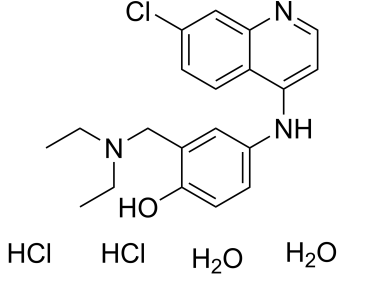
Amodiaquin dihydrochloride (trade names Camoquin, Flavoquine) is a potent and orally bioactive inhibitor of the Ebola virus, acts by targeting the viral protein 35 (VP35). It is also a 4-aminoquinoline class of antimalarial agent and anti-inflammatory agent that inhibits histamine N-methyltransferase inhibitor. Amodiaquine is also a Nurr1 agonist and specifically binds to Nurr1-LBD (ligand binding domain) with an EC50 of ~20 μM. Amodiaquine has been shown to be more effective than chloroquine in treating chloroquine-resistant Plasmodium falciparum malaria infections and may give more protection than chloroquine when used as weekly prophylaxis. Amodiaquine, like chloroquine, is generally well tolerated. Amodiaquine is a histamine N-methyltransferase inhibitor. It is on the World Health Organization's List of Essential Medicines, the most important medications needed in a basic health system.
Physicochemical Properties
| Molecular Formula | C20H28CL3N3O3 |
| Molecular Weight | 464.8136 |
| Exact Mass | 463.119 |
| CAS # | 6398-98-7 |
| Related CAS # | Amodiaquine;86-42-0;Amodiaquine dihydrochloride;69-44-3 |
| PubChem CID | 64646 |
| Appearance | White to light yellow solid powder |
| Boiling Point | 535.4ºC at 760 mmHg |
| Flash Point | 277.6ºC |
| LogP | 6.856 |
| Hydrogen Bond Donor Count | 6 |
| Hydrogen Bond Acceptor Count | 6 |
| Rotatable Bond Count | 6 |
| Heavy Atom Count | 29 |
| Complexity | 406 |
| Defined Atom Stereocenter Count | 0 |
| SMILES | ClC1C([H])=C([H])C2C(C=1[H])=NC([H])=C([H])C=2N([H])C1C([H])=C([H])C(=C(C=1[H])C([H])([H])N(C([H])([H])C([H])([H])[H])C([H])([H])C([H])([H])[H])O[H].Cl[H].Cl[H].O([H])[H].O([H])[H] |
| InChi Key | YVNAYSHNIILOJS-UHFFFAOYSA-N |
| InChi Code | InChI=1S/C20H22ClN3O.2ClH.2H2O/c1-3-24(4-2)13-14-11-16(6-8-20(14)25)23-18-9-10-22-19-12-15(21)5-7-17(18)19/h5-12,25H,3-4,13H2,1-2H3,(H,22,23)2*1H2*1H2 |
| Chemical Name | 4-[(7-chloroquinolin-4-yl)amino]-2-(diethylaminomethyl)phenol dihydrate dihydrochloride |
| Synonyms | Amodiaquin dihydrochloride dihydrate Amodiaquin dihydrochloride Amodiaquine hydrochloride dihydrate |
| HS Tariff Code | 2934.99.9001 |
| Storage |
Powder-20°C 3 years 4°C 2 years In solvent -80°C 6 months -20°C 1 month Note: Please store this product in a sealed and protected environment (e.g. under nitrogen), avoid exposure to moisture and light. |
| Shipping Condition | Room temperature (This product is stable at ambient temperature for a few days during ordinary shipping and time spent in Customs) |
Biological Activity
| ln Vitro | Treatment with amodiaquine (10-20 μM; 4 h) suppresses in a dose-dependent manner the expression of pro-inflammatory cytokines (IL-1β, interleukin-6, TNF-α, and iNOS) caused by lipopolysaccharide (PLS) [1]. As measured by TH+ neuron number and dopamine uptake, amodiaquine (5 μM; 24 h) effectively reduced primary dopamine cell mortality produced by neurotoxic (6-OHDA). Rat PC12 cells also showed signs of amodiaquine. Modiquine's neuroprotective effects [1] |
| ln Vivo | Amodiaquine (40 mg/kg; intraperitoneal; daily; for 3 days) treatment decreased perihematoma activation of astrocytes and microglia/macrophages in male ICR mice. In addition to improving motor impairment in mice, amodiaquine also reduces ICH-induced mRNA expression of IL-1β, CCL2, and CXCL2 [2]. |
| Cell Assay |
RT-PCR[1] Cell Types: primary microglia Tested Concentrations: 10 µM, 15 µM, 20 µM Incubation Duration: 4 hrs (hours) Experimental Results: Inhibition of LPS-induced pro-inflammatory cytokines (IL-1β, interleukin-6, TNF-α, and iNOS) in a dose-dependent manner. |
| Animal Protocol |
Animal/Disease Models: Male ICR mice (8-10 weeks old) induced intracerebral hemorrhage (ICH) [2] Doses: 40 mg/kg Route of Administration: intraperitoneal (ip) injection; daily; lasted for 3 days Experimental Results: Microglia around the hematoma / diminished activation of macrophages and astrocytes. |
| References |
[1]. Chun-Hyung Kim, et al. Nuclear receptor Nurr1 agonists enhance its dual functions and improve behavioral deficits in an animal model of Parkinson's disease. Proc Natl Acad Sci U S A. 2015 Jul 14;112(28):8756-61. [2]. Keita Kinoshita, et al. A Nurr1 agonist amodiaquine attenuates inflammatory events and neurological deficits in a mouse model of intracerebral hemorrhage. J Neuroimmunol. 2019 May 15;330:48-54. [3]. Akira Yokoyama, et al. Effect of amodiaquine, a histamine N-methyltransferase inhibitor, on, Propionibacterium acnes and lipopolysaccharide-induced hepatitis in mice. Eur J Pharmacol. 2007 Mar 8;558(1-3):179-84. [4]. M T HOEKENGA. The treatment of acute malaria with single oral doses of amodiaquin, chloroquine, hydroxychloroquine and pyrimethamine. Am J Trop Med Hyg. 1954 Sep;3(5):833-8. |
| Additional Infomation |
A 4-aminoquinoline compound with anti-inflammatory properties. See also: Amodiaquine Hydrochloride (annotation moved to). |
Solubility Data
| Solubility (In Vitro) |
DMSO : ~100 mg/mL (~215.14 mM) H2O : ~20 mg/mL (~43.03 mM) |
| Solubility (In Vivo) |
Solubility in Formulation 1: ≥ 2.5 mg/mL (5.38 mM) (saturation unknown) in 10% DMSO + 40% PEG300 + 5% Tween80 + 45% Saline (add these co-solvents sequentially from left to right, and one by one), clear solution. For example, if 1 mL of working solution is to be prepared, you can add 100 μL of 25.0 mg/mL clear DMSO stock solution to 400 μL PEG300 and mix evenly; then add 50 μL Tween-80 to the above solution and mix evenly; then add 450 μL normal saline to adjust the volume to 1 mL. Preparation of saline: Dissolve 0.9 g of sodium chloride in 100 mL ddH₂ O to obtain a clear solution. Solubility in Formulation 2: ≥ 2.5 mg/mL (5.38 mM) (saturation unknown) in 10% DMSO + 90% (20% SBE-β-CD in Saline) (add these co-solvents sequentially from left to right, and one by one), clear solution. For example, if 1 mL of working solution is to be prepared, you can add 100 μL of 25.0 mg/mL clear DMSO stock solution to 900 μL of 20% SBE-β-CD physiological saline solution and mix evenly. Preparation of 20% SBE-β-CD in Saline (4°C,1 week): Dissolve 2 g SBE-β-CD in 10 mL saline to obtain a clear solution. (Please use freshly prepared in vivo formulations for optimal results.) |
| Preparing Stock Solutions | 1 mg | 5 mg | 10 mg | |
| 1 mM | 2.1514 mL | 10.7571 mL | 21.5142 mL | |
| 5 mM | 0.4303 mL | 2.1514 mL | 4.3028 mL | |
| 10 mM | 0.2151 mL | 1.0757 mL | 2.1514 mL |