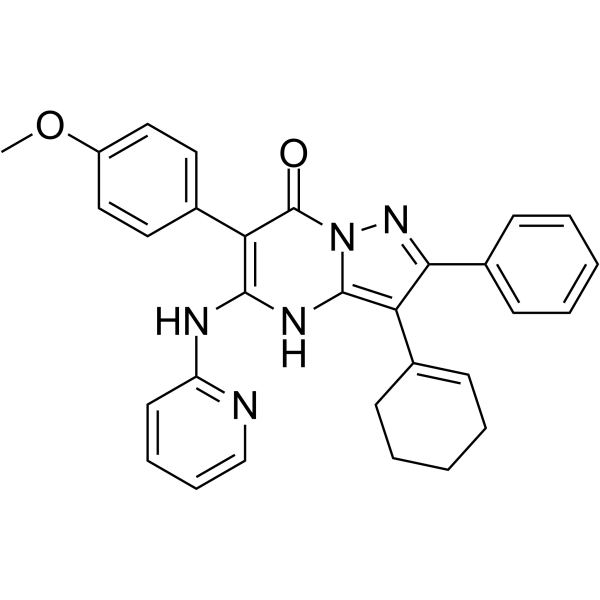
AG 270 (AG-270; AG270) is a novel, first-in-class, reversible, allosteric, noncompetitive and orally bioactive MAT2A inhibitor( IC50 =14 nM) with anticancer activity. It substantially reduce SAM levels in cancer cells and selectively block proliferation of MTAP-null cells both in tissue culture and xenograft tumors. The metabolic enzyme methionine adenosyltransferase 2A (MAT2A) was recently implicated as a synthetic lethal target in cancers with deletion of the methylthioadenosine phosphorylase (MTAP) gene
Physicochemical Properties
| Molecular Formula | C30H31N5O2 |
| Molecular Weight | 493.5994 |
| Exact Mass | 489.216 |
| CAS # | 2201056-66-6 |
| Related CAS # | 2201056-66-6 (free);2761546-65-8 (sodium); |
| PubChem CID | 134307820 |
| Appearance | White to off-white solid powder |
| LogP | 5.6 |
| Hydrogen Bond Donor Count | 2 |
| Hydrogen Bond Acceptor Count | 6 |
| Rotatable Bond Count | 6 |
| Heavy Atom Count | 37 |
| Complexity | 997 |
| Defined Atom Stereocenter Count | 0 |
| SMILES | O=C1C(C2C([H])=C([H])C(=C([H])C=2[H])OC([H])([H])[H])=C(N([H])C2=C([H])C([H])=C([H])C([H])=N2)N([H])C2([H])C([H])(C3=C([H])C([H])([H])C([H])([H])C([H])([H])C3([H])[H])C([H])(C3C([H])=C([H])C([H])=C([H])C=3[H])N([H])N21 |
| InChi Key | LSOYYWKBUKXUHQ-UHFFFAOYSA-N |
| InChi Code | InChI=1S/C30H27N5O2/c1-37-23-17-15-21(16-18-23)26-28(32-24-14-8-9-19-31-24)33-29-25(20-10-4-2-5-11-20)27(34-35(29)30(26)36)22-12-6-3-7-13-22/h3,6-10,12-19,34H,2,4-5,11H2,1H3,(H,31,32) |
| Chemical Name | 3-(cyclohexen-1-yl)-6-(4-methoxyphenyl)-2-phenyl-5-(pyridin-2-ylamino)-1H-pyrazolo[1,5-a]pyrimidin-7-one |
| Synonyms | AG-270AG 270AG270 |
| HS Tariff Code | 2934.99.9001 |
| Storage |
Powder-20°C 3 years 4°C 2 years In solvent -80°C 6 months -20°C 1 month |
| Shipping Condition | Room temperature (This product is stable at ambient temperature for a few days during ordinary shipping and time spent in Customs) |
Biological Activity
| ln Vitro | In an in vitro HCT116 MTAP syngeneic cell model, AG-270 demonstrates selective antiproliferative activity that effectively lowers intracellular SAM levels and MTAP ineffectiveness [1]. In HCT116 MTAP-null cell SAM, AG-270 has an IC50 of 20 nM after 72 hours [1]. The production of the ubiquitous methyl donor S-adenosylmethionine (SAM) is carried out by MAT2A, an essential enzyme in the methionine salvage pathway [2]. |
| ln Vivo | In a variety of species, including humans, mice, rats, dogs, and monkeys, AG-270 demonstrates exceptional microsomal, hepatocyte, and in vivo metabolic stability. With regard to mice, rats, monkeys, and dogs, the corresponding T1/2 values for AG-270 are 5.9 h, 4.2 h, 4.8 h, and 21.3 h [1]. AG-270 (200 mg/kg, PO, once daily for 38 days) was well tolerated, with a mean weight loss of less than 5%, and it reduced tumor SAM levels and tumor growth in KP4 MTAP-null xenografts in a dose-dependent manner[1]. Benefits of combination therapy have been observed in PDX models of cancer. AG-270 produced additive synergistic antitumor activity in combination with taxanes and gemcitabine, and docetaxel produced complete tumor regression in 50% of selected models; in patients with tumors originating from non-small cell lung cancer, pancreas cancer, and esophageal cancer [2]. |
| Animal Protocol |
Animal/Disease Models: Pancreatic KP4 MTAP-null xenograft mouse model [1]. Doses: 10-200 mg/kg. Route of Administration: po (po (oral gavage)) one time/day for 38 days. Experimental Results: Resulting in a dose-dependent reduction in tumor SAM levels and tumor growth in KP4 MTAP-null xenografts (TGI = 36% (10 mg/kg), 48% (30 mg/kg), 66% (100 mg/kg) ), 67% (200 mg/kg). |
| References |
[1]. Discovery of AG-270, a First-in-Class Oral MAT2A Inhibitor for the Treatment of Tumors with Homozygous MTAP Deletion. J Med Chem. 2021 Apr 8. [2]. The MAT2A inhibitor AG-270 combines with both taxanes and gemcitabine to yield enhanced antitumor activity in patient-derived xenograft models. |
| Additional Infomation | MAT2A Inhibitor AG-270 is an orally available small molecule inhibitor of methionine adenosyltransferase II alpha (MAT2A) with potential antineoplastic activity. Upon administration, AG-270 inhibits the activity of MAT2A, a metabolic enzyme responsible for the production of S-Adenosyl-L-methionine (SAM), a primary donor of methyl groups in cellular transmethylation reactions that regulate gene expression, cell growth, and differentiation. MAT2A activity is selectively essential in cancer cells deficient in methylthioadenosine phosphorylase (MTAP), a critical enzyme in the methionine salvage pathway, that is deleted in some human cancers. Inhibition of MAT2A may potentially inhibit tumor cell growth in MTAP-deleted cancers that rely heavily on SAM synthesis. |
Solubility Data
| Solubility (In Vitro) | DMSO : ~4 mg/mL (~8.17 mM) |
| Solubility (In Vivo) |
Solubility in Formulation 1: ≥ 4.75 mg/mL (9.70 mM) (saturation unknown) in 10% DMSO + 40% PEG300 + 5% Tween80 + 45% Saline (add these co-solvents sequentially from left to right, and one by one), clear solution. For example, if 1 mL of working solution is to be prepared, you can add 100 μL of 47.5 mg/mL clear DMSO stock solution to 400 μL PEG300 and mix evenly; then add 50 μL Tween-80 to the above solution and mix evenly; then add 450 μL normal saline to adjust the volume to 1 mL. Preparation of saline: Dissolve 0.9 g of sodium chloride in 100 mL ddH₂ O to obtain a clear solution. Solubility in Formulation 2: ≥ 4.75 mg/mL (9.70 mM) (saturation unknown) in 10% DMSO + 90% (20% SBE-β-CD in Saline) (add these co-solvents sequentially from left to right, and one by one), clear solution. For example, if 1 mL of working solution is to be prepared, you can add 100 μL of 47.5 mg/mL clear DMSO stock solution to 900 μL of 20% SBE-β-CD physiological saline solution and mix evenly. Preparation of 20% SBE-β-CD in Saline (4°C,1 week): Dissolve 2 g SBE-β-CD in 10 mL saline to obtain a clear solution. (Please use freshly prepared in vivo formulations for optimal results.) |
| Preparing Stock Solutions | 1 mg | 5 mg | 10 mg | |
| 1 mM | 2.0259 mL | 10.1297 mL | 20.2593 mL | |
| 5 mM | 0.4052 mL | 2.0259 mL | 4.0519 mL | |
| 10 mM | 0.2026 mL | 1.0130 mL | 2.0259 mL |