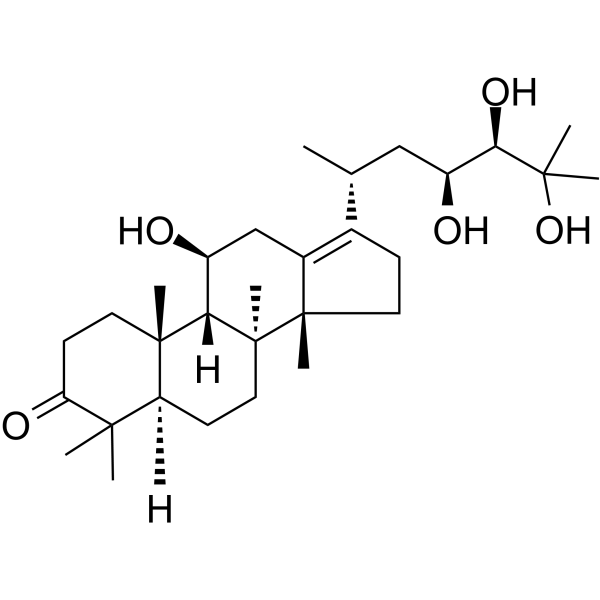
Physicochemical Properties
| Molecular Formula | C30H50O5 |
| Molecular Weight | 490.7150 |
| Exact Mass | 490.365 |
| CAS # | 19885-10-0 |
| Related CAS # | Alisol A 24-acetate;18674-16-3 |
| PubChem CID | 15558616 |
| Appearance | White to light yellow solid powder |
| Density | 1.1±0.1 g/cm3 |
| Boiling Point | 629.3±55.0 °C at 760 mmHg |
| Melting Point | 90-91ºC |
| Flash Point | 348.4±28.0 °C |
| Vapour Pressure | 0.0±4.2 mmHg at 25°C |
| Index of Refraction | 1.559 |
| LogP | 3.99 |
| Hydrogen Bond Donor Count | 4 |
| Hydrogen Bond Acceptor Count | 5 |
| Rotatable Bond Count | 5 |
| Heavy Atom Count | 35 |
| Complexity | 904 |
| Defined Atom Stereocenter Count | 9 |
| SMILES | C[C@H](C[C@@H]([C@H](C(C)(C)O)O)O)C1=C2C[C@@H]([C@H]3[C@]4(CCC(=O)C([C@@H]4CC[C@@]3([C@]2(CC1)C)C)(C)C)C)O |
| InChi Key | HNOSJVWYGXOFRP-UNPOXIGHSA-N |
| InChi Code | InChI=1S/C30H50O5/c1-17(15-21(32)25(34)27(4,5)35)18-9-13-29(7)19(18)16-20(31)24-28(6)12-11-23(33)26(2,3)22(28)10-14-30(24,29)8/h17,20-22,24-25,31-32,34-35H,9-16H2,1-8H3/t17-,20+,21+,22+,24+,25-,28+,29+,30+/m1/s1 |
| Chemical Name | (5R,8S,9S,10S,11S,14R)-11-hydroxy-4,4,8,10,14-pentamethyl-17-[(2R,4S,5R)-4,5,6-trihydroxy-6-methylheptan-2-yl]-1,2,5,6,7,9,11,12,15,16-decahydrocyclopenta[a]phenanthren-3-one |
| HS Tariff Code | 2934.99.9001 |
| Storage |
Powder-20°C 3 years 4°C 2 years In solvent -80°C 6 months -20°C 1 month |
| Shipping Condition | Room temperature (This product is stable at ambient temperature for a few days during ordinary shipping and time spent in Customs) |
Biological Activity
| ln Vitro |
1. A liquid chromatography-mass spectrometry (LC-MS) method was established to study the enzyme kinetics of Alisol A in rat liver microsomes (RLM) and human liver microsomes (HLM) incubation systems, and to conduct semi-quantitative determination of each metabolite of Alisol A 2. High-performance liquid chromatography-quadrupole time-of-flight mass spectrometry (HPLC-QTOF MS) was used to identify the metabolites of Alisol A in RLM, HLM and human recombinant CYP3A4 enzyme incubation systems. A total of 3 oxidative metabolites were found in RLM incubation system and 6 oxidative metabolites were found in HLM incubation system, among which 3 metabolites were identified in both systems, while the exact hydroxylation positions of metabolites M1 and M2 could not be determined 3. Chemical inhibitors of cytochrome P450 (CYP450) and individual human recombinant CYP450 enzymes were used to identify CYP450 isozymes involved in the formation of each metabolite of Alisol A, and the results showed that the formation of each metabolite of Alisol A was mainly catalyzed by CYP3A4 enzyme[1] |
| Enzyme Assay |
1. First, construct the incubation systems of rat liver microsomes (RLM), human liver microsomes (HLM) and human recombinant CYP3A4 enzyme containing Alisol A, and then use chemical inhibitors of cytochrome P450 (CYP450) and individual human recombinant CYP450 enzymes to intervene in the incubation process 2. After the incubation is completed, the enzyme kinetics of Alisol A in the system is analyzed by LC-MS, and the CYP450 isozymes involved in the formation of Alisol A metabolites are identified by combining the results of inhibitor intervention and recombinant enzyme incubation[1] |
| Animal Protocol |
1. Collect rat plasma samples (200 μl per sample) that may contain Alisol A and Alisol A 24-acetate, and use methyl tert-butyl ether to extract the analytes in the plasma samples 2. The extracted samples are separated on a Kromasil C18 column (150 × 4.6 mm, 5 μm) with the mobile phase of acetonitrile (containing 0.1% formic acid)-water (73:27, v/v) at a flow rate of 0.8 ml/min, and the run time is 10 min 3. The two analytes (including Alisol A) are monitored in positive electrospray ionization by selected ion monitoring mode, with diazepam as the internal standard, to realize the simultaneous determination of Alisol A and Alisol A 24-acetate in rat plasma[2] |
| ADME/Pharmacokinetics |
1. In vitro metabolism: The formation of metabolites of Alisol A in liver microsome incubation systems is mainly catalyzed by CYP3A4 enzyme; there are 3 oxidative metabolites in RLM system and 6 oxidative metabolites in HLM system, with 3 overlapping metabolites in the two systems[1] 2. The lower limit of quantitation of Alisol A in rat plasma is 10 ng/ml, and the calibration curve is linear in the range of 10-1,000 ng/ml; the mean extraction recovery of Alisol A from biological matrix is above 74.7%; the intra- and inter-day precision (RSD %) of all quality control concentrations is lower than 14.1%, and the accuracy (RE %) ranges from -12.3% to 9.8%[2] |
| References |
[1]. In vitro metabolism of alisol A and its metabolites' identification using high-performance liquid chromatography-mass spectrometry. J Chromatogr B Analyt Technol Biomed Life Sci. 2013 Dec 15;941:31-7. [2]. A sensitive liquid chromatography-mass spectrometry method for simultaneous determination of alisol A and alisol A 24-acetate from Alisma orientale (Sam.) Juz. in rat plasma. Anal Bioanal Chem. 2011 Jan;399(3):1363-9. |
| Additional Infomation |
1. Alisol A is a component from Alisma orientale (Sam.) Juz., and Alisol A 24-acetate is its related derivative, which can be simultaneously determined in rat plasma by LC-MS method[2] |
Solubility Data
| Solubility (In Vitro) | DMSO : ~100 mg/mL (~203.78 mM) |
| Solubility (In Vivo) |
Solubility in Formulation 1: ≥ 2.5 mg/mL (5.09 mM) (saturation unknown) in 10% DMSO + 40% PEG300 + 5% Tween80 + 45% Saline (add these co-solvents sequentially from left to right, and one by one), clear solution. For example, if 1 mL of working solution is to be prepared, you can add 100 μL of 25.0 mg/mL clear DMSO stock solution to 400 μL PEG300 and mix evenly; then add 50 μL Tween-80 to the above solution and mix evenly; then add 450 μL normal saline to adjust the volume to 1 mL. Preparation of saline: Dissolve 0.9 g of sodium chloride in 100 mL ddH₂ O to obtain a clear solution. Solubility in Formulation 2: ≥ 2.5 mg/mL (5.09 mM) (saturation unknown) in 10% DMSO + 90% (20% SBE-β-CD in Saline) (add these co-solvents sequentially from left to right, and one by one), clear solution. For example, if 1 mL of working solution is to be prepared, you can add 100 μL of 25.0 mg/mL clear DMSO stock solution to 900 μL of 20% SBE-β-CD physiological saline solution and mix evenly. Preparation of 20% SBE-β-CD in Saline (4°C,1 week): Dissolve 2 g SBE-β-CD in 10 mL saline to obtain a clear solution. Solubility in Formulation 3: ≥ 2.5 mg/mL (5.09 mM) (saturation unknown) in 10% DMSO + 90% Corn Oil (add these co-solvents sequentially from left to right, and one by one), clear solution. For example, if 1 mL of working solution is to be prepared, you can add 100 μL of 25.0 mg/mL clear DMSO stock solution to 900 μL of corn oil and mix evenly. (Please use freshly prepared in vivo formulations for optimal results.) |
| Preparing Stock Solutions | 1 mg | 5 mg | 10 mg | |
| 1 mM | 2.0378 mL | 10.1891 mL | 20.3782 mL | |
| 5 mM | 0.4076 mL | 2.0378 mL | 4.0756 mL | |
| 10 mM | 0.2038 mL | 1.0189 mL | 2.0378 mL |