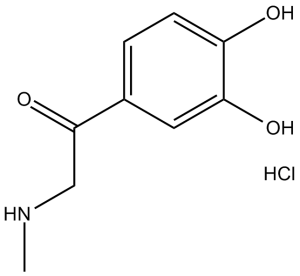
Adrenalone HCl (Adrenalonium chloratum, Adrenone, Epinephrine ketone, Kephrine, Stryphnonasal), the hydrochloride salt of adrenalone, is a potent adrenergic agonist used as a topical vasoconstrictor and hemostatic. Adrenalone primarily acts on alpha-1 adrenergic receptors and blocks dopamine β oxidase, which prevents dopamine from being converted to norepinephrine. The only structural difference between adrenaline and epinine is that the former has a ketone group in the β position. All OH radicals have been scavenged since the reduction of adrenalone (0.1 mM) by hydrated electrons in nitrogenated aqueous solutions containing either 10 or 100 mM tert-butyl alcohol produces identical transient spectra.
Physicochemical Properties
| Molecular Formula | C9H12CLNO3 | |
| Molecular Weight | 217.65 | |
| Exact Mass | 217.05 | |
| Elemental Analysis | C, 49.67; H, 5.56; Cl, 16.29; N, 6.44; O, 22.05 | |
| CAS # | 62-13-5 | |
| Related CAS # | Adrenalone; 99-45-6 | |
| PubChem CID | 66136 | |
| Appearance | Light yellow to yellow solid powder | |
| Boiling Point | 405.6ºC at 760 mmHg | |
| Melting Point | 244-249 °C (dec.) | |
| LogP | 1.692 | |
| Hydrogen Bond Donor Count | 4 | |
| Hydrogen Bond Acceptor Count | 4 | |
| Rotatable Bond Count | 3 | |
| Heavy Atom Count | 14 | |
| Complexity | 184 | |
| Defined Atom Stereocenter Count | 0 | |
| SMILES | Cl[H].O=C(C([H])([H])N([H])C([H])([H])[H])C1C([H])=C([H])C(=C(C=1[H])O[H])O[H] |
|
| InChi Key | CSRRBDMYOUQTCO-UHFFFAOYSA-N | |
| InChi Code | InChI=1S/C9H11NO3.ClH/c1-10-5-9(13)6-2-3-7(11)8(12)4-6;/h2-4,10-12H,5H2,1H3;1H | |
| Chemical Name | 1-(3,4-dihydroxyphenyl)-2-(methylamino)ethanone;hydrochloride | |
| Synonyms |
|
|
| HS Tariff Code | 2934.99.9001 | |
| Storage |
Powder-20°C 3 years 4°C 2 years In solvent -80°C 6 months -20°C 1 month Note: (1). This product requires protection from light (avoid light exposure) during transportation and storage.(2). Please store this product in a sealed and protected environment (e.g. under nitrogen), avoid exposure to moisture.(3). This product is not stable in solution, please use freshly prepared working solution for optimal results. |
|
| Shipping Condition | Room temperature (This product is stable at ambient temperature for a few days during ordinary shipping and time spent in Customs) |
Biological Activity
| Targets | α1-adrenergic receptor | ||
| ln Vitro |
|
||
| ln Vivo |
|
||
| Animal Protocol |
|
||
| References |
[1]. Nature . 1961 Dec 16:192:1081. [2]. J. Phys. Chem. 1979, 83, 19, 2447–2452. [3]. Proc Natl Acad Sci U S A . 2011 Sep 20;108(38):15810-5. [4]. Exp Eye Res . 1984 Jun;38(6):621-6. |
Solubility Data
| Solubility (In Vitro) |
|
|||
| Solubility (In Vivo) |
Solubility in Formulation 1: ≥ 2.5 mg/mL (11.49 mM) (saturation unknown) in 10% DMSO + 40% PEG300 + 5% Tween80 + 45% Saline (add these co-solvents sequentially from left to right, and one by one), clear solution. For example, if 1 mL of working solution is to be prepared, you can add 100 μL of 25.0 mg/mL clear DMSO stock solution to 400 μL PEG300 and mix evenly; then add 50 μL Tween-80 to the above solution and mix evenly; then add 450 μL normal saline to adjust the volume to 1 mL. Preparation of saline: Dissolve 0.9 g of sodium chloride in 100 mL ddH₂ O to obtain a clear solution. Solubility in Formulation 2: ≥ 2.5 mg/mL (11.49 mM) (saturation unknown) in 10% DMSO + 90% (20% SBE-β-CD in Saline) (add these co-solvents sequentially from left to right, and one by one), clear solution. For example, if 1 mL of working solution is to be prepared, you can add 100 μL of 25.0 mg/mL clear DMSO stock solution to 900 μL of 20% SBE-β-CD physiological saline solution and mix evenly. Preparation of 20% SBE-β-CD in Saline (4°C,1 week): Dissolve 2 g SBE-β-CD in 10 mL saline to obtain a clear solution. Solubility in Formulation 3: ≥ 2.5 mg/mL (11.49 mM) (saturation unknown) in 10% DMSO + 90% Corn Oil (add these co-solvents sequentially from left to right, and one by one), clear solution. For example, if 1 mL of working solution is to be prepared, you can add 100 μL of 25.0 mg/mL clear DMSO stock solution to 900 μL of corn oil and mix evenly. (Please use freshly prepared in vivo formulations for optimal results.) |
| Preparing Stock Solutions | 1 mg | 5 mg | 10 mg | |
| 1 mM | 4.5945 mL | 22.9727 mL | 45.9453 mL | |
| 5 mM | 0.9189 mL | 4.5945 mL | 9.1891 mL | |
| 10 mM | 0.4595 mL | 2.2973 mL | 4.5945 mL |