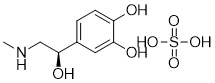
Physicochemical Properties
| Molecular Formula | C9H13NO3.H2O4S |
| Molecular Weight | 281.2829 |
| Exact Mass | 210.125 |
| CAS # | 52455-32-0 |
| Related CAS # | L-Epinephrine;51-43-4;L-Epinephrine-d3;1217733-17-9 |
| PubChem CID | 122037 |
| Appearance | Typically exists as solid at room temperature |
| Density | 1.0±0.1 g/cm3 |
| Boiling Point | 301.3±42.0 °C at 760 mmHg |
| Flash Point | 129.0±27.9 °C |
| Vapour Pressure | 0.0±0.6 mmHg at 25°C |
| Index of Refraction | 1.471 |
| LogP | 2.29 |
| Hydrogen Bond Donor Count | 6 |
| Hydrogen Bond Acceptor Count | 8 |
| Rotatable Bond Count | 3 |
| Heavy Atom Count | 18 |
| Complexity | 235 |
| Defined Atom Stereocenter Count | 1 |
| SMILES | CNCC(C1=CC(=C(C=C1)O)O)O.OS(=O)(=O)O |
| InChi Key | NDOXJVMFOWUYBP-FVGYRXGTSA-N |
| InChi Code | InChI=1S/C9H13NO3.H2O4S/c1-10-5-9(13)6-2-3-7(11)8(12)4-6;1-5(2,3)4/h2-4,9-13H,5H2,1H3;(H2,1,2,3,4)/t9-;/m0./s1 |
| Chemical Name | 4-[(1R)-1-hydroxy-2-(methylamino)ethyl]benzene-1,2-diol;sulfuric acid |
| HS Tariff Code | 2934.99.9001 |
| Storage |
Powder-20°C 3 years 4°C 2 years In solvent -80°C 6 months -20°C 1 month |
| Shipping Condition | Room temperature (This product is stable at ambient temperature for a few days during ordinary shipping and time spent in Customs) |
Biological Activity
| ln Vivo | Rats administered intraperitoneally with L-adrenaline sulfate (0.75, 1.5, or 3 mg/kg) experience oxidative and nitrative stress, which worsens lipid and protein damage as well as cardiomyopathy and cytogenetic damage [2]. In mature pigs, L-adrenaline sulfate (0.02, 0.03 mg/kg) dramatically lowers organ and brain perfusion while slightly raising ABP and CePP [3]. In young adult rats, subcutaneous injection of L-epinephrine sulfate (0.1 mg/kg) improves memory partly via raising blood glucose levels necessary for memory regulation [6]. |
| Animal Protocol |
Animal/Disease Models: 220-280 g, 18 weeks Wistar rats [2] Doses: 0.75, 1.5, 3 mg/kg Route of Administration: IP Experimental Results: Induced CAT activity, MDA levels, PCC, NO2− and 3-NT were significant Elevated SOD activity Dramatically diminished, and the total activities of LDH, LDH1 and LDH2 isoenzymes increased. Animal/Disease Models: 24-25 month old male Fischer-344 rats [6] Doses: 0.1 mg/kg Route of Administration: subcutaneous injection Experimental Results: Enhanced memory in young adult rats by increasing blood sugar levels required to regulate memory. |
| References |
[1]. Adrenaline in the treatment of anaphylaxis: what is the evidence? BMJ. 2003 Dec 6;327(7427):1332-5. [2]. Nitroso-Oxidative Stress, Acute Phase Response, and Cytogenetic Damage in Wistar Rats Treated with Adrenaline. Oxid Med Cell Longev. 2018 Nov 21;2018:1805354. [3]. Physiologic effect of repeated adrenaline (epinephrine) doses during cardiopulmonary resuscitation in the cath lab setting: A randomised porcine study. Resuscitation. 2016 Apr;101:77-83. [4]. Callaway CW. Epinephrine for cardiac arrest. Curr Opin Cardiol. 2013 Jan;28(1):36-42. [5]. First-aid treatment of anaphylaxis to food: focus on epinephrine. J Allergy Clin Immunol. 2004 May;113(5):837-44. [6]. Epinephrine and glucose modulate training-related CREB phosphorylation in old rats: relationships to age-related memory impairments. Exp Gerontol. 2013 Feb;48(2):115-27. |
Solubility Data
| Solubility (In Vitro) | May dissolve in DMSO (in most cases), if not, try other solvents such as H2O, Ethanol, or DMF with a minute amount of products to avoid loss of samples |
| Solubility (In Vivo) |
Note: Listed below are some common formulations that may be used to formulate products with low water solubility (e.g. < 1 mg/mL), you may test these formulations using a minute amount of products to avoid loss of samples. Injection Formulations (e.g. IP/IV/IM/SC) Injection Formulation 1: DMSO : Tween 80: Saline = 10 : 5 : 85 (i.e. 100 μL DMSO stock solution → 50 μL Tween 80 → 850 μL Saline) *Preparation of saline: Dissolve 0.9 g of sodium chloride in 100 mL ddH ₂ O to obtain a clear solution. Injection Formulation 2: DMSO : PEG300 :Tween 80 : Saline = 10 : 40 : 5 : 45 (i.e. 100 μL DMSO → 400 μLPEG300 → 50 μL Tween 80 → 450 μL Saline) Injection Formulation 3: DMSO : Corn oil = 10 : 90 (i.e. 100 μL DMSO → 900 μL Corn oil) Example: Take the Injection Formulation 3 (DMSO : Corn oil = 10 : 90) as an example, if 1 mL of 2.5 mg/mL working solution is to be prepared, you can take 100 μL 25 mg/mL DMSO stock solution and add to 900 μL corn oil, mix well to obtain a clear or suspension solution (2.5 mg/mL, ready for use in animals). Injection Formulation 4: DMSO : 20% SBE-β-CD in saline = 10 : 90 [i.e. 100 μL DMSO → 900 μL (20% SBE-β-CD in saline)] *Preparation of 20% SBE-β-CD in Saline (4°C,1 week): Dissolve 2 g SBE-β-CD in 10 mL saline to obtain a clear solution. Injection Formulation 5: 2-Hydroxypropyl-β-cyclodextrin : Saline = 50 : 50 (i.e. 500 μL 2-Hydroxypropyl-β-cyclodextrin → 500 μL Saline) Injection Formulation 6: DMSO : PEG300 : castor oil : Saline = 5 : 10 : 20 : 65 (i.e. 50 μL DMSO → 100 μLPEG300 → 200 μL castor oil → 650 μL Saline) Injection Formulation 7: Ethanol : Cremophor : Saline = 10: 10 : 80 (i.e. 100 μL Ethanol → 100 μL Cremophor → 800 μL Saline) Injection Formulation 8: Dissolve in Cremophor/Ethanol (50 : 50), then diluted by Saline Injection Formulation 9: EtOH : Corn oil = 10 : 90 (i.e. 100 μL EtOH → 900 μL Corn oil) Injection Formulation 10: EtOH : PEG300:Tween 80 : Saline = 10 : 40 : 5 : 45 (i.e. 100 μL EtOH → 400 μLPEG300 → 50 μL Tween 80 → 450 μL Saline) Oral Formulations Oral Formulation 1: Suspend in 0.5% CMC Na (carboxymethylcellulose sodium) Oral Formulation 2: Suspend in 0.5% Carboxymethyl cellulose Example: Take the Oral Formulation 1 (Suspend in 0.5% CMC Na) as an example, if 100 mL of 2.5 mg/mL working solution is to be prepared, you can first prepare 0.5% CMC Na solution by measuring 0.5 g CMC Na and dissolve it in 100 mL ddH2O to obtain a clear solution; then add 250 mg of the product to 100 mL 0.5% CMC Na solution, to make the suspension solution (2.5 mg/mL, ready for use in animals). Oral Formulation 3: Dissolved in PEG400 Oral Formulation 4: Suspend in 0.2% Carboxymethyl cellulose Oral Formulation 5: Dissolve in 0.25% Tween 80 and 0.5% Carboxymethyl cellulose Oral Formulation 6: Mixing with food powders Note: Please be aware that the above formulations are for reference only. InvivoChem strongly recommends customers to read literature methods/protocols carefully before determining which formulation you should use for in vivo studies, as different compounds have different solubility properties and have to be formulated differently. (Please use freshly prepared in vivo formulations for optimal results.) |
| Preparing Stock Solutions | 1 mg | 5 mg | 10 mg | |
| 1 mM | 3.5552 mL | 17.7759 mL | 35.5518 mL | |
| 5 mM | 0.7110 mL | 3.5552 mL | 7.1104 mL | |
| 10 mM | 0.3555 mL | 1.7776 mL | 3.5552 mL |