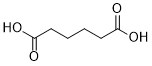
Physicochemical Properties
| Molecular Formula | C6H10O4 |
| Molecular Weight | 146.14 |
| Exact Mass | 146.057 |
| CAS # | 124-04-9 |
| Related CAS # | Adipic acid-d10;25373-21-1;Adipic acid-13C6;942037-55-0;Adipic acid-d4;121311-78-2;Adipic acid-13C;2708283-72-9;Adipic acid-d8;52089-65-3;Adipic acid-d4-1;19031-55-1 |
| PubChem CID | 196 |
| Appearance | White to off-white solid powder |
| Density | 1.3±0.1 g/cm3 |
| Boiling Point | 338.5±15.0 °C at 760 mmHg |
| Melting Point | 151-154 °C(lit.) |
| Flash Point | 196 ºC |
| Vapour Pressure | 0.0±1.6 mmHg at 25°C |
| Index of Refraction | 1.476 |
| LogP | 0.08 |
| Hydrogen Bond Donor Count | 2 |
| Hydrogen Bond Acceptor Count | 4 |
| Rotatable Bond Count | 5 |
| Heavy Atom Count | 10 |
| Complexity | 114 |
| Defined Atom Stereocenter Count | 0 |
| InChi Key | WNLRTRBMVRJNCN-UHFFFAOYSA-N |
| InChi Code | InChI=1S/C6H10O4/c7-5(8)3-1-2-4-6(9)10/h1-4H2,(H,7,8)(H,9,10) |
| Chemical Name | hexanedioic acid |
| Synonyms | Adipic acid NSC7622 NSC 7622 NSC-7622 |
| HS Tariff Code | 2934.99.9001 |
| Storage |
Powder-20°C 3 years 4°C 2 years In solvent -80°C 6 months -20°C 1 month |
| Shipping Condition | Room temperature (This product is stable at ambient temperature for a few days during ordinary shipping and time spent in Customs) |
Biological Activity
| ADME/Pharmacokinetics |
Absorption, Distribution and Excretion Absorbed adipic acid is primarily excreted in the urine unchanged or in the breath of carbon dioxide. In man following ingestion, adipic acid is only partially metabolized; the balance is eliminated unchanged in the urine. Metabolism / Metabolites Radioactive adipic acid was fed to fasted experimental rats and the metabolic products identified in the urine were urea, glutamic acid, lactic acid, beta-ketoadipic acid, and citric acid. The presence of beta-ketoadipic acid provided some evidence that adipic acid is metabolized by beta-oxidation in much the same fashion as fatty acids. Further evidence was provided by the appearance of succinate in the urine of rats fed radioactive (14)C-adipic acid and injected with malonic acid. The presence of radioactive acetyl-gamma-phenyl-alphaaminobutyric acid after feeding gamma-phenyl-alpha-aminobutyric acid and (14)C-labeled adipic acid provided very strong evidence that acetate is a metabolite of adipic acid. Radioactive glycogen was isolated following feeding of glucose and radioactive adipic acid. Adipic acid is metabolized via beta-oxidation to succinic and acetic acids, and subsequently to other normal intermediary metabolites. |
| Toxicity/Toxicokinetics |
Toxicity Summary IDENTIFICATION AND USE: Adipic acid is white crystalline solid. The major markets for adipic acid include use as feedstocks for nylon 6,6 resins and fibers, polyester polyols and plasticzers. Nylon 6,6 fibers and engineering resins accounted for approximately 85% of total adipic acid consumption in 2011. Polyester polyols and plasticizers, which combined accounted for 24-32% of global adipic acid consumption in 2010 . Other applications documented for adipic acid are as a lubricant additive in coatings, and foams, and in shoe soles, as tanning agent in leather industry, pH regulator in processes such as in the production of cleaning agents, pelletizing agent in disinfectant pills for drinking water, additive in flue gas sulfurization, in the coating of dishwashing machine tablets and as an additive in chemicals. Adipic acid has been identified as being used in hydraulic fracturing as a gelling agent. HUMAN EXPOSURE AND TOXICITY: Adipic acid exhibits an asthma hazard index of 0.75 using the chemical asthma hazard assessment program. Substances with indices of >0.5 have a high probability of being an asthmagen. Threshold for irritation of the human eye was 20 mg/cu m. ANIMAL STUDIES: Adipic acid is slightly toxic on acute exposure but produces moderate to severe eye irritation in rabbits (20 mg/24 hr). High concentrations of adipic acid can cause persistent pulmonary structural and functional alterations. In both mice and rabbits, lethal doses produce signs of inactivity, stomach and intestinal distention, and irritation and hemorrhage of the intestines. A group of mice received intravaginally, three time weekly, applications of a powdered mixture containing urea, adipic acid, and carboxymethyl cellulose. There was a high incidence of vaginal cancer after prolonged treatment. Experiments extended over one year, in which the three ingredients were given separately, yielded no tumors. Adipic acid is not mutagenic in Salmonella typhimurium strains TA98, TA100, TA1535, TA1537, and TA1538 or in Escherichia coli (WP2(uvrA)) with or without rat microsomal activation. ECOTOXICITY STUDIES: Adipic acid is slightly to moderately toxic to fish, daphnia, and algae in acute tests. Interactions A group of mice received intravaginally, three time weekly, applications of a powdered mixture containing urea, adipic acid, and carboxymethyl cellulose. There was a high incidence of vaginal cancer after prolonged treatment. Experiments extended over one year, in which the three ingredients were given separately, yielded no tumors. Non-Human Toxicity Values Rat: inhalation: no effect level: 126 g/L, 15 x 6 hr (as in source) LD50 Mouse iv 680 mg/kg /From table/ LD50 Mouse oral 1900 mg/kg /From table/ LD50 Mouse ip 275 mg/kg /From table/ For more Non-Human Toxicity Values (Complete) data for ADIPIC ACID (8 total), please visit the HSDB record page. |
| References |
[1]. G.Frauendienst-Egger, Friedrich K. Trefz (2017). MetaGene: Metabolic & Genetic Information Center. METAGENE consortium. |
| Additional Infomation |
Adipic acid is a white crystalline solid. It is insoluble in water. The primary hazard is the threat to the environment. Immediate steps should be taken to limit its spread to the environment. It is used to make plastics and foams and for other uses. Adipic acid is an alpha,omega-dicarboxylic acid that is the 1,4-dicarboxy derivative of butane. It has a role as a food acidity regulator and a human xenobiotic metabolite. It is an alpha,omega-dicarboxylic acid and a dicarboxylic fatty acid. It is a conjugate acid of an adipate(1-). Adipic Acid has been reported in Drosophila melanogaster, Populus tremula, and other organisms with data available. See also: Polyester-10 (monomer of); Polyester-7 (monomer of); Adipic acid/diglycol crosspolymer (20000 MPA.S) (monomer of) ... View More ... |
Solubility Data
| Solubility (In Vitro) |
DMSO : ~100 mg/mL (~684.28 mM) H2O : ~2.86 mg/mL (~19.57 mM) |
| Solubility (In Vivo) |
Solubility in Formulation 1: ≥ 2.5 mg/mL (17.11 mM) (saturation unknown) in 10% DMSO + 40% PEG300 + 5% Tween80 + 45% Saline (add these co-solvents sequentially from left to right, and one by one), clear solution. For example, if 1 mL of working solution is to be prepared, you can add 100 μL of 25.0 mg/mL clear DMSO stock solution to 400 μL PEG300 and mix evenly; then add 50 μL Tween-80 to the above solution and mix evenly; then add 450 μL normal saline to adjust the volume to 1 mL. Preparation of saline: Dissolve 0.9 g of sodium chloride in 100 mL ddH₂ O to obtain a clear solution. Solubility in Formulation 2: ≥ 2.5 mg/mL (17.11 mM) (saturation unknown) in 10% DMSO + 90% (20% SBE-β-CD in Saline) (add these co-solvents sequentially from left to right, and one by one), clear solution. For example, if 1 mL of working solution is to be prepared, you can add 100 μL of 25.0 mg/mL clear DMSO stock solution to 900 μL of 20% SBE-β-CD physiological saline solution and mix evenly. Preparation of 20% SBE-β-CD in Saline (4°C,1 week): Dissolve 2 g SBE-β-CD in 10 mL saline to obtain a clear solution. Solubility in Formulation 3: ≥ 2.5 mg/mL (17.11 mM) (saturation unknown) in 10% DMSO + 90% Corn Oil (add these co-solvents sequentially from left to right, and one by one), clear solution. For example, if 1 mL of working solution is to be prepared, you can add 100 μL of 25.0 mg/mL clear DMSO stock solution to 900 μL of corn oil and mix evenly. Solubility in Formulation 4: 25 mg/mL (171.07 mM) in PBS (add these co-solvents sequentially from left to right, and one by one), clear solution; with ultrasonication (<60°C). (Please use freshly prepared in vivo formulations for optimal results.) |
| Preparing Stock Solutions | 1 mg | 5 mg | 10 mg | |
| 1 mM | 6.8428 mL | 34.2138 mL | 68.4275 mL | |
| 5 mM | 1.3686 mL | 6.8428 mL | 13.6855 mL | |
| 10 mM | 0.6843 mL | 3.4214 mL | 6.8428 mL |