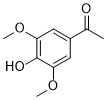
Physicochemical Properties
| Molecular Formula | C10H12O4 |
| Molecular Weight | 196.1999 |
| Exact Mass | 196.073 |
| CAS # | 2478-38-8 |
| PubChem CID | 17198 |
| Appearance | Off-white to light brown solid powder |
| Density | 1.2±0.1 g/cm3 |
| Boiling Point | 334.7±37.0 °C at 760 mmHg |
| Melting Point | 124-127 °C(lit.) |
| Flash Point | 131.7±20.0 °C |
| Vapour Pressure | 0.0±0.8 mmHg at 25°C |
| Index of Refraction | 1.528 |
| LogP | 1.23 |
| Hydrogen Bond Donor Count | 1 |
| Hydrogen Bond Acceptor Count | 4 |
| Rotatable Bond Count | 3 |
| Heavy Atom Count | 14 |
| Complexity | 190 |
| Defined Atom Stereocenter Count | 0 |
| InChi Key | OJOBTAOGJIWAGB-UHFFFAOYSA-N |
| InChi Code | InChI=1S/C10H12O4/c1-6(11)7-4-8(13-2)10(12)9(5-7)14-3/h4-5,12H,1-3H3 |
| Chemical Name | 1-(4-hydroxy-3,5-dimethoxyphenyl)ethanone |
| HS Tariff Code | 2934.99.9001 |
| Storage |
Powder-20°C 3 years 4°C 2 years In solvent -80°C 6 months -20°C 1 month |
| Shipping Condition | Room temperature (This product is stable at ambient temperature for a few days during ordinary shipping and time spent in Customs) |
Biological Activity
| ln Vitro | Acetosyringone, a phenolic substance derived from injured plant cells, stimulates the hydrolysis of additional vir genes by phosphorylating the VirA gene, which codes for membrane-bound cleavage, and activating the virG gene product [1]. The capacity of Agrobacterium Escherichia coli strains to effectively change Dunaliella algae [2]. |
| References |
[1]. Acetosyringone treatment duration affects large T-DNA molecule transfer to rice callus. BMC Biotechnol. 2018 Aug 9;18(1):48. [2]. Synergistic Action of D-Glucose and Acetosyringone on Agrobacterium Strains for Efficient Dunaliella Transformation. PLoS One. 2016 Jun 28;11(6):e0158322. |
| Additional Infomation |
Acetosyringone is a member of the class of acetophenones that is 1-phenylethanone substituted by a hydroxy group at position 4 and methoxy groups at positions 3 and 5. It has a role as a non-steroidal anti-inflammatory drug, an anti-asthmatic drug, a non-narcotic analgesic, a peripheral nervous system drug and a plant metabolite. It is a member of acetophenones, a dimethoxybenzene and a member of phenols. Acetosyringone has been reported in Atropa belladonna, Triticum aestivum, and other organisms with data available. Acetosyringone is a metabolite found in or produced by Saccharomyces cerevisiae. |
Solubility Data
| Solubility (In Vitro) | DMSO : ~100 mg/mL (~509.68 mM) |
| Solubility (In Vivo) |
Solubility in Formulation 1: ≥ 2.5 mg/mL (12.74 mM) (saturation unknown) in 10% DMSO + 40% PEG300 + 5% Tween80 + 45% Saline (add these co-solvents sequentially from left to right, and one by one), clear solution. For example, if 1 mL of working solution is to be prepared, you can add 100 μL of 25.0 mg/mL clear DMSO stock solution to 400 μL PEG300 and mix evenly; then add 50 μL Tween-80 to the above solution and mix evenly; then add 450 μL normal saline to adjust the volume to 1 mL. Preparation of saline: Dissolve 0.9 g of sodium chloride in 100 mL ddH₂ O to obtain a clear solution. Solubility in Formulation 2: ≥ 2.5 mg/mL (12.74 mM) (saturation unknown) in 10% DMSO + 90% (20% SBE-β-CD in Saline) (add these co-solvents sequentially from left to right, and one by one), clear solution. For example, if 1 mL of working solution is to be prepared, you can add 100 μL of 25.0 mg/mL clear DMSO stock solution to 900 μL of 20% SBE-β-CD physiological saline solution and mix evenly. Preparation of 20% SBE-β-CD in Saline (4°C,1 week): Dissolve 2 g SBE-β-CD in 10 mL saline to obtain a clear solution. Solubility in Formulation 3: ≥ 2.5 mg/mL (12.74 mM) (saturation unknown) in 10% DMSO + 90% Corn Oil (add these co-solvents sequentially from left to right, and one by one), clear solution. For example, if 1 mL of working solution is to be prepared, you can add 100 μL of 25.0 mg/mL clear DMSO stock solution to 900 μL of corn oil and mix evenly. (Please use freshly prepared in vivo formulations for optimal results.) |
| Preparing Stock Solutions | 1 mg | 5 mg | 10 mg | |
| 1 mM | 5.0968 mL | 25.4842 mL | 50.9684 mL | |
| 5 mM | 1.0194 mL | 5.0968 mL | 10.1937 mL | |
| 10 mM | 0.5097 mL | 2.5484 mL | 5.0968 mL |