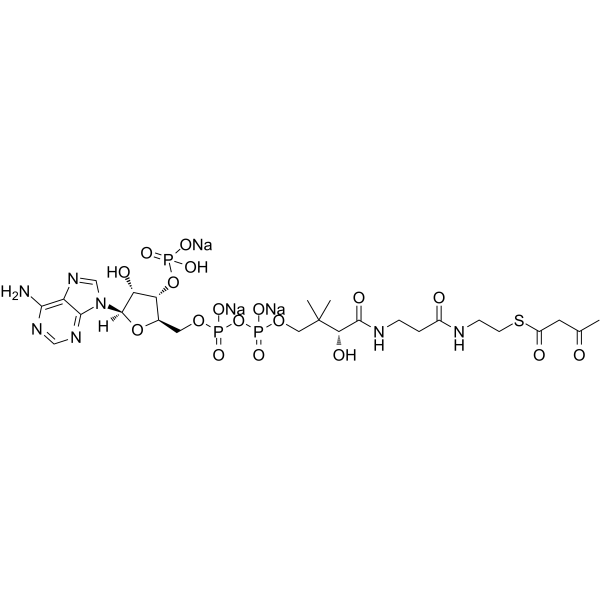
Physicochemical Properties
| Molecular Formula | C25H37N7O18P3S-3.3[NA+] |
| Molecular Weight | 917.553180000001 |
| Exact Mass | 917.082 |
| CAS # | 102029-52-7 |
| PubChem CID | 44134488 |
| Appearance | Typically exists as solid at room temperature |
| LogP | 1.321 |
| Hydrogen Bond Donor Count | 6 |
| Hydrogen Bond Acceptor Count | 23 |
| Rotatable Bond Count | 22 |
| Heavy Atom Count | 57 |
| Complexity | 1480 |
| Defined Atom Stereocenter Count | 0 |
| SMILES | [Na+].[Na+].[Na+].CC(CC(SCCNC(CCNC(C(C(COP(OP(OCC1OC(N2C=NC3=C(N=CN=C23)N)C(O)C1OP([O-])(O)=O)(=O)[O-])(=O)[O-])(C)C)O)=O)=O)=O)=O |
| InChi Key | KJJYKBIEKQJXHM-UHFFFAOYSA-K |
| InChi Code | InChI=1S/C25H40N7O18P3S.3Na/c1-13(33)8-16(35)54-7-6-27-15(34)4-5-28-23(38)20(37)25(2,3)10-47-53(44,45)50-52(42,43)46-9-14-19(49-51(39,40)41)18(36)24(48-14)32-12-31-17-21(26)29-11-30-22(17)32;;;/h11-12,14,18-20,24,36-37H,4-10H2,1-3H3,(H,27,34)(H,28,38)(H,42,43)(H,44,45)(H2,26,29,30)(H2,39,40,41);;;/q;3*+1/p-3 |
| Chemical Name | trisodium;[5-(6-aminopurin-9-yl)-4-hydroxy-2-[[[[3-hydroxy-2,2-dimethyl-4-oxo-4-[[3-oxo-3-[2-(3-oxobutanoylsulfanyl)ethylamino]propyl]amino]butoxy]-oxidophosphoryl]oxy-oxidophosphoryl]oxymethyl]oxolan-3-yl] hydrogen phosphate |
| Synonyms | 102029-52-7; trisodium;[5-(6-aminopurin-9-yl)-4-hydroxy-2-[[[[3-hydroxy-2,2-dimethyl-4-oxo-4-[[3-oxo-3-[2-(3-oxobutanoylsulfanyl)ethylamino]propyl]amino]butoxy]-oxidophosphoryl]oxy-oxidophosphoryl]oxymethyl]oxolan-3-yl] hydrogen phosphate; Acetoacetyl coenzyme A sodium salt; Acetoacetyl-CoANa3 tetrahydrate; Acetoacetyl-CoAxNa; Acetoacetyl-CoANa3; Acetoacetyl coenzyme A trisodium salt tetrahydrate; DTXSID00657518; |
| HS Tariff Code | 2934.99.9001 |
| Storage |
Powder-20°C 3 years 4°C 2 years In solvent -80°C 6 months -20°C 1 month |
| Shipping Condition | Room temperature (This product is stable at ambient temperature for a few days during ordinary shipping and time spent in Customs) |
Biological Activity
| Targets | Endogenous metabolite |
| ln Vitro |
During the study of acetoacetyl coenzyme A (CoA)-reacting enzymes of Clostridium beijerinckii NRRL B593, a phosphate-dependent acetoacetyl-CoA-utilizing activity was detected in protein fractions devoid of thiolase and phosphotransacetylase. Further purification of this acetoacetyl-CoA-utilizing activity yielded an enzyme which may be designated as phosphotransbutyrylase (PTB; phosphate butyryltransferase [EC 2.3.1.19]). PTB from C. beijerinckii NRRL B593 was purified 160-fold with a yield of 14% and, with the best fractions, purified 190-fold to near homogeneity. It showed a native Mr of 205,000 and a subunit Mr of 33,000. PTB activity was sensitive to pH changes within the physiological range of 6 to 8. PTB exhibited a broad substrate specificity. The Km values at pH 7.5 for butyryl-CoA, acetoacetyl-CoA, and acetyl-CoA were 0.04, 1.10, and 3.33 mM, respectively. The Vmax values with butyryl-CoA and acetoacetyl-CoA were comparable, but the Vmax/Km was higher for butyryl-CoA than for acetoacetyl-CoA. An apparent Km of 6.5 mM for phosphate was obtained with butyryl-CoA as the cosubstrate, whereas it was 12.9 mM with acetoacetyl-CoA as the cosubstrate. It remains to be established whether the putative compound acetoacetyl phosphate is produced in the PTB-catalyzed reaction with acetoacetyl-CoA. [1] Biochemical controls that regulate the biosynthesis of poly-3-hydroxybutyrate (PHB) were investigated in Rhizobium (Cicer) sp. strain CC 1192. This species is of interest for studying PHB synthesis because the polymer accumulates to a large extent in free-living cells but not in bacteroids during nitrogen-fixing symbiosis with chickpea (Cicer arietinum L.) plants. Evidence is presented that indicates that CC 1192 cells retain the enzymic capacity to synthesize PHB when they differentiate from the free-living state to the bacteroid state. This evidence includes the incorporation by CC 1192 bacteroids of radiolabel from [14C]malate into 3-hydroxybutyrate which was derived by chemically degrading insoluble material from bacteroid pellets. Furthermore, the presence of an NADPH-dependent acetoacetyl coenzyme A (CoA) reductase, which was specific for R-(-)-3-hydroxybutyryl-CoA and NADP+ in the oxidative direction, was demonstrated in extracts from free-living and bacteroid cells of CC 1192. Activity of this enzyme in the reductive direction appeared to be regulated at the biochemical level mainly by the availability of substrates. The CC 1192 cells also contained an NADH-specific acetoacetyl-CoA reductase which oxidized S-(+)-3-hydroxybutyryl-CoA. A membrane preparation from CC 1192 bacteroids readily oxidized NADH but not NADPH, which is suggested to be a major source of reductant for nitrogenase. Thus, a high ratio of NADPH to NADP+, which could enhance delivery of reductant to nitrogenase, could also favor the reduction of acetoacetyl-CoA for PHB synthesis. This would mean that fine controls that regulate the partitioning of acetyl-CoA between citrate synthase and 3-ketothiolase are important in determining whether PHB accumulates [2]. |
| References |
[1]. Purification and properties of an acetoacetyl coenzyme A-reacting phosphotransbutyrylase from Clostridium beijerinckii ("Clostridium butylicum") NRRL B593. Appl Environ Microbiol. 1990 Mar;56(3):607-13. [2]. Acetoacetyl coenzyme A reductase and polyhydroxybutyrate synthesis in rhizobium (Cicer) sp. Strain CC 1192. Appl Environ Microbiol. 1998 Aug;64(8):2859-63. |
Solubility Data
| Solubility (In Vitro) | May dissolve in DMSO (in most cases), if not, try other solvents such as H2O, Ethanol, or DMF with a minute amount of products to avoid loss of samples |
| Solubility (In Vivo) |
Note: Listed below are some common formulations that may be used to formulate products with low water solubility (e.g. < 1 mg/mL), you may test these formulations using a minute amount of products to avoid loss of samples. Injection Formulations (e.g. IP/IV/IM/SC) Injection Formulation 1: DMSO : Tween 80: Saline = 10 : 5 : 85 (i.e. 100 μL DMSO stock solution → 50 μL Tween 80 → 850 μL Saline) *Preparation of saline: Dissolve 0.9 g of sodium chloride in 100 mL ddH ₂ O to obtain a clear solution. Injection Formulation 2: DMSO : PEG300 :Tween 80 : Saline = 10 : 40 : 5 : 45 (i.e. 100 μL DMSO → 400 μLPEG300 → 50 μL Tween 80 → 450 μL Saline) Injection Formulation 3: DMSO : Corn oil = 10 : 90 (i.e. 100 μL DMSO → 900 μL Corn oil) Example: Take the Injection Formulation 3 (DMSO : Corn oil = 10 : 90) as an example, if 1 mL of 2.5 mg/mL working solution is to be prepared, you can take 100 μL 25 mg/mL DMSO stock solution and add to 900 μL corn oil, mix well to obtain a clear or suspension solution (2.5 mg/mL, ready for use in animals). Injection Formulation 4: DMSO : 20% SBE-β-CD in saline = 10 : 90 [i.e. 100 μL DMSO → 900 μL (20% SBE-β-CD in saline)] *Preparation of 20% SBE-β-CD in Saline (4°C,1 week): Dissolve 2 g SBE-β-CD in 10 mL saline to obtain a clear solution. Injection Formulation 5: 2-Hydroxypropyl-β-cyclodextrin : Saline = 50 : 50 (i.e. 500 μL 2-Hydroxypropyl-β-cyclodextrin → 500 μL Saline) Injection Formulation 6: DMSO : PEG300 : castor oil : Saline = 5 : 10 : 20 : 65 (i.e. 50 μL DMSO → 100 μLPEG300 → 200 μL castor oil → 650 μL Saline) Injection Formulation 7: Ethanol : Cremophor : Saline = 10: 10 : 80 (i.e. 100 μL Ethanol → 100 μL Cremophor → 800 μL Saline) Injection Formulation 8: Dissolve in Cremophor/Ethanol (50 : 50), then diluted by Saline Injection Formulation 9: EtOH : Corn oil = 10 : 90 (i.e. 100 μL EtOH → 900 μL Corn oil) Injection Formulation 10: EtOH : PEG300:Tween 80 : Saline = 10 : 40 : 5 : 45 (i.e. 100 μL EtOH → 400 μLPEG300 → 50 μL Tween 80 → 450 μL Saline) Oral Formulations Oral Formulation 1: Suspend in 0.5% CMC Na (carboxymethylcellulose sodium) Oral Formulation 2: Suspend in 0.5% Carboxymethyl cellulose Example: Take the Oral Formulation 1 (Suspend in 0.5% CMC Na) as an example, if 100 mL of 2.5 mg/mL working solution is to be prepared, you can first prepare 0.5% CMC Na solution by measuring 0.5 g CMC Na and dissolve it in 100 mL ddH2O to obtain a clear solution; then add 250 mg of the product to 100 mL 0.5% CMC Na solution, to make the suspension solution (2.5 mg/mL, ready for use in animals). Oral Formulation 3: Dissolved in PEG400 Oral Formulation 4: Suspend in 0.2% Carboxymethyl cellulose Oral Formulation 5: Dissolve in 0.25% Tween 80 and 0.5% Carboxymethyl cellulose Oral Formulation 6: Mixing with food powders Note: Please be aware that the above formulations are for reference only. InvivoChem strongly recommends customers to read literature methods/protocols carefully before determining which formulation you should use for in vivo studies, as different compounds have different solubility properties and have to be formulated differently. (Please use freshly prepared in vivo formulations for optimal results.) |
| Preparing Stock Solutions | 1 mg | 5 mg | 10 mg | |
| 1 mM | 1.0899 mL | 5.4493 mL | 10.8986 mL | |
| 5 mM | 0.2180 mL | 1.0899 mL | 2.1797 mL | |
| 10 mM | 0.1090 mL | 0.5449 mL | 1.0899 mL |