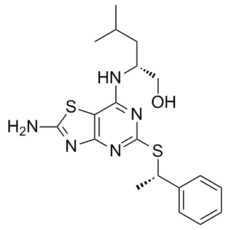
AZD8797 (AZD-8797) is a novel, selective, orally bioavailable and allosteric non-competitive modulator of the human CX3CR1 receptor with potential anti-Inflammatory and immunomodulatory activity. It irritates CX3CR1 and CXCR2, with corresponding Ki values of 3.9 and 2800 nM. AZD8797 inhibited the natural ligand fractalkine (CX3CL1) in a flow adhesion assay using IC50 values of 300 and 6 nM, respectively, in human whole blood (hWB) and a B-lymphocyte cell line. In an assay for [(35)S]GTPηS (guanosine 5'-[γ-thio]triphosphate) accumulation, AZD8797 also inhibited G-protein activation. By contrast, AZD8797 agonism was found to be weakly Gαi-dependent through dynamic mass redistribution (DMR) experiments. Furthermore, in an β-arrestin recruitment assay, AZD8797 positively modulated the CX3CL1 response at sub-micromolar concentrations. AZD8797 decreased the maximum binding of (125)I-CX3CL1 in equilibrium saturation binding experiments while having no effect on Kd. Kinetic studies that determined the kon and koff of AZD8797 showed that this was a genuine non-competitive mechanism rather than an artifact of irreversible or insurmountable binding. Ultimately, we demonstrate that GTPγS and AZD8797 both raise the rate at which CX3CL1 separates from CX3CR1 in a comparable way, suggesting a link between AZD8797 and the G-protein bound to CX3CR1. All together, these findings demonstrate that AZD8797 functions as a non-competitive allosteric modulator of CX3CL1, binding CX3CR1 and causing biased effects on G-protein signaling and β-arrestin acquisition.
Physicochemical Properties
| Molecular Formula | C19H25N5OS2 | |
| Molecular Weight | 403.56 | |
| Exact Mass | 403.15 | |
| Elemental Analysis | C, 56.55; H, 6.24; N, 17.35; O, 3.96; S, 15.89 | |
| CAS # | 911715-90-7 | |
| Related CAS # |
|
|
| PubChem CID | 11965767 | |
| Appearance | Light yellow to yellow solid powder | |
| Density | 1.3±0.1 g/cm3 | |
| Boiling Point | 651.1±65.0 °C at 760 mmHg | |
| Flash Point | 347.6±34.3 °C | |
| Vapour Pressure | 0.0±2.0 mmHg at 25°C | |
| Index of Refraction | 1.669 | |
| LogP | 4.6 | |
| Hydrogen Bond Donor Count | 3 | |
| Hydrogen Bond Acceptor Count | 8 | |
| Rotatable Bond Count | 8 | |
| Heavy Atom Count | 27 | |
| Complexity | 452 | |
| Defined Atom Stereocenter Count | 2 | |
| SMILES | N(C1N=C(S[C@H](C2C=CC=CC=2)C)N=C2N=C(SC=12)N)[C@@H](CO)CC(C)C |
|
| InChi Key | ZMQSLMZOWVGBSM-GXTWGEPZSA-N | |
| InChi Code | InChI=1S/C19H25N5OS2/c1-11(2)9-14(10-25)21-16-15-17(22-18(20)27-15)24-19(23-16)26-12(3)13-7-5-4-6-8-13/h4-8,11-12,14,25H,9-10H2,1-3H3,(H3,20,21,22,23,24)/t12-,14+/m0/s1 | |
| Chemical Name | (2R)-2-[[2-amino-5-[(1S)-1-phenylethyl]sulfanyl-[1,3]thiazolo[4,5-d]pyrimidin-7-yl]amino]-4-methylpentan-1-ol | |
| Synonyms |
|
|
| HS Tariff Code | 2934.99.9001 | |
| Storage |
Powder-20°C 3 years 4°C 2 years In solvent -80°C 6 months -20°C 1 month |
|
| Shipping Condition | Room temperature (This product is stable at ambient temperature for a few days during ordinary shipping and time spent in Customs) |
Biological Activity
| Targets | CX3CR1 ( Ki = 3.9 nM ); 125I-IL-8-CXCR2 ( Ki = 2800 nM ) | |
| ln Vitro |
|
|
| ln Vivo |
|
|
| Enzyme Assay | In a MicroWell 96-well plate, CHO-hCX3CR1 membranes are incubated in 50 mM HEPES, 100 mM NaCl, 5 mM MgCl2, 10 μM GDP, and 0.01% gelatin along with varying concentrations of AZD8797. Next, EC80 of CX3CL1 and 0.56 μCi/mL [35S]GTPηS are added. After one hour of incubation at 30°C, the plate is vacuum-filtered to a Printed Filtermat B to separate the bound and unbound [35S]GTPγS. Regardless of the AZD8797 concentration, the various AZD8797 concentrations are obtained by stepwise dilution in DMSO, which results in a final DMSO concentration of 1% in all wells following the addition of assay buffer. | |
| Cell Assay | AZD8797 inhibits the natural ligand fractalkine (CX3CL1) in a flow adhesion assay using IC50 values of 300 and 6 nM, respectively, in human whole blood (hWB) and a B-lymphocyte cell line. Additionally, AZD8797 inhibits G-protein activation in an assay for [35S]GTPγS accumulation. In an β-arrestin recruitment assay, AZD8797 at sub-micromolar concentrations positively modulates the CX3CL1 response. AZD8797 lowers the maximal binding of 125I-CX3CL1 in equilibrium saturation binding experiments while having no effect on Kd. AZD8797 exhibits high affinity and selectivity when binding to CX3CR1 in both humans and rats (Ki of hCX3CR1, 4 nM, and Ki of rCX3CR1, 7 nM, respectively). AZD8797 is a very strong inhibitor of human CX3CR1 (10 nM), as evidenced by the equilibrium dissociation constant, KB. Rat CX3CR1 has a potency of 29 nM, which is three times lower than mouse CX3CR1, which has an even smaller potency of 54 nM. | |
| Animal Protocol |
|
|
| References |
[1]. AZD8797 is an allosteric non-competitive modulator of the human CX3CR1 receptor. Biochem J. 2016 Mar 1;473(5):641-9. [2]. Pharmacological inhibition of the chemokine receptor CX3CR1 attenuates disease in a chronic-relapsing rat model for multiple sclerosis. Proc Natl Acad Sci U S A. 2014 Apr 8;111(14):5409-14. [3]. Substituted 7-amino-5-thio-thiazolo[4,5-d]pyrimidines as potent and selective antagonists of the fractalkine receptor (CX3CR1). J Med Chem. 2013 Apr 25;56(8):3177-90. |
Solubility Data
| Solubility (In Vitro) |
|
|||
| Solubility (In Vivo) |
Solubility in Formulation 1: ≥ 2.5 mg/mL (6.19 mM) (saturation unknown) in 10% DMSO + 40% PEG300 + 5% Tween80 + 45% Saline (add these co-solvents sequentially from left to right, and one by one), clear solution. For example, if 1 mL of working solution is to be prepared, you can add 100 μL of 25.0 mg/mL clear DMSO stock solution to 400 μL PEG300 and mix evenly; then add 50 μL Tween-80 to the above solution and mix evenly; then add 450 μL normal saline to adjust the volume to 1 mL. Preparation of saline: Dissolve 0.9 g of sodium chloride in 100 mL ddH₂ O to obtain a clear solution. Solubility in Formulation 2: ≥ 2.5 mg/mL (6.19 mM) (saturation unknown) in 10% DMSO + 90% (20% SBE-β-CD in Saline) (add these co-solvents sequentially from left to right, and one by one), clear solution. For example, if 1 mL of working solution is to be prepared, you can add 100 μL of 25.0 mg/mL clear DMSO stock solution to 900 μL of 20% SBE-β-CD physiological saline solution and mix evenly. Preparation of 20% SBE-β-CD in Saline (4°C,1 week): Dissolve 2 g SBE-β-CD in 10 mL saline to obtain a clear solution. Solubility in Formulation 3: ≥ 2.5 mg/mL (6.19 mM) (saturation unknown) in 10% DMSO + 90% Corn Oil (add these co-solvents sequentially from left to right, and one by one), clear solution. For example, if 1 mL of working solution is to be prepared, you can add 100 μL of 25.0 mg/mL clear DMSO stock solution to 900 μL of corn oil and mix evenly. Solubility in Formulation 4: 5 mg/mL (12.39 mM) in 20% HP-β-CD in Saline (add these co-solvents sequentially from left to right, and one by one), suspension solution; with ultrasonication. Preparation of saline: Dissolve 0.9 g of sodium chloride in 100 mL ddH₂ O to obtain a clear solution. (Please use freshly prepared in vivo formulations for optimal results.) |
| Preparing Stock Solutions | 1 mg | 5 mg | 10 mg | |
| 1 mM | 2.4779 mL | 12.3897 mL | 24.7795 mL | |
| 5 mM | 0.4956 mL | 2.4779 mL | 4.9559 mL | |
| 10 mM | 0.2478 mL | 1.2390 mL | 2.4779 mL |