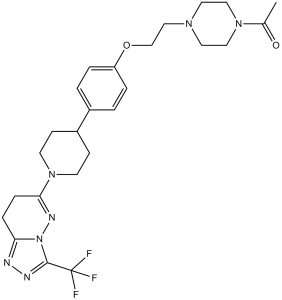
AZD3514 (AZD-3514; AZD 3514) is a novel, potent and orally bioavailable androgen receptor downregulator with potential anticancer activity. It inhibits AR with Ki of 2.2 μM and has the ability to reduce AR protein expression and thus has the potential to be used as an anticancer agent. In LNCaP and LAPC4 prostate cancer cells, AZD3514 inhibited DHT-driven proliferation of LNCaP cells in a dose-dependent way and inhibited the ligand-driven expression of AR-regulated genes PSA and TMPRSS2. Also, AZD3514 reduced AR protein expression in a dose-dependent way. AZD3514 is being studied in a Phase I clinical trial to treat patients with castrate-resistant prostate cancer.
Physicochemical Properties
| Molecular Formula | C25H32F3N7O2 | |
| Molecular Weight | 519.56 | |
| Exact Mass | 519.256 | |
| CAS # | 1240299-33-5 | |
| Related CAS # | 1240299-36-8;1240299-33-5; | |
| PubChem CID | 46893585 | |
| Appearance | White to off-white solid powder | |
| Density | 1.4±0.1 g/cm3 | |
| Boiling Point | 669.5±65.0 °C at 760 mmHg | |
| Flash Point | 358.7±34.3 °C | |
| Vapour Pressure | 0.0±2.0 mmHg at 25°C | |
| Index of Refraction | 1.642 | |
| LogP | 1.16 | |
| Hydrogen Bond Donor Count | 0 | |
| Hydrogen Bond Acceptor Count | 9 | |
| Rotatable Bond Count | 6 | |
| Heavy Atom Count | 37 | |
| Complexity | 805 | |
| Defined Atom Stereocenter Count | 0 | |
| InChi Key | JMEYDSHPKCSIJC-UHFFFAOYSA-N | |
| InChi Code | InChI=1S/C25H32F3N7O2/c1-18(36)33-14-12-32(13-15-33)16-17-37-21-4-2-19(3-5-21)20-8-10-34(11-9-20)23-7-6-22-29-30-24(25(26,27)28)35(22)31-23/h2-5,20H,6-17H2,1H3 | |
| Chemical Name | 1-[4-[2-[4-[1-[3-(trifluoromethyl)-7,8-dihydro-[1,2,4]triazolo[4,3-b]pyridazin-6-yl]piperidin-4-yl]phenoxy]ethyl]piperazin-1-yl]ethanone | |
| Synonyms |
|
|
| HS Tariff Code | 2934.99.9001 | |
| Storage |
Powder-20°C 3 years 4°C 2 years In solvent -80°C 6 months -20°C 1 month |
|
| Shipping Condition | Room temperature (This product is stable at ambient temperature for a few days during ordinary shipping and time spent in Customs) |
Biological Activity
| ln Vitro | AZD3514 (0-10 μM/L; 7 d) suppresses the growth of LNCaP and LAPC4 cells[2]. AZD3514 (0-10 μM/L; 24 h) suppresses known AR-regulated gene ligand-driven expression[2]. In LNCaPs and LAPC4s, AZD3514 (0-30 μM/L; 24 h) decreases AR protein expression[2]. In LNCaP cells, AZD3514 (1–10 μM/L; 2 h) decreases AR nuclear translocation[2]. |
| ln Vivo | Rats' AR signaling is inhibited by AZD3514 (10-100 mg/kg; po once daily for 6 days)[2]. For 30 days, AZD3514 (50 mg/kg, po once daily) slows the growth of prostate tumors[2]. In vivo, AZD3514 (50–100 mg/kg; po once daily for three days) dramatically lowers nuclear AR protein[2]. |
| Cell Assay |
Cell Proliferation Assay [2] Cell Types: LNCaP and LAPC4 cell lines Tested Concentrations: 0, 0.1, 0.4, 1.1, 3.3 and 10 μM/L Incubation Duration: 7 days Experimental Results: Inhibited LAPC4 cells growth and dose-dependently inhibited proliferation of LNCaP cells. Western Blot Analysis[2] Cell Types: LNCaP and LAPC4 cell lines Tested Concentrations: 0, 0.4, 1.1, 3.3, 10 and 30 μM/L Incubation Duration: 0-24 hrs (hours) Experimental Results: Dose-dependently decreased AR protein expression in LNCaPs, and diminished AR protein in LAPC4 cells with a concentration of 10 μM/L. decreased the rate of AR synthesis to reduce the concentration of AR protein. RT-PCR[2] Cell Types: LNCaP and LAPC4 cell lines Tested Concentrations: 0, 0.4, 1.1, 3.3 and 10 μM/L Incubation Duration: 24 hrs (hours) Experimental Results: Inhibited ligand-driven expression of AR-regulated genes PSA and TMPRSS2 in both LNCaP and LAPC4 cells. |
| Animal Protocol |
Animal/Disease Models: Intact or castrat 42- and 49-day-old Hans Wistar rats[2] Doses: 10, 50 and 100 mg/kg Route of Administration: po (oral gavage); 10-100 mg/kg one time/day; for 6 days Experimental Results: Inhibited AR signaling in rats, decreased seminal vesicle weight in intact rats, and inhibited the ability of exogenous testosterone proprionate to cause an increase in seminal vesicle weight in castrated rat. Animal/Disease Models: Male Copenhagen rats with Dunning R3327H prostate tumors[2] Doses: 50 mg/kg Route of Administration: po (oral gavage); 50 mg/kg one time/day; for 30 days Experimental Results: Dramatically inhibited prostate tumor growth of rats. |
| References |
[1]. Discovery of AZD3514, a small-molecule androgen receptor downregulator for treatment of advanced prostate cancer. Bioorg Med Chem Lett. 2013 Apr 1;23(7):1945-8. [2]. AZD3514: a small molecule that modulates androgen receptor signaling and function in vitro and in vivo. Mol Cancer Ther. 2013 Sep;12(9):1715-27. [3]. AZD3514, an oral selective androgen receptor down-regulator in patients with castration-resistant prostate cancer - results of two parallel first-in-human phase I studies. Invest New Drugs. 2015 Jun;33(3):679-90. |
| Additional Infomation | Androgen Receptor Downregulator AZD3514 is an orally available selective androgen receptor (AR) downregulator (SARD), with potential antineoplastic activity. Upon oral administration, AZD3514 binds to the AR ligand binding domain and inhibits the binding of androgen, thereby preventing androgen-dependent AR signaling. AZD3514 also causes downregulation of AR expression, which further prevents AR-mediated signaling. This results in an inhibition of proliferation in AR-overexpressing tumor cells. AR plays a key role in the proliferation of castration-resistant prostate cancer cells. |
Solubility Data
| Solubility (In Vitro) |
|
|||
| Solubility (In Vivo) |
Solubility in Formulation 1: ≥ 2.5 mg/mL (4.81 mM) (saturation unknown) in 10% DMSO + 40% PEG300 + 5% Tween80 + 45% Saline (add these co-solvents sequentially from left to right, and one by one), clear solution. For example, if 1 mL of working solution is to be prepared, you can add 100 μL of 25.0 mg/mL clear DMSO stock solution to 400 μL PEG300 and mix evenly; then add 50 μL Tween-80 to the above solution and mix evenly; then add 450 μL normal saline to adjust the volume to 1 mL. Preparation of saline: Dissolve 0.9 g of sodium chloride in 100 mL ddH₂ O to obtain a clear solution. Solubility in Formulation 2: ≥ 2.5 mg/mL (4.81 mM) (saturation unknown) in 10% DMSO + 90% (20% SBE-β-CD in Saline) (add these co-solvents sequentially from left to right, and one by one), clear solution. For example, if 1 mL of working solution is to be prepared, you can add 100 μL of 25.0 mg/mL clear DMSO stock solution to 900 μL of 20% SBE-β-CD physiological saline solution and mix evenly. Preparation of 20% SBE-β-CD in Saline (4°C,1 week): Dissolve 2 g SBE-β-CD in 10 mL saline to obtain a clear solution. Solubility in Formulation 3: ≥ 2.5 mg/mL (4.81 mM) (saturation unknown) in 10% DMSO + 90% Corn Oil (add these co-solvents sequentially from left to right, and one by one), clear solution. For example, if 1 mL of working solution is to be prepared, you can add 100 μL of 25.0 mg/mL clear DMSO stock solution to 900 μL of corn oil and mix evenly. (Please use freshly prepared in vivo formulations for optimal results.) |
| Preparing Stock Solutions | 1 mg | 5 mg | 10 mg | |
| 1 mM | 1.9247 mL | 9.6235 mL | 19.2471 mL | |
| 5 mM | 0.3849 mL | 1.9247 mL | 3.8494 mL | |
| 10 mM | 0.1925 mL | 0.9624 mL | 1.9247 mL |