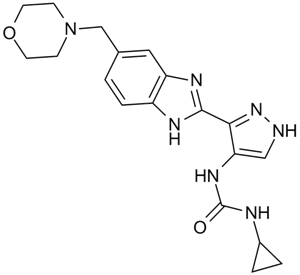
AT9283 is a novel, potent and selective inhibitor of multikinase including Aurora A/B, JAK2/3, Abl (T315I) and Flt3 etc. It was identified from fragment-based approach as a potential antineoplastic agent for the treatment of multiple myeloma. AT9283 inhibits JAK2/3 with IC50s of 1.2 nM/1.1 nM in cell-free assays. AT9283 binds to and inhibits Aurora kinases A and B, JAK2 and the kinase BCR-ABL, which may result in the inhibition of cellular division and proliferation and the induction of apoptosis in tumor cells that overexpress these kinases.
Physicochemical Properties
| Molecular Formula | C19H23N7O2 |
| Molecular Weight | 381.43 |
| Exact Mass | 381.191 |
| CAS # | 896466-04-9 |
| Related CAS # | AT9283 lactic acid;896466-76-5 |
| PubChem CID | 135398495 |
| Appearance | White to off-white solid powder |
| Density | 1.5±0.1 g/cm3 |
| Index of Refraction | 1.715 |
| LogP | 0.92 |
| Hydrogen Bond Donor Count | 4 |
| Hydrogen Bond Acceptor Count | 5 |
| Rotatable Bond Count | 5 |
| Heavy Atom Count | 28 |
| Complexity | 554 |
| Defined Atom Stereocenter Count | 0 |
| InChi Key | LOLPPWBBNUVNQZ-UHFFFAOYSA-N |
| InChi Code | InChI=1S/C19H23N7O2/c27-19(21-13-2-3-13)24-16-10-20-25-17(16)18-22-14-4-1-12(9-15(14)23-18)11-26-5-7-28-8-6-26/h1,4,9-10,13H,2-3,5-8,11H2,(H,20,25)(H,22,23)(H2,21,24,27) |
| Chemical Name | 1-cyclopropyl-3-(3-(5-(morpholinomethyl)-1H-benzo[d]imidazol-2-yl)-1H-pyrazol-4-yl)urea |
| Synonyms | AT9 283; AT-9283; AT9283 |
| HS Tariff Code | 2934.99.9001 |
| Storage |
Powder-20°C 3 years 4°C 2 years In solvent -80°C 6 months -20°C 1 month |
| Shipping Condition | Room temperature (This product is stable at ambient temperature for a few days during ordinary shipping and time spent in Customs) |
Biological Activity
| ln Vitro | AT9283 inhibits Aurora B kinase activity in HCT116 cells with an IC50 of 30 nM, resulting in a phenotypic that is obviously polyploid. Additionally, AT9283 inhibits HCT116 colony development with a strong degree[1]. AT9283 reduces cell proliferation with an IC50 < 1 μM in B-NHL cell lines and promotes apoptosis in a dose- and time-dependent manner[2]. In MM cell lines, AT9283 inhibits the STAT3 signaling pathway, causes dose-dependent cytotoxicity, and hinders proliferation. T9283 suppresses the phosphorylation of Histone H3 and Aurora A at Thr 288. Time-dependently, AT9283 causes MM cells to enter the G2/M phase and undergo apoptosis[3]. | ||
| ln Vivo | Treatment with AT9283 (15 mg/kg and 20 mg/kg) for 16 days causes a considerable tumor growth inhibition of 67% and 76%, respectively, in mice bearing HCT116 human colon cancer xenografts. Furthermore, compared to plasma, AT9283 has a much longer half-life in tumors (2.5 hours) and a moderate oral bioavailability in mice[1]. The combined anti-tumor efficacy of docetaxel (10 mg/kg) and AT9283 (15 mg/kg) is moderate. In a mouse xenograft model of mantle cell lymphoma, T9283 at 20 mg/kg and AT9283 (15 or 20 mg/kg) plus docetaxel (10 mg/kg) show a statistically significant tumor growth suppression and improve survival[2]. In mice, AT9283 (45 mg/kg, ip) suppresses the formation of tumors. Reduced expression of phospho-Histone H3 and Aurora B in treated rats is confirmed by two cycles of AT9283 45 mg/kg administered 14 hours after medication administration[3]. | ||
| Animal Protocol |
|
||
| References |
[1]. Fragment-Based Discovery of the Pyrazol-4-yl Urea (AT9283), a Multitargeted Kinase Inhibitor with Potent Aurora Kinase Activity. Journal of Medicinal Chemistry (2009), 52(2), 379-388. [2]. AT9283, a novel aurora kinase inhibitor, suppresses tumor growth in aggressive B-cell lymphomas. Int J Cancer. 2012 Jun 15;130(12):2997-3005. [3]. Antimyeloma activity of a multitargeted kinase inhibitor, AT9283, via potent Aurora kinase and STAT3 inhibition either alone or in combination with lenalidomide. Clin Cancer Res. 2011 May 15;17(10):3259-71. |
||
| Additional Infomation |
1-cyclopropyl-3-[3-[5-(4-morpholinylmethyl)-2-benzimidazolylidene]-1,2-dihydropyrazol-4-yl]urea is a member of benzimidazoles. AT9283 is an aurora Kinase inhibitor developed by Astex Therapeutics for the treatment of cancer. It was discovered and developed internally using Astex’s fragment-based drug discovery platform, Pyramid. Multikinase Inhibitor AT9283 is a small synthetic molecule and aurora kinase (AK) inhibitor with potential antineoplastic activity. AT9283 selectively binds to and inhibits AKs A and B, which are serine-threonine kinases that play essential roles in mitotic checkpoint control during mitosis. Inhibition of these kinases results in an inhibition of cellular division and proliferation in tumor cells that overexpress AKs. Drug Indication Investigated for use/treatment in cancer/tumors (unspecified), leukemia (myeloid), and solid tumors. Mechanism of Action AT9283 is an inhibitor of mitosis (cell division) and is the second most progressed drug candidate in the Astex portfolio of novel molecularly targeted cancer drugs. All of Astex’s current products have been discovered internally using its proprietary drug discovery approach. AT9283 is a potent inhibitor of the Aurora A and B kinases and has been shown to arrest tumour growth in a range of tumour models. Aurora kinases play a key role in mitotic checkpoint control in cell division. Both Aurora A and B are over-expressed in many human tumours and are believed to be excellent targets for anti-cancer therapy. |
Solubility Data
| Solubility (In Vitro) |
|
|||
| Solubility (In Vivo) |
Solubility in Formulation 1: ≥ 2.5 mg/mL (6.55 mM) (saturation unknown) in 10% DMSO + 40% PEG300 + 5% Tween80 + 45% Saline (add these co-solvents sequentially from left to right, and one by one), clear solution. For example, if 1 mL of working solution is to be prepared, you can add 100 μL of 25.0 mg/mL clear DMSO stock solution to 400 μL PEG300 and mix evenly; then add 50 μL Tween-80 to the above solution and mix evenly; then add 450 μL normal saline to adjust the volume to 1 mL. Preparation of saline: Dissolve 0.9 g of sodium chloride in 100 mL ddH₂ O to obtain a clear solution. Solubility in Formulation 2: ≥ 2.5 mg/mL (6.55 mM) (saturation unknown) in 10% DMSO + 90% (20% SBE-β-CD in Saline) (add these co-solvents sequentially from left to right, and one by one), clear solution. For example, if 1 mL of working solution is to be prepared, you can add 100 μL of 25.0 mg/mL clear DMSO stock solution to 900 μL of 20% SBE-β-CD physiological saline solution and mix evenly. Preparation of 20% SBE-β-CD in Saline (4°C,1 week): Dissolve 2 g SBE-β-CD in 10 mL saline to obtain a clear solution. Solubility in Formulation 3: ≥ 2.5 mg/mL (6.55 mM) (saturation unknown) in 10% DMSO + 90% Corn Oil (add these co-solvents sequentially from left to right, and one by one), clear solution. For example, if 1 mL of working solution is to be prepared, you can add 100 μL of 25.0 mg/mL clear DMSO stock solution to 900 μL of corn oil and mix evenly. Solubility in Formulation 4: 2% DMSO+30% PEG 300+ddH2O:5mg/mL (Please use freshly prepared in vivo formulations for optimal results.) |
| Preparing Stock Solutions | 1 mg | 5 mg | 10 mg | |
| 1 mM | 2.6217 mL | 13.1086 mL | 26.2171 mL | |
| 5 mM | 0.5243 mL | 2.6217 mL | 5.2434 mL | |
| 10 mM | 0.2622 mL | 1.3109 mL | 2.6217 mL |