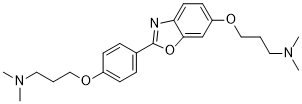
AT791 (AT-791) is a novel and potent inhibitor of TLR7 and TLR9 with anti-inflammatory and immunomodulatory effects. It inhibits TLR7 and TLR9 with IC50 of 3.33 uM and 0.04 uM respectively.
Physicochemical Properties
| Molecular Formula | C23H31N3O3 |
| Molecular Weight | 397.510545969009 |
| Exact Mass | 397.236 |
| Elemental Analysis | C, 69.49; H, 7.86; N, 10.57; O, 12.07 |
| CAS # | 1219962-49-8 |
| PubChem CID | 45256283 |
| Appearance | White to off-white solid powder |
| LogP | 4.2 |
| Hydrogen Bond Donor Count | 0 |
| Hydrogen Bond Acceptor Count | 6 |
| Rotatable Bond Count | 11 |
| Heavy Atom Count | 29 |
| Complexity | 455 |
| Defined Atom Stereocenter Count | 0 |
| SMILES | O(C1C=CC2=C(C=1)OC(C1C=CC(=CC=1)OCCCN(C)C)=N2)CCCN(C)C |
| InChi Key | JKFYWFWUJUHSMZ-UHFFFAOYSA-N |
| InChi Code | InChI=1S/C23H31N3O3/c1-25(2)13-5-15-27-19-9-7-18(8-10-19)23-24-21-12-11-20(17-22(21)29-23)28-16-6-14-26(3)4/h7-12,17H,5-6,13-16H2,1-4H3 |
| Chemical Name | 3-[4-[6-[3-(dimethylamino)propoxy]-1,3-benzoxazol-2-yl]phenoxy]-N,N-dimethylpropan-1-amine |
| Synonyms | AT791; 1219962-49-8; 3-(4-(6-(3-(Dimethylamino)propoxy)benzo[d]oxazol-2-yl)phenoxy)-N,N-dimethylpropan-1-amine; 3-[4-[6-[3-(dimethylamino)propoxy]-1,3-benzoxazol-2-yl]phenoxy]-N,N-dimethylpropan-1-amine; SCHEMBL12396693; |
| HS Tariff Code | 2934.99.9001 |
| Storage |
Powder-20°C 3 years 4°C 2 years In solvent -80°C 6 months -20°C 1 month |
| Shipping Condition | Room temperature (This product is stable at ambient temperature for a few days during ordinary shipping and time spent in Customs) |
Biological Activity
| Targets | TLR7 (IC50 = 3.33 μM); TLR9 (IC50 = 0.04 μM) |
| ln Vitro | AT791 has been shown to be able to effectively suppress HEK:TLR9 cell DNA stimulation (IC50 = 0.04 μM), but R848 (IC50 = 3.33 μM) has a substantially weaker effect on HEK:TLR7 cell stimulation [1]. Due to their lipophilicity and weakly basic amino acid content, AT791 and E6446 are typical "lysosomal" molecules. These substances have IC50s between 1 and 10 μM and behave non-polarly at neutral pH [1]. are polarizing membranes and sexual; yet, in low pH vesicles, they get protonated and imprisoned (de Duve et al., 1974). With respect to the lysosomal compartment, they satisfy a higher degree of protonation than in the cytoplasm, as demonstrated by capillary polarization, which yielded pKas of 7.9 and 6.1 for AT791 and 8.6 and 6.5 for E6446 [1]. |
| ln Vivo | AT791 (20 mg/kg; po) can efficiently block the CpG1668 DNA-induced short-term increase of serum interleukin-6 in mice [1]. |
| Enzyme Assay |
Inhibition of TLR9 and TLR7 Signaling by Small Molecule Ligands [1] HEK293 cells expressing cloned human TLR9 and an NF-κB:luciferase reporter (HEK:TLR9 cells) were used to screen a compound library for small molecules that could suppress induction of NF-κB by stimulatory DNA (CpG2006). AT791 and E6446 (Fig. 1A) potently suppressed DNA stimulation of HEK:TLR9 cells, with IC50 values of 40 and 10 nM, respectively, but were significantly less effective at suppressing LPS endotoxin stimulation of HEK:TLR4 cells (Table 1) or R848 stimulation of HEK:TLR7 cells. |
| References |
[1]. Novel small molecule inhibitors of TLR7 and TLR9: mechanism of action and efficacy in vivo. Mol Pharmacol. 2014;85(3):429-440. |
| Additional Infomation | The discovery that circulating nucleic acid-containing complexes in the serum of autoimmune lupus patients can stimulate B cells and plasmacytoid dendritic cells via Toll-like receptors 7 and 9 suggested that agents that block these receptors might be useful therapeutics. We identified two compounds, AT791 {3-[4-(6-(3-(dimethylamino)propoxy)benzo[d]oxazol-2-yl)phenoxy]-N,N-dimethylpropan-1-amine} and E6446 {6-[3-(pyrrolidin-1-yl)propoxy)-2-(4-(3-(pyrrolidin-1-yl)propoxy)phenyl]benzo[d]oxazole}, that inhibit Toll-like receptor (TLR)7 and 9 signaling in a variety of human and mouse cell types and inhibit DNA-TLR9 interaction in vitro. When administered to mice, these compounds suppress responses to challenge doses of cytidine-phosphate-guanidine (CpG)-containing DNA, which stimulates TLR9. When given chronically in spontaneous mouse lupus models, E6446 slowed development of circulating antinuclear antibodies and had a modest effect on anti-double-stranded DNA titers but showed no observable impact on proteinuria or mortality. We discovered that the ability of AT791 and E6446 to inhibit TLR7 and 9 signaling depends on two properties: weak interaction with nucleic acids and high accumulation in the intracellular acidic compartments where TLR7 and 9 reside. Binding of the compounds to DNA prevents DNA-TLR9 interaction in vitro and modulates signaling in vivo. Our data also confirm an earlier report that this same mechanism may explain inhibition of TLR7 and 9 signaling by hydroxychloroquine (Plaquenil; Sanofi-Aventis, Bridgewater, NJ), a drug commonly prescribed to treat lupus. Thus, very different structural classes of molecules can inhibit endosomal TLRs by essentially identical mechanisms of action, suggesting a general mechanism for targeting this group of TLRs. [1] |
Solubility Data
| Solubility (In Vitro) | DMSO : ~100 mg/mL (~251.57 mM) |
| Solubility (In Vivo) |
Solubility in Formulation 1: ≥ 2.5 mg/mL (6.29 mM) (saturation unknown) in 10% DMSO + 40% PEG300 + 5% Tween80 + 45% Saline (add these co-solvents sequentially from left to right, and one by one), clear solution. For example, if 1 mL of working solution is to be prepared, you can add 100 μL of 25.0 mg/mL clear DMSO stock solution to 400 μL PEG300 and mix evenly; then add 50 μL Tween-80 to the above solution and mix evenly; then add 450 μL normal saline to adjust the volume to 1 mL. Preparation of saline: Dissolve 0.9 g of sodium chloride in 100 mL ddH₂ O to obtain a clear solution. Solubility in Formulation 2: ≥ 2.5 mg/mL (6.29 mM) (saturation unknown) in 10% DMSO + 90% (20% SBE-β-CD in Saline) (add these co-solvents sequentially from left to right, and one by one), clear solution. For example, if 1 mL of working solution is to be prepared, you can add 100 μL of 25.0 mg/mL clear DMSO stock solution to 900 μL of 20% SBE-β-CD physiological saline solution and mix evenly. Preparation of 20% SBE-β-CD in Saline (4°C,1 week): Dissolve 2 g SBE-β-CD in 10 mL saline to obtain a clear solution. Solubility in Formulation 3: ≥ 2.5 mg/mL (6.29 mM) (saturation unknown) in 10% DMSO + 90% Corn Oil (add these co-solvents sequentially from left to right, and one by one), clear solution. For example, if 1 mL of working solution is to be prepared, you can add 100 μL of 25.0 mg/mL clear DMSO stock solution to 900 μL of corn oil and mix evenly. (Please use freshly prepared in vivo formulations for optimal results.) |
| Preparing Stock Solutions | 1 mg | 5 mg | 10 mg | |
| 1 mM | 2.5157 mL | 12.5783 mL | 25.1566 mL | |
| 5 mM | 0.5031 mL | 2.5157 mL | 5.0313 mL | |
| 10 mM | 0.2516 mL | 1.2578 mL | 2.5157 mL |