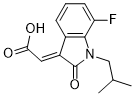
ASP7663 is an selective and orally bioavailable TRPA1 activator, acting by stimulating 5-HT release from QGP-1 cells and exhibiting an abdominal analgesic effect in vivo.
Physicochemical Properties
| Molecular Formula | C14H14FNO3 |
| Molecular Weight | 263.26 |
| Exact Mass | 263.095 |
| Elemental Analysis | C, 63.87; H, 5.36; F, 7.22; N, 5.32; O, 18.23 |
| CAS # | 1190217-35-6 |
| Related CAS # | 1190217-35-6 |
| PubChem CID | 44232532 |
| Appearance | Light yellow to orange solid powder |
| Density | 1.4±0.1 g/cm3 |
| Boiling Point | 368.1±42.0 °C at 760 mmHg |
| Flash Point | 176.4±27.9 °C |
| Vapour Pressure | 0.0±0.9 mmHg at 25°C |
| Index of Refraction | 1.628 |
| LogP | 2.82 |
| Hydrogen Bond Donor Count | 1 |
| Hydrogen Bond Acceptor Count | 4 |
| Rotatable Bond Count | 3 |
| Heavy Atom Count | 19 |
| Complexity | 419 |
| Defined Atom Stereocenter Count | 0 |
| SMILES | CC(C)CN1C2=C(C=CC=C2F)/C(=C\C(=O)O)/C1=O |
| InChi Key | RCVZUIGCNAAMIC-UXBLZVDNSA-N |
| InChi Code | InChI=1S/C14H14FNO3/c1-8(2)7-16-13-9(4-3-5-11(13)15)10(14(16)19)6-12(17)18/h3-6,8H,7H2,1-2H3,(H,17,18)/b10-6+ |
| Chemical Name | (2E)-2-[7-Fluoro-1,2-dihydro-1-(2-methylpropyl)-2-oxo-3H-indol-3-ylidene]acetic acid |
| Synonyms | ASP-7663; 1190217-35-6; (2E)-2-[7-fluoro-1-(2-methylpropyl)-2-oxoindol-3-ylidene]acetic acid; DTXSID401336557; (2E)-2-(7-fluoro-1-(2-methylpropyl)-2-oxoindol-3-ylidene)acetic acid; DTXCID501766761; ASP7663 |
| HS Tariff Code | 2934.99.9001 |
| Storage |
Powder-20°C 3 years 4°C 2 years In solvent -80°C 6 months -20°C 1 month |
| Shipping Condition | Room temperature (This product is stable at ambient temperature for a few days during ordinary shipping and time spent in Customs) |
Biological Activity
| Targets |
Transient receptor potential ankyrin 1 (TRPA1) (EC50: ~0.5 μM in human, mouse and rat) [1] |
| ln Vitro |
The intracellular Ca2+ concentration of human, rat, and mouse TRPA1 expressed in HEK293 cells was concentration-dependently enhanced by ASP7663, with EC50 values (95% confidence interval [CI]) of 0.51 (0.40–0.66), 0.54 (0.41–0.72), and 0.50 (0.41-0.63) μmol/L[1]. With an EC50 value of 72.5 (52.6–99.9) μmol/L, ASP7663 concentration-dependently increases the release of 5-HT from QGP-1 cells (EC cell lineage expressing TRPA1) [1].
TRPA1 activation and 5 - HT release: ASP7663 activated TRPA1 receptor in QGP-1 cells, stimulating the release of 5 - hydroxytryptamine (5 - HT). The EC50 for activating TRPA1 was approximately 0.5 μM in human, mouse and rat, and it showed little or no affinity for more than 60 other related receptors, channels and enzymes [1]. |
| ln Vivo |
The colon transit delay caused by loperamide in mice is greatly alleviated by ASP7663 [1]. Oral ASP7663 at 0.3 and 1 mg/kg dramatically lowers the delayed microbead ejection caused by loperamide [1]. Orally administered at 1 and 3 mg/kg, ASP7663 prevents colorectal distension in rats [1].
- Relief of visceral pain and improvement of constipation: Oral administration of ASP7663 (0.3–30 mg/kg) produced an abdominal analgesic effect in mice with drug - induced visceral pain, as evaluated by the abdominal stretching test. It also improved drug - induced constipation, increasing fecal output and softening stools. The optimal dose for pain relief was 3 mg/kg, and for constipation improvement was 10 mg/kg [1]. - Reduction of myocardial ischemia - reperfusion injury: In a rat in vivo model of cardiac injury, ASP7663 reduced myocardial injury. The infarct size was 45 ± 5% in the ASP7663 - treated group, compared with 66 ± 6% in the control group (n = 6 per group, p < 0.001). It also improved cardiac function parameters such as left ventricular developed pressure during reperfusion [2]. |
| Enzyme Assay |
TRPA1 activation assay: QGP - 1 cells were incubated with different concentrations of ASP7663 (0.01–10 μM) in a culture medium. After a certain incubation time, the release of 5 - HT in the supernatant was measured by ELISA. The activation of TRPA1 by ASP7663 was evaluated according to the amount of 5 - HT released, and the EC50 value was calculated by non - linear regression analysis [1]. |
| Animal Protocol |
Animal/Disease Models: CRD model (rat colorectal dilatation) [1]. Doses: 1 and 3 mg/kg. Mode of Route of Administration: Orally. Experimental Results: Significant reduction in the number of abdominal contractions induced by CRD at 30, 45 and 60 mmHg pressures. ASP7663 also diminished the number of abdominal contractions with intravenous (iv) (iv)treatment. - Mouse model of drug - induced constipation and visceral pain: Mice were induced with drug - induced constipation and visceral pain by relevant drugs. ASP7663 was dissolved in 0.5% methylcellulose and administered orally to mice at doses of 0.3, 1, 3, 10, 30 mg/kg once a day. The number of feces was counted, and the consistency of feces was evaluated. The abdominal stretching test was used to assess visceral pain, and the experiment was continued for a certain number of days [1]. - Rat model of myocardial ischemia - reperfusion injury: Rats were anesthetized, and the left anterior descending coronary artery was ligated to induce myocardial ischemia for 30 minutes, followed by reperfusion. ASP7663 was administered intravenously 10 minutes before reperfusion at a certain dose. Cardiac function parameters were monitored in real - time during reperfusion, and after the experiment, the infarct size was measured by TTC staining [2]. |
| ADME/Pharmacokinetics |
Oral bioavailability: ASP7663 is orally bioavailable, but the specific value of oral bioavailability is not described in the literature [1]. |
| References |
[1]. Effects of Novel TRPA1 Receptor Agonist ASP7663 in Models of Drug-Induced Constipation and Visceral Pain. Eur J Pharmacol. 2014 Jan 15;723:288-93. [2]. Transient Receptor Potential Ankyrin 1 Activation Within the Cardiac Myocyte Limits Ischemia-reperfusion Injury in Rodents. Anesthesiology. 2016 Dec;125(6):1171-1180. |
| Additional Infomation |
Mechanism of action: ASP7663 is a selective TRPA1 agonist. It activates TRPA1, leading to the release of 5 - HT, which may be related to its effect on relieving visceral pain and improving constipation. In the heart, activating TRPA1 can limit myocardial ischemia - reperfusion injury, possibly by regulating relevant ion channels and reducing calcium overload [1, 2]. |
Solubility Data
| Solubility (In Vitro) | DMSO : ~50 mg/mL (~189.93 mM) |
| Solubility (In Vivo) |
Solubility in Formulation 1: ≥ 2.08 mg/mL (7.90 mM) (saturation unknown) in 10% DMSO + 40% PEG300 + 5% Tween80 + 45% Saline (add these co-solvents sequentially from left to right, and one by one), clear solution. For example, if 1 mL of working solution is to be prepared, you can add 100 μL of 20.8 mg/mL clear DMSO stock solution to 400 μL PEG300 and mix evenly; then add 50 μL Tween-80 to the above solution and mix evenly; then add 450 μL normal saline to adjust the volume to 1 mL. Preparation of saline: Dissolve 0.9 g of sodium chloride in 100 mL ddH₂ O to obtain a clear solution. Solubility in Formulation 2: ≥ 2.08 mg/mL (7.90 mM) (saturation unknown) in 10% DMSO + 90% (20% SBE-β-CD in Saline) (add these co-solvents sequentially from left to right, and one by one), clear solution. For example, if 1 mL of working solution is to be prepared, you can add 100 μL of 20.8 mg/mL clear DMSO stock solution to 900 μL of 20% SBE-β-CD physiological saline solution and mix evenly. Preparation of 20% SBE-β-CD in Saline (4°C,1 week): Dissolve 2 g SBE-β-CD in 10 mL saline to obtain a clear solution. (Please use freshly prepared in vivo formulations for optimal results.) |
| Preparing Stock Solutions | 1 mg | 5 mg | 10 mg | |
| 1 mM | 3.7985 mL | 18.9926 mL | 37.9853 mL | |
| 5 mM | 0.7597 mL | 3.7985 mL | 7.5971 mL | |
| 10 mM | 0.3799 mL | 1.8993 mL | 3.7985 mL |