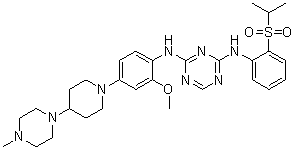
ASP3026 (ASP-3026; ASP 3026) is an orally bioavailable inhibitor of ALK (anaplastic lymphoma kinase) with potential antineoplastic activity. It inhibits ALK with an IC50 of 3.5 nM. Treatment for ALK-positive non-small cell lung cancer (NSCLC) has been proven to be effective when targeting ALK. High anti-proliferative activity of ASP3026 is shown in vitro against a variety of cancer cells, including NCI-H2228 and 3T3 cells that express variants 1, 2, and 3 of EML4-ALK. Additionally, it demonstrated strong in vivo antitumor efficacy in mice that were xenografted with NCI-H2228 cells that expressed EML4-ALK.
Physicochemical Properties
| Molecular Formula | C29H40N8O3S | |
| Molecular Weight | 580.74 | |
| Exact Mass | 580.294 | |
| Elemental Analysis | C, 59.98; H, 6.94; N, 19.29; O, 8.26; S, 5.52 | |
| CAS # | 1097917-15-1 | |
| Related CAS # |
|
|
| PubChem CID | 25134326 | |
| Appearance | White to off-white solid powder | |
| Density | 1.3±0.1 g/cm3 | |
| Boiling Point | 794.3±70.0 °C at 760 mmHg | |
| Flash Point | 434.2±35.7 °C | |
| Vapour Pressure | 0.0±2.8 mmHg at 25°C | |
| Index of Refraction | 1.620 | |
| LogP | 1.01 | |
| Hydrogen Bond Donor Count | 2 | |
| Hydrogen Bond Acceptor Count | 11 | |
| Rotatable Bond Count | 9 | |
| Heavy Atom Count | 41 | |
| Complexity | 904 | |
| Defined Atom Stereocenter Count | 0 | |
| SMILES | S(C1=C([H])C([H])=C([H])C([H])=C1N([H])C1N=C([H])N=C(N=1)N([H])C1C([H])=C([H])C(=C([H])C=1OC([H])([H])[H])N1C([H])([H])C([H])([H])C([H])(C([H])([H])C1([H])[H])N1C([H])([H])C([H])([H])N(C([H])([H])[H])C([H])([H])C1([H])[H])(C([H])(C([H])([H])[H])C([H])([H])[H])(=O)=O |
|
| InChi Key | MGGBYMDAPCCKCT-UHFFFAOYSA-N | |
| InChi Code | InChI=1S/C29H40N8O3S/c1-21(2)41(38,39)27-8-6-5-7-25(27)33-29-31-20-30-28(34-29)32-24-10-9-23(19-26(24)40-4)36-13-11-22(12-14-36)37-17-15-35(3)16-18-37/h5-10,19-22H,11-18H2,1-4H3,(H2,30,31,32,33,34) | |
| Chemical Name | 2-N-[2-methoxy-4-[4-(4-methylpiperazin-1-yl)piperidin-1-yl]phenyl]-4-N-(2-propan-2-ylsulfonylphenyl)-1,3,5-triazine-2,4-diamine | |
| Synonyms | ASP-3026; ASP 3026; ASP3026 | |
| HS Tariff Code | 2934.99.9001 | |
| Storage |
Powder-20°C 3 years 4°C 2 years In solvent -80°C 6 months -20°C 1 month |
|
| Shipping Condition | Room temperature (This product is stable at ambient temperature for a few days during ordinary shipping and time spent in Customs) |
Biological Activity
| Targets |
ALK (IC50 = 3.5 nM) Anaplastic Lymphoma Kinase (ALK): Wild-type ALK (IC50 = 1.2 nM), ALK L1196M (IC50 = 5.6 nM), ALK G1269A (IC50 = 3.4 nM); no significant activity against EGFR, ROS1, MET (IC50 > 1000 nM) [1] - Confirmed ALK as primary target (ALCL model; no additional IC50 values) [2] - Confirmed ALK as primary target (NSCLC model; consistent with [1]’s IC50 data) [4] |
| ln Vitro |
ASP3026 exhibits a more focused inhibition of ALK than PF02341066 in a Tyr-kinase panel. NCI-H2228 is a human NSCLC tumor cell line that endogenously expresses EML4-ALK variant 3. At an IC50 value of 64.8 nM, ASP3026 inhibits the growth of this cell line. Inhibited ALK kinase activity and proliferation of ALK+ cells: NSCLC H3122 (IC50 = 4.8 nM), ALCL Karpas 299 (IC50 = 3.7 nM); reduced p-ALK (Tyr1604) by 92% in H3122 cells (100 nM, 2 hours) [1] - Suppressed viability of NPM-ALK+ ALCL cells: Karpas 299 (IC50 = 3.7 nM), SU-DHL-1 (IC50 = 4.3 nM); induced apoptosis (Annexin V+ cells: 45% at 200 nM, 48 hours) via caspase-3 activation [2] - Inhibited growth of ALK+ NSCLC cells: H2228 (IC50 = 5.2 nM), H3122-G1202R (alectinib-resistant, IC50 = 22 nM); blocked downstream p-AKT (Ser473) and p-ERK1/2 (Thr202/Tyr204) [4] - Inhibited erythrocyte membrane scrambling (non-antitumor activity): 1 μM ASP3026 reduced calcium-induced phosphatidylserine exposure by 60% in human erythrocytes [3] |
| ln Vivo |
ASP3026 causes dose-dependent anti-tumor effects beginning at 1 mg/kg with strong regression at 10, 30, and 100 mg/kg when given orally twice daily for 14 days to mice bearing subcutaneous NCI-H2228 tumor xenografts. In NOD/SCID mice with systemic Karpas 299 ALCL: Intraperitoneal injection of ASP3026 (20 mg/kg, twice daily) for 21 days eliminated tumor cells in peripheral blood (from 15% to <0.1%); median survival extended from 35 days (vehicle) to 72 days [2] - In nude mice bearing H3122 NSCLC xenografts: Oral ASP3026 (50 mg/kg/day) for 28 days resulted in 91% tumor growth inhibition (TGI); tumor p-ALK reduced by 85% (immunohistochemistry) [4] - In nude mice bearing H2228 NSCLC xenografts: Oral ASP3026 (60 mg/kg/day) for 21 days caused 83% TGI; no tumor regression but delayed tumor progression [4] |
| Enzyme Assay |
ASP3026 exhibited an inhibitory spectrum distinct from crizotinib, a dual ALK/MET inhibitor, and inhibited ALK activity in an ATP-competitive manner. ALK kinase activity assay: Recombinant human ALK kinase domain (50 ng/well) was incubated with 10 μM ATP and a biotinylated peptide substrate in reaction buffer (25 mM HEPES pH 7.5, 10 mM MgCl2, 1 mM DTT) at 30°C for 60 minutes. ASP3026 (0.01-100 nM) was added 15 minutes before ATP. Phosphorylated peptide was detected via streptavidin-HRP and chemiluminescence; IC50 values were calculated via nonlinear regression [1] |
| Cell Assay |
ASP3026, when administered orally, was well absorbed in tumor tissues in mice xenografted with NCI-H2228 cells expressing EML4-ALK. Its concentrations in tumor tissues exceeded those in plasma by more than ten times, and it caused tumor regression with a therapeutic margin spanning from highly effective to highly toxic doses. Paclitaxel and pemetrexed's antitumor activities were improved in the same mouse model by ASP3026, without compromising body weight. Strong antitumor effects were also demonstrated by ASP3026 in hEML4-ALK transgenic mice, where it led to tumor shrinkage to undetectable levels and increased survival in mice receiving intrapleural NCI-H2228 xenografts. Relative to mice treated with crizotinib, tumors in the intrahepatic xenograft model utilizing NCI-H2228 cells continuously regressed when ASP3026 was administered. Finally, ASP3026 shown significant antitumor activity against EML4-ALK-expressing cells carrying the L1196M gatekeeper position mutation, which results in crizotinib resistance. All things considered, these results suggest that ASP3026 may be effective in treating NSCLC and should help patients whose cancer has an abnormal ALK expression receive better treatment outcomes. ALK+ cell proliferation assay (H3122/Karpas 299/H2228): Cells were seeded in 96-well plates (5×10³ cells/well) and treated with ASP3026 (0.1 nM-1 μM) for 72 hours. Viability was measured via tetrazolium-based assay; absorbance at 570 nm recorded; IC50 calculated via four-parameter fitting [1][2][4] - Western blot assay (ALK/AKT/ERK): H3122 or Karpas 299 cells were treated with ASP3026 (10-200 nM) for 2 hours, lysed in RIPA buffer (with protease/phosphatase inhibitors). Lysates (30 μg protein) were separated by 8% SDS-PAGE, probed with p-ALK, total ALK, p-AKT, total AKT, p-ERK, total ERK, GAPDH antibodies; signals detected via chemiluminescence [1][2][4] - Erythrocyte membrane scrambling assay: Human erythrocytes were incubated with ASP3026 (0.1-5 μM) + 1 μM calcium for 60 minutes. Phosphatidylserine exposure was measured via Annexin V-FITC staining and flow cytometry [3] |
| Animal Protocol |
10, 30 and 100 mg/kg; s.c. Mice wtih NCI-H2228 tumor xenografts Systemic ALCL model (NOD/SCID mice): 6-week-old mice were intravenously injected with 1×10⁶ Karpas 299 cells. Seven days later, mice received ASP3026 (20 mg/kg, intraperitoneal injection) twice daily for 21 days. Drug was dissolved in 10% DMSO + 40% PEG400 + 50% normal saline; peripheral blood tumor cells were quantified weekly [2] - H3122 NSCLC xenograft model (nude mice): Female nude mice were subcutaneously injected with 5×10⁶ H3122 cells. When tumors reached 100-120 mm³, mice received ASP3026 (50 mg/kg/day, oral gavage) for 28 days. Drug dissolved in 0.5% methylcellulose + 0.2% Tween 80; tumor volume (length × width² / 2) measured every 3 days [4] - H2228 NSCLC xenograft model (nude mice): Mice were implanted with 2×10⁶ H2228 cells subcutaneously. When tumors reached 100 mm³, mice received ASP3026 (60 mg/kg/day, oral gavage) for 21 days [4] |
| ADME/Pharmacokinetics |
In mice: Oral bioavailability of ASP3026 was 52% (50 mg/kg dose); plasma half-life (t1/2) = 4.9 hours; maximum plasma concentration (Cmax) = 4.1 μM at 1.3 hours post-oral administration [1] - In rats: Intravenous administration (10 mg/kg) showed a clearance rate of 12 mL/min/kg; volume of distribution at steady state (Vss) = 0.8 L/kg [1] - Plasma protein binding: 98.7% binding to human plasma proteins (measured via ultrafiltration) [1] |
| Toxicity/Toxicokinetics |
In 28-day H3122 xenograft study (50 mg/kg/day, oral): No significant weight loss (>8%); serum ALT (27 ± 5 U/L), AST (51 ± 6 U/L), BUN (18 ± 3 mg/dL) within normal ranges [4] - In 21-day ALCL study (20 mg/kg, twice daily, IP): 1/8 mice showed mild peritoneal irritation (resolved post-treatment); no histopathological changes in liver/kidney [2] - Erythrocyte toxicity: No hemolysis observed at <5 μM ASP3026 in human erythrocyte cultures [3] |
| References |
[1]. N-{2-Methoxy-4-[4-(4-methylpiperazin-1-yl)piperidin-1-yl]phenyl}-N'-[2-(propane-2-sulfonyl)phenyl]-1,3,5-triazine-2,4-diamine (ASP3026), a Potent and Selective Anaplastic Lymphoma Kinase (ALK) Inhibitor. Chem Pharm Bull (Tokyo). 2018;66(3):251-262. [2]. The ALK inhibitor ASP3026 eradicates NPM-ALK⁺ T-cell anaplastic large-cell lymphoma in vitro and in a systemic xenograft lymphoma model. Oncotarget. 2014 Jul 30;5(14):5750-63. [3]. Inhibition of Erythrocyte Cell Membrane Scrambling by ASP3026. Cell Physiol Biochem. 2017;43(2):507-517. [4]. The selective anaplastic lymphoma receptor tyrosine kinase inhibitor ASP3026 induces tumor regression and prolongs survival in non-small cell lung cancer model mice. Mol Cancer Ther. 2014 Feb;13(2):329-40. |
| Additional Infomation |
ASP-3026 is a member of the class of diamino-1,3,5-triazines that is 1,3,5-triazine-2,4-diamine in which the amino groups at positions 2 and 4 are respectively carrying 2-methoxy-4-[4-(4-methylpiperazin-1-yl)piperidin-1-yl]phenyl and 2-(propan-2-ylsulfonyl)phenyl substituents. It is a potent inhibitor of anaplastic lymphoma kinase (ALK), Ack and ROS1 activity (IC50 values are 3.5, 5.8 and 8.9 nM respectively) and exhibits anti-cancer properties. It has a role as an antineoplastic agent, an apoptosis inducer, an EC 2.7.10.1 (receptor protein-tyrosine kinase) inhibitor, an antimalarial and an EC 6.1.1.6 (lysine--tRNA ligase) inhibitor. It is a secondary amino compound, a monomethoxybenzene, a N-methylpiperazine, an aromatic amine, a diamino-1,3,5-triazine, a member of piperidines and a sulfone. ASP3026 has been used in trials studying the treatment of Solid Tumor, B-Cell Lymphoma, Advanced Malignancies, Positive for Anaplastic Lymphoma Kinase, and Positive for Proto-Oncogene Tyrosine-Protein Kinase ROS. ALK Inhibitor ASP3026 is an orally available, small molecule inhibitor of the receptor tyrosine kinase anaplastic lymphoma kinase (ALK), with potential antineoplastic activity. Upon oral administration, ASP3026 binds to and inhibits ALK tyrosine kinase, ALK fusion proteins and ALK point mutation variants. Inhibition of ALK leads to the disruption of ALK-mediated signaling and the inhibition of cell growth in ALK-expressing tumor cells. ALK belongs to the insulin receptor superfamily and plays an important role in nervous system development. ALK is not expressed in healthy adult human tissue but ALK dysregulation and gene rearrangements are associated with a series of tumors. Additionally, ALK mutations are associated with acquired resistance to small molecule tyrosine kinase inhibitors. ASP3026 is a selective ATP-competitive ALK inhibitor, designed to target ALK fusion-driven cancers (e.g., ALCL, NSCLC) via high affinity for wild-type and mutant ALK [1][2][4] - It exhibits potent activity against ALK L1196M (crizotinib-resistant mutant) but moderate activity against ALK G1202R (alectinib-resistant mutant) [1][4] - In erythrocytes, ASP3026 inhibits calcium-induced membrane scrambling (potential for reducing erythrocyte damage, not related to antitumor efficacy) [3] |
Solubility Data
| Solubility (In Vitro) |
|
|||
| Solubility (In Vivo) |
Solubility in Formulation 1: ≥ 2 mg/mL (3.44 mM) (saturation unknown) in 10% DMSO + 40% PEG300 + 5% Tween80 + 45% Saline (add these co-solvents sequentially from left to right, and one by one), clear solution. For example, if 1 mL of working solution is to be prepared, you can add 100 μL of 20.0 mg/mL clear DMSO stock solution to 400 μL PEG300 and mix evenly; then add 50 μL Tween-80 to the above solution and mix evenly; then add 450 μL normal saline to adjust the volume to 1 mL. Preparation of saline: Dissolve 0.9 g of sodium chloride in 100 mL ddH₂ O to obtain a clear solution. Solubility in Formulation 2: ≥ 2 mg/mL (3.44 mM) (saturation unknown) in 10% DMSO + 90% (20% SBE-β-CD in Saline) (add these co-solvents sequentially from left to right, and one by one), clear solution. For example, if 1 mL of working solution is to be prepared, you can add 100 μL of 20.0 mg/mL clear DMSO stock solution to 900 μL of 20% SBE-β-CD physiological saline solution and mix evenly. Preparation of 20% SBE-β-CD in Saline (4°C,1 week): Dissolve 2 g SBE-β-CD in 10 mL saline to obtain a clear solution. Solubility in Formulation 3: ≥ 2 mg/mL (3.44 mM) (saturation unknown) in 10% DMSO + 90% Corn Oil (add these co-solvents sequentially from left to right, and one by one), clear solution. For example, if 1 mL of working solution is to be prepared, you can add 100 μL of 20.0 mg/mL clear DMSO stock solution to 900 μL of corn oil and mix evenly. (Please use freshly prepared in vivo formulations for optimal results.) |
| Preparing Stock Solutions | 1 mg | 5 mg | 10 mg | |
| 1 mM | 1.7219 mL | 8.6097 mL | 17.2194 mL | |
| 5 mM | 0.3444 mL | 1.7219 mL | 3.4439 mL | |
| 10 mM | 0.1722 mL | 0.8610 mL | 1.7219 mL |