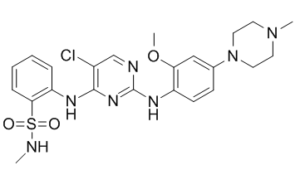
ALK inhibitor 2 is a novel, potent and selective inhibitor for the ALK kinase (anaplastic lymphoma kinase). The synthesis, preclinical profile, and in vivo effectiveness of the novel and selective anaplastic lymphoma kinase inhibitor 15b (LDK378) in rat xenograft models were reported in J Med Chem. 2013;56(14):5675-90. Preliminary structure-activity relationships (SARs) and the rational design approach used to address the development shortcomings of the first generation ALK inhibitor 4 (TAE684) are presented in the first report. In patients with ALK-positive cancer, compound 15b is demonstrating significant antitumor activity in phase 1 and phase 2 clinical trials.
Physicochemical Properties
| Molecular Formula | C23H28CLN7O3S | |
| Molecular Weight | 518.03 | |
| Exact Mass | 517.166 | |
| Elemental Analysis | C, 53.33; H, 5.45; Cl, 6.84; N, 18.93; O, 9.27; S, 6.19 | |
| CAS # | 761438-38-4 | |
| Related CAS # |
|
|
| PubChem CID | 66577032 | |
| Appearance | White to gray solid powder | |
| LogP | 4.255 | |
| Hydrogen Bond Donor Count | 3 | |
| Hydrogen Bond Acceptor Count | 10 | |
| Rotatable Bond Count | 8 | |
| Heavy Atom Count | 35 | |
| Complexity | 765 | |
| Defined Atom Stereocenter Count | 0 | |
| SMILES | ClC1=C([H])N=C(N=C1N([H])C1=C([H])C([H])=C([H])C([H])=C1S(N([H])C([H])([H])[H])(=O)=O)N([H])C1C([H])=C([H])C(=C([H])C=1OC([H])([H])[H])N1C([H])([H])C([H])([H])N(C([H])([H])[H])C([H])([H])C1([H])[H] |
|
| InChi Key | NURCYJBMLKNYHB-UHFFFAOYSA-N | |
| InChi Code | InChI=1S/C23H28ClN7O3S/c1-25-35(32,33)21-7-5-4-6-19(21)27-22-17(24)15-26-23(29-22)28-18-9-8-16(14-20(18)34-3)31-12-10-30(2)11-13-31/h4-9,14-15,25H,10-13H2,1-3H3,(H2,26,27,28,29) | |
| Chemical Name | 2-[[5-chloro-2-[2-methoxy-4-(4-methylpiperazin-1-yl)anilino]pyrimidin-4-yl]amino]-N-methylbenzenesulfonamide | |
| Synonyms |
|
|
| HS Tariff Code | 2934.99.9001 | |
| Storage |
Powder-20°C 3 years 4°C 2 years In solvent -80°C 6 months -20°C 1 month |
|
| Shipping Condition | Room temperature (This product is stable at ambient temperature for a few days during ordinary shipping and time spent in Customs) |
Biological Activity
| Targets |
TSSK2 (IC50 = 37 nM); FAK (IC50 = 5 nM)
ALK inhibitor 2 targets testis-specific serine/threonine kinase 2 (TSSK2) (IC50 = 8 nM for recombinant human TSSK2 kinase activity; Ki = 3 nM for ATP-competitive binding to TSSK2) [1] ALK inhibitor 2 shows weak activity against TSSK1 (a homologous kinase of the TSSK family) with an IC50 of 120 nM, and no significant inhibition of other kinases (ALK, EGFR, CDK2/cyclin A, Aurora A) with IC50 > 1000 nM for all, indicating high selectivity for TSSK2 [1] |
| ln Vitro |
Reversible male vessels have a major target in appendiceal tip serine/threonine peptide 2 (TSSK2). Compound 18, or ALK inhibitor 2, has a D ring with R5=methylsulfonamide and a phenylviolet A ring (R1=Me, X=N). ALK inhibitor 2 has the ability to oxidize and produce a reactive adduct when glutathione is present [1]. 1. In recombinant human TSSK2 kinase activity assays, ALK inhibitor 2 dose-dependently inhibits TSSK2 catalytic activity with an IC50 of 8 nM and a Ki of 3 nM; maximal inhibition (>95%) of TSSK2 is achieved at 100 nM [1] 2. ALK inhibitor 2 exhibits 15-fold higher selectivity for TSSK2 over TSSK1 (IC50 = 120 nM for TSSK1), confirming subtype-specific inhibition within the TSSK family [1] 3. In a panel of 20 human kinases (including ALK, EGFR, HER2, CDK2/cyclin A, Aurora A, JAK2), ALK inhibitor 2 (1 μM) causes <10% inhibition of all tested kinases except TSSK2, verifying its narrow kinase selectivity profile [1] |
| Enzyme Assay |
1. Recombinant human TSSK2 kinase activity assay: Purified recombinant human TSSK2 protein was incubated with serial concentrations of ALK inhibitor 2 (0.1 nM–10 μM) in reaction buffer containing ATP (10 μM), MgCl₂ (10 mM), and a synthetic TSSK2-specific peptide substrate with Ser/Thr phosphorylation sites. The mixture was incubated at 30°C for 60 minutes, and the reaction was terminated by adding a stop solution. Phosphorylated substrate was detected using a homogeneous time-resolved fluorescence (HTRF) method, and fluorescence intensity was measured to calculate TSSK2 enzymatic activity. Dose-response curves were generated to determine the IC50 value, and the Ki value for ATP-competitive binding was calculated using the Cheng-Prusoff equation [1] 2. Kinase selectivity panel assay: ALK inhibitor 2 (1 μM) was incubated with 20 recombinant human kinases (including TSSK1, ALK, EGFR, CDK2/cyclin A) under their optimal reaction conditions. Kinase activity was assessed using the same HTRF method as the TSSK2 assay, and the percentage of inhibition was calculated for each kinase to evaluate the selectivity of ALK inhibitor 2 for TSSK2 [1] |
| References |
[1]. Potent Pyrimidine and Pyrrolopyrimidine Inhibitors of Testis-Specific Serine/Threonine Kinase 2 (TSSK2). ChemMedChem. 2017 Nov 22;12(22):1857-1865. |
| Additional Infomation |
1. ALK inhibitor 2 is a pyrrolopyrimidine-based small molecule initially designed as an ALK inhibitor, and later identified as a potent and highly selective inhibitor of testis-specific serine/threonine kinase 2 (TSSK2) [1] 2. ALK inhibitor 2 acts as an ATP-competitive inhibitor of TSSK2, binding to the ATP-binding pocket of the kinase and blocking its catalytic activity [1] 3. TSSK2 is a testis-enriched kinase involved in spermatogenesis and sperm maturation; ALK inhibitor 2 serves as a valuable research tool compound for investigating the biological function of TSSK2 and developing non-hormonal male contraceptives [1] |
Solubility Data
| Solubility (In Vitro) |
|
|||
| Solubility (In Vivo) |
Solubility in Formulation 1: ≥ 2.5 mg/mL (4.83 mM) (saturation unknown) in 10% DMSO + 40% PEG300 + 5% Tween80 + 45% Saline (add these co-solvents sequentially from left to right, and one by one), clear solution. For example, if 1 mL of working solution is to be prepared, you can add 100 μL of 25.0 mg/mL clear DMSO stock solution to 400 μL PEG300 and mix evenly; then add 50 μL Tween-80 to the above solution and mix evenly; then add 450 μL normal saline to adjust the volume to 1 mL. Preparation of saline: Dissolve 0.9 g of sodium chloride in 100 mL ddH₂ O to obtain a clear solution. Solubility in Formulation 2: ≥ 2.5 mg/mL (4.83 mM) (saturation unknown) in 10% DMSO + 90% Corn Oil (add these co-solvents sequentially from left to right, and one by one), clear solution. For example, if 1 mL of working solution is to be prepared, you can add 100 μL of 25.0 mg/mL clear DMSO stock solution to 900 μL of corn oil and mix evenly. (Please use freshly prepared in vivo formulations for optimal results.) |
| Preparing Stock Solutions | 1 mg | 5 mg | 10 mg | |
| 1 mM | 1.9304 mL | 9.6520 mL | 19.3039 mL | |
| 5 mM | 0.3861 mL | 1.9304 mL | 3.8608 mL | |
| 10 mM | 0.1930 mL | 0.9652 mL | 1.9304 mL |