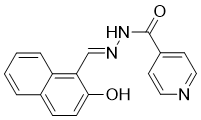
AS8351 is a potent inhibitor of KDM5B (lysine-specific histone demethylase 5B) which plays an important role in maintaining cancer stem cells and justifies the rationale for studying the effects of continuous inhibition of this epigenetic factor in cancer. AS8351 can induce and sustain active chromatin marks to facilitate the induction of cardiomyocyte-like cells.It induces reprogramming of human fetal lung fibroblasts into functional cardiomyocytes, in combination with CHIR 99021, A83-01, BIX 01294, SC1, Y-27632, OAC2, SU 16f and JNJ 10198409. Reprogramming somatic fibroblasts into alternative lineages would provide a promising source of cells for regenerative therapy. However, transdifferentiating human cells into specific homogeneous, functional cell types is challenging.
Physicochemical Properties
| Molecular Formula | C17H13N3O2 | |
| Molecular Weight | 291.3 | |
| Exact Mass | 291.101 | |
| Elemental Analysis | C, 70.09; H, 4.50; N, 14.42; O, 10.98 | |
| CAS # | 796-42-9 | |
| Related CAS # |
|
|
| PubChem CID | 135400486 | |
| Appearance | Light yellow to yellow solid powder | |
| Density | 1.364g/cm3 | |
| Boiling Point | 503.5ºC at 760 mmHg | |
| Melting Point | 266 °C | |
| Flash Point | 258.3ºC | |
| Index of Refraction | 1.715 | |
| LogP | 3.095 | |
| Hydrogen Bond Donor Count | 2 | |
| Hydrogen Bond Acceptor Count | 4 | |
| Rotatable Bond Count | 3 | |
| Heavy Atom Count | 22 | |
| Complexity | 407 | |
| Defined Atom Stereocenter Count | 0 | |
| SMILES | O=C(C1C=CN=CC=1)NN=CC1C2C(=CC=CC=2)C=CC=1O |
|
| InChi Key | WQSHHAVECQJKLX-YBFXNURJSA-N | |
| InChi Code | InChI=1S/C17H13N3O2/c21-16-6-5-12-3-1-2-4-14(12)15(16)11-19-20-17(22)13-7-9-18-10-8-13/h1-11,21H,(H,20,22)/b19-11+ | |
| Chemical Name | N-[(E)-(2-hydroxynaphthalen-1-yl)methylideneamino]pyridine-4-carboxamide | |
| Synonyms |
|
|
| HS Tariff Code | 2934.99.9001 | |
| Storage |
Powder-20°C 3 years 4°C 2 years In solvent -80°C 6 months -20°C 1 month |
|
| Shipping Condition | Room temperature (This product is stable at ambient temperature for a few days during ordinary shipping and time spent in Customs) |
Biological Activity
| ln Vitro | By competing with α-ketoglutarate (α-KG) to chelate iron [Fe(II)] in specific epigenetic enzymes, like the JmjC-containing structure that needs α-KG and iron domain-based histone demethylase (JmjC-KDM) as a cofactor, AS8351 influences epigenetic modifications [2]. | ||
| ln Vivo |
|
||
| Animal Protocol |
|
||
| References |
[1]. Chemical Modulation of Cell Fate in Stem Cell Therapeutics and Regenerative Medicine. Cell Chem Biol. 2016 Aug 18;23(8):893-916. [2]. Conversion of human fibroblasts into functional cardiomyocytes by small molecules. Science. 2016 Jun 3;352(6290):1216-20. |
Solubility Data
| Solubility (In Vitro) |
|
|||
| Solubility (In Vivo) |
Solubility in Formulation 1: ≥ 2.5 mg/mL (8.58 mM) (saturation unknown) in 10% DMSO + 40% PEG300 +5% Tween-80 + 45% Saline (add these co-solvents sequentially from left to right, and one by one), clear solution. For example, if 1 mL of working solution is to be prepared, you can add 100 μL of 25.0 mg/mL clear DMSO stock solution to 400 μL PEG300 and mix evenly; then add 50 μL Tween-80 + to the above solution and mix evenly; then add 450 μL normal saline to adjust the volume to 1 mL. Preparation of saline: Dissolve 0.9 g of sodium chloride in 100 mL ddH₂ O to obtain a clear solution. (Please use freshly prepared in vivo formulations for optimal results.) |
| Preparing Stock Solutions | 1 mg | 5 mg | 10 mg | |
| 1 mM | 3.4329 mL | 17.1644 mL | 34.3289 mL | |
| 5 mM | 0.6866 mL | 3.4329 mL | 6.8658 mL | |
| 10 mM | 0.3433 mL | 1.7164 mL | 3.4329 mL |