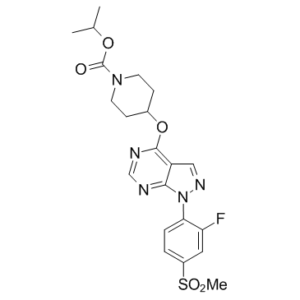
APD668 (also known as JNJ-28630368) is a novel and potent agonist of the pancreatic and GI-expressed orphan G-protein coupled receptor GPR119, with EC50 of 2.7 nM and 33 nM for hGPR119 and ratGPR119 respectively. In the field of metabolism, GPR119 has garnered a lot of attention lately, thanks in part to the archetypal agonist AR231453. The addition of a piperidine ether group capped with a carbamate and the addition of a pyrazolopyrimidine core to form a new structural series both improved a number of important parameters. In Zucker Diabetic Fatty (ZDF) rats, chronic treatment with one compound from the series, 3k (APD668, JNJ-28630368), demonstrated for the first time that blood glucose and glycated hemoglobin (HbA1c) levels could be significantly reduced over several weeks of dosing. These and additional data, which are detailed here, led to the advancement of 3k (APD668, JNJ-28630368) into clinical development as the first compound with this mechanism of action for the treatment of diabetes.
Physicochemical Properties
| Molecular Formula | C21H24FN5O5S | |
| Molecular Weight | 477.51 | |
| Exact Mass | 477.148 | |
| Elemental Analysis | C, 52.82; H, 5.07; F, 3.98; N, 14.67; O, 16.75; S, 6.72 | |
| CAS # | 832714-46-2 | |
| Related CAS # |
|
|
| PubChem CID | 11705608 | |
| Appearance | White to off-white solid powder | |
| Density | 1.5±0.1 g/cm3 | |
| Boiling Point | 611.6±55.0 °C at 760 mmHg | |
| Flash Point | 323.7±31.5 °C | |
| Vapour Pressure | 0.0±1.8 mmHg at 25°C | |
| Index of Refraction | 1.658 | |
| LogP | 1.99 | |
| Hydrogen Bond Donor Count | 0 | |
| Hydrogen Bond Acceptor Count | 9 | |
| Rotatable Bond Count | 6 | |
| Heavy Atom Count | 33 | |
| Complexity | 788 | |
| Defined Atom Stereocenter Count | 0 | |
| SMILES | O=C(N1CCC(OC2C3C=NN(C=3N=CN=2)C2C(F)=CC(S(C)(=O)=O)=CC=2)CC1)OC(C)C |
|
| InChi Key | XTRUQJBVQBUKSQ-UHFFFAOYSA-N | |
| InChi Code | InChI=1S/C21H24FN5O5S/c1-13(2)31-21(28)26-8-6-14(7-9-26)32-20-16-11-25-27(19(16)23-12-24-20)18-5-4-15(10-17(18)22)33(3,29)30/h4-5,10-14H,6-9H2,1-3H3 | |
| Chemical Name | propan-2-yl 4-[1-(2-fluoro-4-methylsulfonylphenyl)pyrazolo[3,4-d]pyrimidin-4-yl]oxypiperidine-1-carboxylate | |
| Synonyms |
|
|
| HS Tariff Code | 2934.99.9001 | |
| Storage |
Powder-20°C 3 years 4°C 2 years In solvent -80°C 6 months -20°C 1 month |
|
| Shipping Condition | Room temperature (This product is stable at ambient temperature for a few days during ordinary shipping and time spent in Customs) |
Biological Activity
| Targets | CYP2C9 ( Ki = 0.1 μM ); hGPR119 ( IC50 = 2.7 nM ); rGPR119 ( IC50 = 33 nM ); hERG channel ( IC50 = 3 μM ) |
| ln Vitro |
APD668 increases adenylate cyclase activation in human GPR119-transfected HEK293 cells in a concentration-dependent manner with an EC50 of 23 nM[1]. APD668 is less extensively bound to male (93.0%) and female (96.6%) rats, but highly bound to the plasma proteins of humans and male and female cynomolgus monkeys (≽99%)[1]. |
| ln Vivo |
APD668 (10-30 mg/kg; p.o. once daily for 8 weeks) does not desensitize the acute drug response while significantly lowering blood glucose and glycated hemoglobin (HbA1c) levels[1]. APD668 (1–10 mg/kg; single oral) significantly lowers blood glucose levels in mice during an oral glucose tolerance test in a dose-dependent manner in mice[1]. APD668 (0.08 mg/kg/min; i.v.) dramatically increases insulin release when blood glucose levels are raised to about 300 mg/dl. However, it has no effect when blood glucose levels are at a euglycemic level in a hyperglycemic clamp model in the Sprague-Dawley rat[1]. APD668 (p.o.) shows moderate to good absolute oral bioavailability (44-79%) in mice, rats, and monkeys, but lower in dogs (22%). It also exhibits rapid to moderate absorption (tmax≤2 h) in mice, rats, and monkeys, but slower in dogs (tmax=6 h)[1]. |
| Animal Protocol |
Male Zucker Diabetic Fatty (ZDF) rats (6 weeks old, 200-250 g) 10, 30 mg/kg P.o. once daily for 8 weeks |
| References |
[1]. Discovery of fused bicyclic agonists of the orphan G-protein coupled receptor GPR119 with in vivo activity in rodent models of glucose control. Bioorg Med Chem Lett. 2011 May 15;21(10):3134-41. [2]. APD668, a G protein-coupled receptor 119 agonist improves fat tolerance and attenuates fatty liver in high-trans fat diet induced steatohepatitis model in C57BL/6 mice. Eur J Pharmacol. 2017 Apr 15;801:35-45. |
| Additional Infomation |
APD668 is a novel, highly potent and orally active glucose-dependent insulinotropic receptor (GDIR) agonist intended to more efficiently stimulate insulin release by beta cells in response to elevated blood glucose levels, and to also avoid hypoglycemia. Drug Indication Investigated for use/treatment in diabetes mellitus type 2. Mechanism of Action The GDIR mechanism is glucose dependent: in preclinical studies, GDIR agonists only lowered blood glucose when it rose above normal levels, such as after a meal. Therefore, unlike the glucose-insensitive sulfonylureas, Arena's GDIR agonists are not expected to lower normal fasting blood glucose levels or cause hypoglycemia. In addition, GDIR stimulation has been found to increase the levels and activity of intracellular factors thought to be involved in the preservation of beta cells. |
Solubility Data
| Solubility (In Vitro) |
|
|||
| Solubility (In Vivo) |
Solubility in Formulation 1: ≥ 2.5 mg/mL (5.24 mM) (saturation unknown) in 10% DMSO + 90% Corn Oil (add these co-solvents sequentially from left to right, and one by one), clear solution. For example, if 1 mL of working solution is to be prepared, you can add 100 μL of 25.0 mg/mL clear DMSO stock solution to 900 μL of corn oil and mix evenly. Solubility in Formulation 2: ≥ 2.08 mg/mL (4.36 mM) (saturation unknown) in 10% DMSO + 90% (20% SBE-β-CD in Saline) (add these co-solvents sequentially from left to right, and one by one), clear solution. For example, if 1 mL of working solution is to be prepared, you can add 100 μL of 20.8 mg/mL clear DMSO stock solution to 900 μL of 20% SBE-β-CD physiological saline solution and mix evenly. Preparation of 20% SBE-β-CD in Saline (4°C,1 week): Dissolve 2 g SBE-β-CD in 10 mL saline to obtain a clear solution. (Please use freshly prepared in vivo formulations for optimal results.) |
| Preparing Stock Solutions | 1 mg | 5 mg | 10 mg | |
| 1 mM | 2.0942 mL | 10.4710 mL | 20.9420 mL | |
| 5 mM | 0.4188 mL | 2.0942 mL | 4.1884 mL | |
| 10 mM | 0.2094 mL | 1.0471 mL | 2.0942 mL |