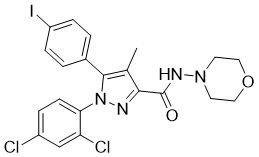
Physicochemical Properties
| Molecular Formula | C21H19N4O2CL2I |
| Molecular Weight | 557.21116 |
| Exact Mass | 555.993 |
| CAS # | 202463-68-1 |
| PubChem CID | 4302962 |
| Appearance | White to light yellow solid powder |
| Density | 1.7±0.1 g/cm3 |
| Index of Refraction | 1.706 |
| LogP | 4.9 |
| Hydrogen Bond Donor Count | 1 |
| Hydrogen Bond Acceptor Count | 4 |
| Rotatable Bond Count | 4 |
| Heavy Atom Count | 30 |
| Complexity | 589 |
| Defined Atom Stereocenter Count | 0 |
| SMILES | CC1=C(N(N=C1C(NN2CCOCC2)=O)C3=C(Cl)C=C(Cl)C=C3)C4=CC=C(I)C=C4 |
| InChi Key | AJFFBPZYXRNAIC-UHFFFAOYSA-N |
| InChi Code | InChI=1S/C21H19Cl2IN4O2/c1-13-19(21(29)26-27-8-10-30-11-9-27)25-28(18-7-4-15(22)12-17(18)23)20(13)14-2-5-16(24)6-3-14/h2-7,12H,8-11H2,1H3,(H,26,29) |
| Chemical Name | 1-(2,4-dichlorophenyl)-5-(4-iodophenyl)-4-methyl-N-morpholin-4-ylpyrazole-3-carboxamide |
| Synonyms | AM 281 AM-281 AM281 |
| HS Tariff Code | 2934.99.9001 |
| Storage |
Powder-20°C 3 years 4°C 2 years In solvent -80°C 6 months -20°C 1 month |
| Shipping Condition | Room temperature (This product is stable at ambient temperature for a few days during ordinary shipping and time spent in Customs) |
Biological Activity
| ln Vitro | In SH-SY5Y cells, AM281 (0.01-10 μM) causes neurotoxicity at concentrations that raise the presence of 10 μM Aβ 25-35 when combined with 10 μM KSO 1-6 [2]. |
| ln Vivo | Both the chronic doses of AM281 (0.62, 1.25, and 2.5 mg/kg) and the chronic doses of AM281 (2.5, 5 and 10 mg/kg) showed improvements in memory performance and exploration time [3]. The recognition index was increased to 22.1±4.8 with long-term administration of 2.5 mg/kg AM281, and memory impairment was improved to 8.5±4 with a single dosage of 5 mg/kg AM281, as opposed to 4.8±2.5 with vehicle therapy. AM281 given continuously at a dose of 2.5 mg/kg and |
| Animal Protocol |
Animal/Disease Models: Male NMRI mice weighing 25-30 g [3] Doses: 0.62, 1.25 and 2.5 mg/kg (chronic dose); rapid dose of 5 mg/kg Can improve memory[3]. 2.5, 5 and 10 mg/kg (acute administration) Dosing: intraperitoneally (ip) (ip) with morphine daily except on the day of the experiment (chronic administration); alone 40 minutes before the second test (acute administration) Experimental Results: Coadministration of AM281 and morphine daily Dramatically shortened exploration time compared to morphine-dependent mice receiving vehicle. The acute administration dose is 5 mg/kg, and the recognition index is Dramatically enhanced. |
| References |
[1]. Development and preliminary validation of a plate-based CB1/CB2 receptor functional assay. Anal Biochem. 2013 Jun 15;437(2):138-43. [2]. Effects of the CB1 cannabinoid receptor antagonist AM281 on kissorphin protection against amyloid-β neurotoxicity. [3]. The effect of AM281, a cannabinoid antagonist, on memory performance during spontaneous morphine withdrawal in mice. Res Pharm Sci. 2013 Jan;8(1):59-64. |
| Additional Infomation | 1-(2,4-dichlorophenyl)-5-(4-iodophenyl)-4-methyl-N-(4-morpholinyl)-3-pyrazolecarboxamide is a member of pyrazoles and a ring assembly. |
Solubility Data
| Solubility (In Vitro) | DMSO : ~7.14 mg/mL (~12.81 mM) |
| Solubility (In Vivo) |
Solubility in Formulation 1: ≥ 0.71 mg/mL (1.27 mM) (saturation unknown) in 10% DMSO + 90% Corn Oil (add these co-solvents sequentially from left to right, and one by one), clear solution. For example, if 1 mL of working solution is to be prepared, you can add 100 μL of 7.1 mg/mL clear DMSO stock solution to 900 μL of corn oil and mix evenly. (Please use freshly prepared in vivo formulations for optimal results.) |
| Preparing Stock Solutions | 1 mg | 5 mg | 10 mg | |
| 1 mM | 1.7947 mL | 8.9733 mL | 17.9466 mL | |
| 5 mM | 0.3589 mL | 1.7947 mL | 3.5893 mL | |
| 10 mM | 0.1795 mL | 0.8973 mL | 1.7947 mL |