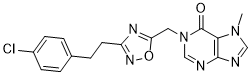
AM-0902 is a novel, potent and selective Transient Receptor Potential A1 (TRPA1) antagonist with IC50s of 71 and 131 nM for rTRPA1 and hTRPA1, respectively. AM-0902 demonstrated dose-dependent inhibition of AITC-induced flinching in rats, validating its utility as a tool for interrogating the role of TRPA1 in in vivo pain models.
Physicochemical Properties
| Molecular Formula | C17H15CLN6O2 |
| Molecular Weight | 370.793001413345 |
| Exact Mass | 370.094 |
| CAS # | 1883711-97-4 |
| PubChem CID | 73297271 |
| Appearance | White to off-white solid powder |
| LogP | 2.3 |
| Hydrogen Bond Donor Count | 0 |
| Hydrogen Bond Acceptor Count | 6 |
| Rotatable Bond Count | 5 |
| Heavy Atom Count | 26 |
| Complexity | 541 |
| Defined Atom Stereocenter Count | 0 |
| SMILES | ClC1C=CC(=CC=1)CCC1=NOC(CN2C=NC3=C(C2=O)N(C)C=N3)=N1 |
| InChi Key | AWJBWNUUODWOKQ-UHFFFAOYSA-N |
| InChi Code | InChI=1S/C17H15ClN6O2/c1-23-9-19-16-15(23)17(25)24(10-20-16)8-14-21-13(22-26-14)7-4-11-2-5-12(18)6-3-11/h2-3,5-6,9-10H,4,7-8H2,1H3 |
| Chemical Name | 1-((3-(4-chlorophenethyl)-1,2,4-oxadiazol-5-yl)methyl)-7-methyl-1,7-dihydro-6H-purin-6-one |
| Synonyms | AM-0902 AM 0902 AM0902. |
| HS Tariff Code | 2934.99.9001 |
| Storage |
Powder-20°C 3 years 4°C 2 years In solvent -80°C 6 months -20°C 1 month |
| Shipping Condition | Room temperature (This product is stable at ambient temperature for a few days during ordinary shipping and time spent in Customs) |
Biological Activity
| ln Vitro | IC50 values for rTRPA1 and hTRPA1 of AM-0902, a strong and selective TRPA1 antagonist, are 71 and 131 nM, respectively. With an average Papp of 44.5 μcm/s in MDCK cells, AM-0902 is highly permeable. It also shows strong solubility (PBS pH 7.4: 226 μM, SIF: 248 μM) and is unlikely to be a substrate for P-gp (efflux ratio = 1.3 in P-gp overexpressing MDCK cells). At doses up to 10 μM, AM-0902 showed no action against rat TRPV1, TRPV3, or TRPM8, nor against human TRPV1 or TRPV4. This indicates that AM-0902 has strong selectivity over other TRP channels. With an IC50 of 0.019 μM, AM-0902 decreases 45Ca2+ flow subsequent to rat TRPA1 activation with methylglyoxal[1]. |
| ln Vivo | In vivo, AM-0902 is a strong and specific antagonist of TRPA1. Rats (t1/2=0.6 hours and 2.8 hours for rat (0.5 mg/kg, IV), rat (30 mg/kg, PO)) have a moderate terminal elimination half-life for AM-0902. AM-0902 was found to reduce allyl isothiocyanate (AITC)-induced withdrawal in a dose-dependent manner; withdrawal was significantly reduced following dosages of 10 and 30 mg/kg. For 1, 3, 10, and 30 mg/kg doses, the 1-hour unbound plasma concentrations (Cu) were 0.051±0.024 (n=8), 0.19±0.11 (n=8), 0.58±0.35 (n=8), and 2.2±0.40 (n=8) μM, respectively. These values covered the in vitro rat TRPA1 45Ca2+ IC50 by 0.72, 2.7, 8.2, and 30.3 times, respectively. This target coverage model showed good exposure-response connections. The unbound in vivo IC90 is 1.7 μM, while the unbound in vivo IC50 is 0.35 μM, which is extremely comparable with the in vitro rat TRPA1 45Ca2+ IC50. Remarkably, AM-0902's binding concentration to TRPA1 at a dose of 30 mg/kg was greater than the in vivo IC90, indicating its potential utility in investigating acute pain models in vivo [1]. |
| References |
[1]. Optimization of a Novel Quinazolinone-Based Series of Transient Receptor Potential A1 (TRPA1)Antagonists Demonstrating Potent in Vivo Activity. J Med Chem. 2016 Mar 24;59(6):2794-809. |
Solubility Data
| Solubility (In Vitro) | DMSO : ~150 mg/mL (~404.54 mM) |
| Solubility (In Vivo) |
Solubility in Formulation 1: ≥ 2.5 mg/mL (6.74 mM) (saturation unknown) in 10% DMSO + 40% PEG300 + 5% Tween80 + 45% Saline (add these co-solvents sequentially from left to right, and one by one), clear solution. For example, if 1 mL of working solution is to be prepared, you can add 100 μL of 25.0 mg/mL clear DMSO stock solution to 400 μL PEG300 and mix evenly; then add 50 μL Tween-80 to the above solution and mix evenly; then add 450 μL normal saline to adjust the volume to 1 mL. Preparation of saline: Dissolve 0.9 g of sodium chloride in 100 mL ddH₂ O to obtain a clear solution. Solubility in Formulation 2: ≥ 2.5 mg/mL (6.74 mM) (saturation unknown) in 10% DMSO + 90% (20% SBE-β-CD in Saline) (add these co-solvents sequentially from left to right, and one by one), clear solution. For example, if 1 mL of working solution is to be prepared, you can add 100 μL of 25.0 mg/mL clear DMSO stock solution to 900 μL of 20% SBE-β-CD physiological saline solution and mix evenly. Preparation of 20% SBE-β-CD in Saline (4°C,1 week): Dissolve 2 g SBE-β-CD in 10 mL saline to obtain a clear solution. Solubility in Formulation 3: ≥ 2.5 mg/mL (6.74 mM) (saturation unknown) in 10% DMSO + 90% Corn Oil (add these co-solvents sequentially from left to right, and one by one), clear solution. For example, if 1 mL of working solution is to be prepared, you can add 100 μL of 25.0 mg/mL clear DMSO stock solution to 900 μL of corn oil and mix evenly. (Please use freshly prepared in vivo formulations for optimal results.) |
| Preparing Stock Solutions | 1 mg | 5 mg | 10 mg | |
| 1 mM | 2.6969 mL | 13.4847 mL | 26.9694 mL | |
| 5 mM | 0.5394 mL | 2.6969 mL | 5.3939 mL | |
| 10 mM | 0.2697 mL | 1.3485 mL | 2.6969 mL |