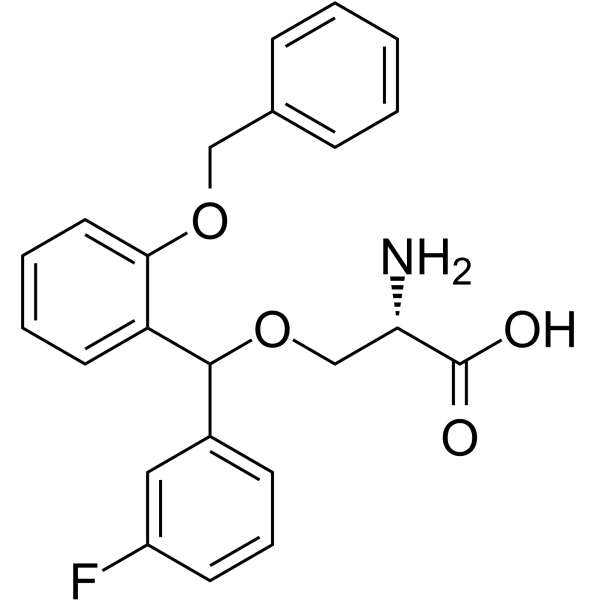
Physicochemical Properties
| Molecular Formula | C23H22FNO4 |
| Molecular Weight | 395.423490047455 |
| Exact Mass | 395.153 |
| Elemental Analysis | C, 69.86; H, 5.61; F, 4.80; N, 3.54; O, 16.18 |
| CAS # | 949164-09-4 |
| Related CAS # | ALX-1393 TFA |
| PubChem CID | 16078939 |
| Appearance | White to off-white solid powder |
| LogP | 4.622 |
| Hydrogen Bond Donor Count | 2 |
| Hydrogen Bond Acceptor Count | 6 |
| Rotatable Bond Count | 9 |
| Heavy Atom Count | 29 |
| Complexity | 499 |
| Defined Atom Stereocenter Count | 1 |
| SMILES | C1=CC=C(C=C1)COC2=CC=CC=C2C(C3=CC(=CC=C3)F)OC[C@@H](C(=O)O)N |
| InChi Key | ADUSZEGHFWRTQS-AIBWNMTMSA-N |
| InChi Code | InChI=1S/C23H22FNO4/c24-18-10-6-9-17(13-18)22(29-15-20(25)23(26)27)19-11-4-5-12-21(19)28-14-16-7-2-1-3-8-16/h1-13,20,22H,14-15,25H2,(H,26,27)/t20-,22?/m0/s1 |
| Chemical Name | (2S)-2-amino-3-[(3-fluorophenyl)-(2-phenylmethoxyphenyl)methoxy]propanoic acid |
| Synonyms | ALX-1393; ALX 1393; ALX1393; O-[2-benzyloxyphenyl-3-flurophenyl]methyl-L-serine; O-(2-benzyloxyphenyl-3-flurophenyl)methyl-L-serine; 949164-09-4; (2S)-2-amino-3-{[2-(benzyloxy)phenyl](3-fluorophenyl)methoxy}propanoic acid; CHEMBL475562; |
| HS Tariff Code | 2934.99.9001 |
| Storage |
Powder-20°C 3 years 4°C 2 years In solvent -80°C 6 months -20°C 1 month |
| Shipping Condition | Room temperature (This product is stable at ambient temperature for a few days during ordinary shipping and time spent in Customs) |
Biological Activity
| Targets |
Glycine Transporter 2 (GlyT2) [1][2] |
| ln Vivo |
Intrathecal administration of ALX1393 (10–30 nmol) in rats significantly increased paw withdrawal thresholds to mechanical stimuli (von Frey test) and reduced formalin-induced Phase 2 flinching behavior, indicating potent antinociception in acute pain models. This effect was blocked by the glycine receptor antagonist strychnine. [1] Intracerebroventricular (i.c.v.) injection of ALX1393 (0.1–10 μg) in rats attenuated thermal hyperalgesia in the Complete Freund's Adjuvant (CFA)-induced inflammatory pain model and mechanical allodynia in the sciatic nerve ligation-induced neuropathic pain model. Efficacy was stronger in inflammatory pain than neuropathic pain. [2] ALX1393 (icv; 25, 50, and 100 μg) in normal rats suppresses late-phase responses in the formalin test but does not impact locomotor performance. ALX1393 reduces mechanical hyperalgesia and cold hyperalgesia in a dose-dependent manner [2]. |
| Animal Protocol |
Acute pain (Formalin test): Rats received intrathecal (i.t.) injections of ALX1393 (3–30 nmol) dissolved in saline via lumbar puncture (L5–L6). Nociceptive behaviors (flinching/lifting) were quantified 0–60 min post-formalin injection. [1] Inflammatory/Neuropathic pain: Rats underwent i.c.v. cannulation. ALX1393 (0.1–10 μg in saline) was administered 14 days post-CFA injection (inflammatory) or 7 days post-nerve ligation (neuropathic). Pain thresholds were assessed via plantar test (thermal) and von Frey filaments (mechanical). [2] |
| References |
[1]. The antinociceptive effect of intrathecal administration of glycine transporter-2 inhibitor ALX1393 in a rat acute pain model. Anesth Analg. 2010 Feb 1;110(2):615-21. [2]. Antinociceptive effect of intracerebroventricular administration of glycine transporter-2 inhibitor ALX1393 in rat models of inflammatory and neuropathic pain. Pharmacol Biochem Behav. 2015 Mar;130:46-52. |
| Additional Infomation |
ALX1393 exerts antinociception by inhibiting GlyT2 in the spinal cord, thereby increasing synaptic glycine levels and enhancing glycinergic inhibitory neurotransmission. This mechanism is validated by strychnine reversibility. [1] The differential efficacy of i.c.v.-administered ALX1393 in inflammatory vs. neuropathic pain suggests region-specific GlyT2 modulation in supraspinal pain pathways. Notably, it did not impair motor function (rotarod test). [2] CNS-penetrant GlyT2 inhibitor showing superior efficacy in neuropathic vs inflammatory pain models [2]. |
Solubility Data
| Solubility (In Vitro) | May dissolve in DMSO (in most cases), if not, try other solvents such as H2O, Ethanol, or DMF with a minute amount of products to avoid loss of samples |
| Solubility (In Vivo) |
Note: Listed below are some common formulations that may be used to formulate products with low water solubility (e.g. < 1 mg/mL), you may test these formulations using a minute amount of products to avoid loss of samples. Injection Formulations (e.g. IP/IV/IM/SC) Injection Formulation 1: DMSO : Tween 80: Saline = 10 : 5 : 85 (i.e. 100 μL DMSO stock solution → 50 μL Tween 80 → 850 μL Saline) *Preparation of saline: Dissolve 0.9 g of sodium chloride in 100 mL ddH ₂ O to obtain a clear solution. Injection Formulation 2: DMSO : PEG300 :Tween 80 : Saline = 10 : 40 : 5 : 45 (i.e. 100 μL DMSO → 400 μLPEG300 → 50 μL Tween 80 → 450 μL Saline) Injection Formulation 3: DMSO : Corn oil = 10 : 90 (i.e. 100 μL DMSO → 900 μL Corn oil) Example: Take the Injection Formulation 3 (DMSO : Corn oil = 10 : 90) as an example, if 1 mL of 2.5 mg/mL working solution is to be prepared, you can take 100 μL 25 mg/mL DMSO stock solution and add to 900 μL corn oil, mix well to obtain a clear or suspension solution (2.5 mg/mL, ready for use in animals). Injection Formulation 4: DMSO : 20% SBE-β-CD in saline = 10 : 90 [i.e. 100 μL DMSO → 900 μL (20% SBE-β-CD in saline)] *Preparation of 20% SBE-β-CD in Saline (4°C,1 week): Dissolve 2 g SBE-β-CD in 10 mL saline to obtain a clear solution. Injection Formulation 5: 2-Hydroxypropyl-β-cyclodextrin : Saline = 50 : 50 (i.e. 500 μL 2-Hydroxypropyl-β-cyclodextrin → 500 μL Saline) Injection Formulation 6: DMSO : PEG300 : castor oil : Saline = 5 : 10 : 20 : 65 (i.e. 50 μL DMSO → 100 μLPEG300 → 200 μL castor oil → 650 μL Saline) Injection Formulation 7: Ethanol : Cremophor : Saline = 10: 10 : 80 (i.e. 100 μL Ethanol → 100 μL Cremophor → 800 μL Saline) Injection Formulation 8: Dissolve in Cremophor/Ethanol (50 : 50), then diluted by Saline Injection Formulation 9: EtOH : Corn oil = 10 : 90 (i.e. 100 μL EtOH → 900 μL Corn oil) Injection Formulation 10: EtOH : PEG300:Tween 80 : Saline = 10 : 40 : 5 : 45 (i.e. 100 μL EtOH → 400 μLPEG300 → 50 μL Tween 80 → 450 μL Saline) Oral Formulations Oral Formulation 1: Suspend in 0.5% CMC Na (carboxymethylcellulose sodium) Oral Formulation 2: Suspend in 0.5% Carboxymethyl cellulose Example: Take the Oral Formulation 1 (Suspend in 0.5% CMC Na) as an example, if 100 mL of 2.5 mg/mL working solution is to be prepared, you can first prepare 0.5% CMC Na solution by measuring 0.5 g CMC Na and dissolve it in 100 mL ddH2O to obtain a clear solution; then add 250 mg of the product to 100 mL 0.5% CMC Na solution, to make the suspension solution (2.5 mg/mL, ready for use in animals). Oral Formulation 3: Dissolved in PEG400 Oral Formulation 4: Suspend in 0.2% Carboxymethyl cellulose Oral Formulation 5: Dissolve in 0.25% Tween 80 and 0.5% Carboxymethyl cellulose Oral Formulation 6: Mixing with food powders Note: Please be aware that the above formulations are for reference only. InvivoChem strongly recommends customers to read literature methods/protocols carefully before determining which formulation you should use for in vivo studies, as different compounds have different solubility properties and have to be formulated differently. (Please use freshly prepared in vivo formulations for optimal results.) |
| Preparing Stock Solutions | 1 mg | 5 mg | 10 mg | |
| 1 mM | 2.5290 mL | 12.6448 mL | 25.2896 mL | |
| 5 mM | 0.5058 mL | 2.5290 mL | 5.0579 mL | |
| 10 mM | 0.2529 mL | 1.2645 mL | 2.5290 mL |